
- Price: $24.99 USD
- Developer: Matthias Linda
- Publisher: Deck 13
- Release Date: December 8, 2022
A review code was kindly provided by PR Hound on behalf of Matthias Linda and Deck 13. We thank them for being able to cover something they’ve worked so hard on.
Content warning: Rated Mature. Focus on the atrocities of war, tyranny, and overall human cruelty. Religious undertones as well as themes of hopelessness. There’s some swearing.
I’ve been a fan of JRPGs for a long time, so when I heard that developer Matthias Linda had been working on Chained Echoes for about seven years, that definitely caught my attention. The game is billed as a 16-bit SNES-style RPG with a soundtrack inspired by the music in PS One RPGs. That certainly works for me! Let’s check it out.

The story of Chained Echoes begins with a festival to celebrate the end of a century-long war between three kingdoms on the continent of Valandis. Unfortunately, some are not so satisfied with peace, and an unknown entity introduces a new weapon of mass destruction to restart the conflict.
Glenn, a former mercenary and talented Sky Armor pilot, seems to be the main character, but you will gather many new party members over the course of the game. There’s a playwright, a princess, a con artist, and some other oddballs who will join your group of unlikely allies who share a common goal: stopping this war.
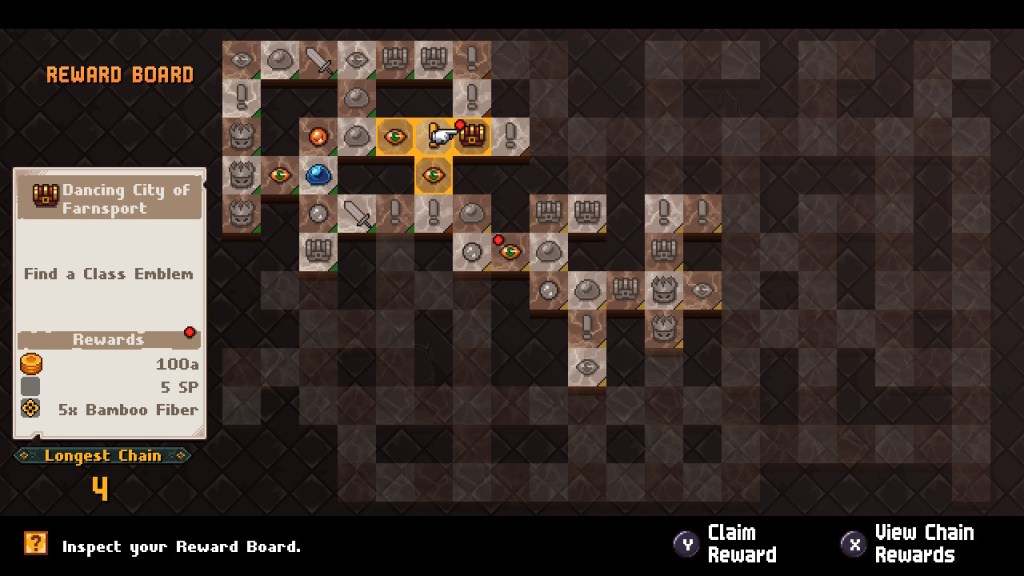
There is so much for you to explore in Valandis as you travel across the land – it’s best to investigate every nook and cranny in cities and especially out in the field. Each region has a ton of treasure chests, a few buried treasures, and even some that are hidden behind concealed caves. I spent a decent amount of time just exploring before even advancing much of the plot because there’s so much to do. Thankfully, you can save anywhere, and there are teleportation crystals as well. The game actually rewards you for being thorough in your explorations with a Reward Board; you’ll receive small rewards for each task on the board, and then there are larger rewards for chaining smaller reward spaces together.

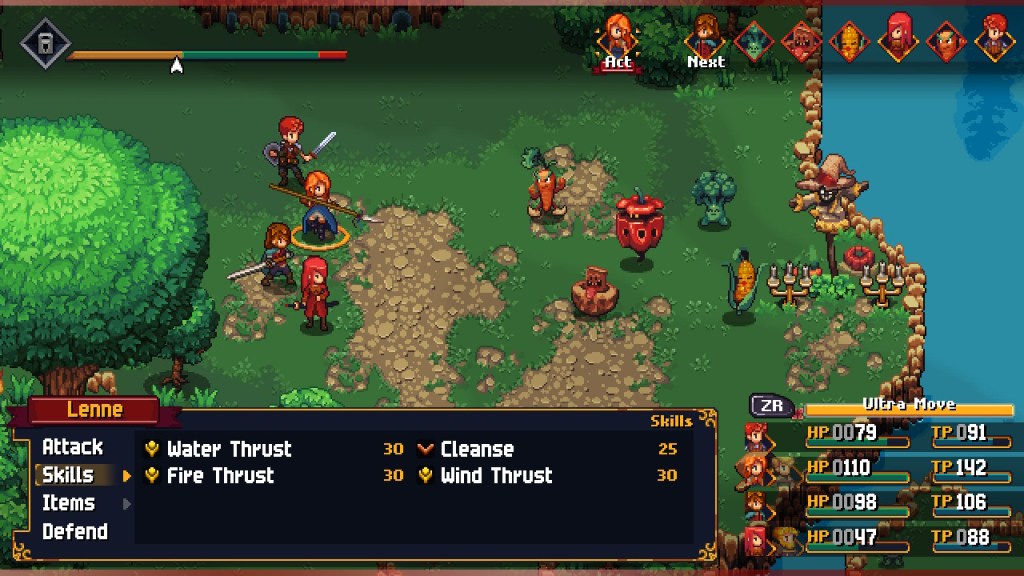

Besides the enemies you will face when confronting the instigators of the renewed war, you’ll naturally have to fight some monsters while traveling between cities. I thought that the enemies were pretty unique compared to the usual monsters I’ve fought in JRPGs before. There are some hilarious vegetable enemies (one with the “Carrote Chop” ability), a toucan, and even some monkeys that throw their…waste…at you. I especially enjoyed the Don Quixote-inspired enemy. Thanks, Spanish Lit class!
Enemies are always visible in the field with you, so there aren’t any surprise encounters. Combat is turn-based, and your party members have their regular attacks, physical-based abilities, magic, and (de)buff abilities. Then each character also has an “Ultra Move” that can be used once the meter is full. Your battle party is limited to four units, but eventually you will have enough members to be able to switch between them in battle. It’s great that they let us act immediately after switching instead of wasting a turn and having to wait.
Another nice feature is that enemies’ elemental strengths and weaknesses are clearly displayed when you have them highlighted. It was interesting to have one character add an oil effect to an enemy, and then direct another to use a fire skill against them for some explosive results. There are some creative battles where you have to use the environment to weaken an enemy, and even one instance where you have to direct a railroad car in the middle of battle. Something else I loved was that after each battle, your HP and TP are completely restored, and if you happen to lose, you can choose to retry or load one of your saves.
There are really great quality of life features in Chained Echoes. The Overdrive meter, the most important aspect of combat, is also pretty intriguing. The Overdrive meter has three segments: a yellow/orange “safe” zone on the left, the green Overdrive portion, and then the red section that means you’re in Overheated mode. You want to stay in Overdrive mode as much as possible, as your party will take less damage, do more damage, and use less TP on skills.
If you end up in Overheated mode, however, your enemies will do a lot more damage to your characters. To get or stay into Overdrive, the meter displays the symbol for one type of ability (physical, magic, etc.). Using that type of ability will move the meter back to the left a little, either remaining in Overdrive or moving you back into the safe area. Not using the right type of ability will move the meter closer to Overheated mode. It’s a delicate balance, and you’ll have to be strategic in the abilities you have your party members learn, equip, and use in battle.
I admittedly took a while to get used to this system, and often ended up in the red zone in combat in the early hours of my playthrough. There isn’t a traditional leveling system in the game, so it’s not a matter of grinding for levels and simply overpowering your enemies. You absolutely have to pay close attention here. (That applies to the game’s tutorials as well, which only appear once and don’t seem to be included anywhere to access them again.)

Regarding “leveling up,” whenever you defeat a boss or complete a special task, you receive “Grimoire Shards,” which are essentially points for each unit to learn an additional skill. I loved being able to choose the skills that each of my characters would learn. There are many different active skills, as well as passive skills that may boost stats or that allow them to counterattack. I was particularly pleased to discover that Sienna (the con artist character) could increase her stealing probability to 100%, which I find unusual in games like this.
You’ll receive different amounts of skill points after each battle, which are used to level up skills’ effectiveness and/or probability of activation. Again, you get to choose when it comes to what skills you end up equipping on each unit, and what skills you level up. In addition to the unique individual skills that each character can learn, there are also class-specific skills they can learn when you equip them with a Class Emblem. Class Emblems can be found in different places around Valandis, and they each provide two active skills and two passive skills. If you level those skills up to the maximum level, that unit can keep those skills even if you unequip the Class Emblem. This allows multiple characters to acquire those skills, which is nice.
And speaking of equipment, you can also customize your weapons and armor to a certain extent. Enemies drop items that can be used to upgrade each piece of equipment twice. Then, you can combine crystals found out in the field and attach them to a weapon or some armor. These crystals can have effects such as stat increases, additional damage against specific types of enemies, and more. There is some kind of “purity” involved with the crystals, which I didn’t quite understand, but the basics of equipment upgrades made sense for the most part.

At a certain point in the game, you’ll get your hands on an airship as well as some “Sky Armors”/mechs. They’ll help you backtrack to areas you’ve been to before and allow you to grab any missing treasure that was previously inaccessible. You’ll have multiple opportunities to pilot and fight in Sky Armors as well. There’s an Overdrive system for the Sky Armor battles too, although there are unfortunately no Ultra skills there. However, you will have to switch between different gears in order to manage the Overdrive meter for your Sky Armors. You can buy or find more equipment for the Sky Armors, and play around with different builds. I couldn’t figure out how to restore a lot of TP at once during Sky Armor battles, as there didn’t seem to be an item for that purpose. But I did really like being able to choose from a selection of paint jobs.
Sky Armors can be used to battle smaller and weaker enemies, but the main purpose of the armors is to battle against other Sky Armors and the much sturdier monsters that you encounter. It’s fun to quickly destroy weaker enemies in the Sky Armors, and they’re definitely more cool and convenient forms of travel. There are certain areas, such as towns and buildings or terrain with long grass, that prevent you from piloting them there.
Most populated areas you’ll visit are smaller towns, but there are some larger cities as well. Some NPCs can’t be spoken to at all, which I thought was a bit of a shame. The ones that do talk to you are well worth the conversation, though. I laughed at the mismatched freshwater and saltwater fish couple, who I found in separate places after the wife insisted on a saltwater vacation with her freshwater husband.
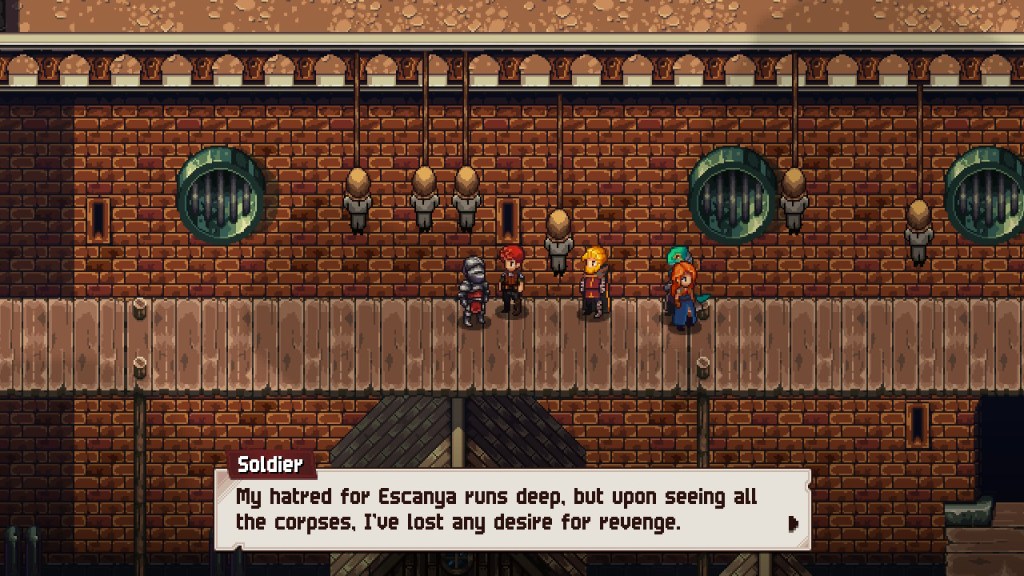
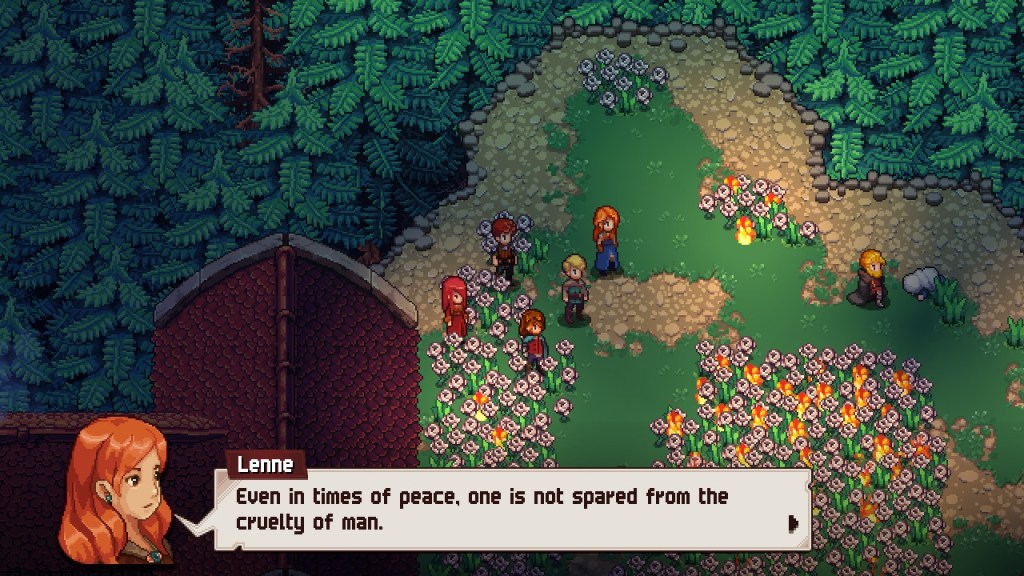
The humor from characters like them is very much needed due to the seriousness of the main storyline. It seems like everywhere that you go in Valandis, you’ll see and hear more and more about the darker side of humanity. The main theme is war, and the game goes into the effects of war on the civilians. Bodies will hang from city walls when the king commands his men to perform one unjust execution after another. Citizens on all sides of the conflict will suffer from starvation and constant cruelty. Soldiers will commit horrific war crimes by order of the king, but that does not preclude civilians from attacking others in order to get ahead themselves.

Many of the characters who will join you have done some morally questionable things before, but they are not irredeemable. I thought they were pretty likable, and even the character I didn’t care for at first ends up having character growth that made him tolerable. Most party members seem to join you automatically, but there are some who will join you through optional side quests. I had 12 characters in my party by the end of the game, and I really liked how we get background on them through the story. Usually in games with so many protagonists I don’t tend to feel like I’ve gotten to know all of them. Chained Echoes manages to provide enough information about the majority of the party members for me.
Eventually you will gain access to an isolated base, where you can collect a group of minor characters to come to your island for different perks. It’s kind of like a much smaller Suikoden sort of thing. Possible benefits for recruitment include being able to see the chests and other secrets you’re missing in each area, giving you discounts across all merchants, or being able to customize weapons and armor at your base. The island and its new inhabitants are yet another part of the game that adds to its depth when combined with the other features.
I had a lot of fun running and flying around Valandis to find its secrets, as well as more members for my cause – whether they were a fisherman added to my base or a major party member. I spent just under 60 hours playing Chained Echoes, and while the ending was different than what I’d hoped it would be, it was still quite emotional. There were some minor aspects of gameplay that I didn’t always completely understand, but other than that, this really is a fantastic retro-inspired JRPG with many modern conveniences and unique features. (And a well-done soundtrack!) I’m super excited to hear that the developer is apparently working on adding New Game+, and I’d love to see a sequel. I’m sure there are many who would…echo…that sentiment. 😉
9/10

 Switch It On Gaming
Leave a reply to Chained Echoes: Ashes of Elrant DLC Out August 7th – Switch It On Gaming Cancel reply