- Price: $19.99 USD
- Developer: Denki
- Publisher: Curve Games
- Release Date: June 16, 2022
A review code was kindly provided by Curve Games on behalf of Denki. We thank them for being able to cover something they’ve worked so hard on.
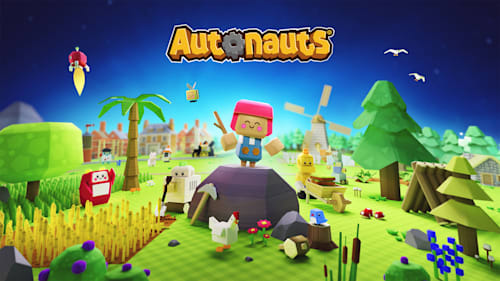
In Autonauts, your adorable character must travel across the universe to build settlements. You arrive on a new planet by yourself, and have to forage for ingredients and tools that will help you start a new civilization. The goal of the game is to automate processes by programming/managing robots and their assigned tasks.
There are three gameplay modes to choose from:
- Settlement: build everything from scratch
- Free: all technology unlocked at the beginning
- Creative: No limitations!

I decided to go with the settlement mode first to learn how the game works. At first, you do a lot of things manually. I gathered sticks and rocks from my surroundings to use as my first (primitive) tools for chopping down trees for lumber and other tasks. Once you’ve chopped down your first few trees, you can combine that lumber and a stick together to create a “Crude Workbench,” where you can then build more effective tools. Each tool that you use has a limited amount of uses, but thankfully workstations and storage do not break.

I spent a decent amount of time gathering ingredients to build storage, which can be stacked on top of each other. Stacking three storage boxes, crates, or barrels results in bonus storage, which I thought was neat. I did have issues moving the entire stack of 3 crates at a time, as it seemed like I couldn’t move the whole stack at once and had to move each piece individually. I also would have liked a central storage system instead of separate units for individual items. It took up a lot of room having one stack for lumber, another for planks, another for poles, etc. Even just having combined storage for each category (wood, stones, water, crops, etc.) would have worked better for me.
Building robots to lessen the burden on you is the next order of business. Your first few robots will be simpler, and require ingredients that are much easier to get. These robots can only perform a few tasks in comparison with the ones you build later – as you complete more research tasks, you’ll unlock better building stations that allow you to create different heads/torsos/bottoms as well as upgrades to allow robots to complete more automated tasks.

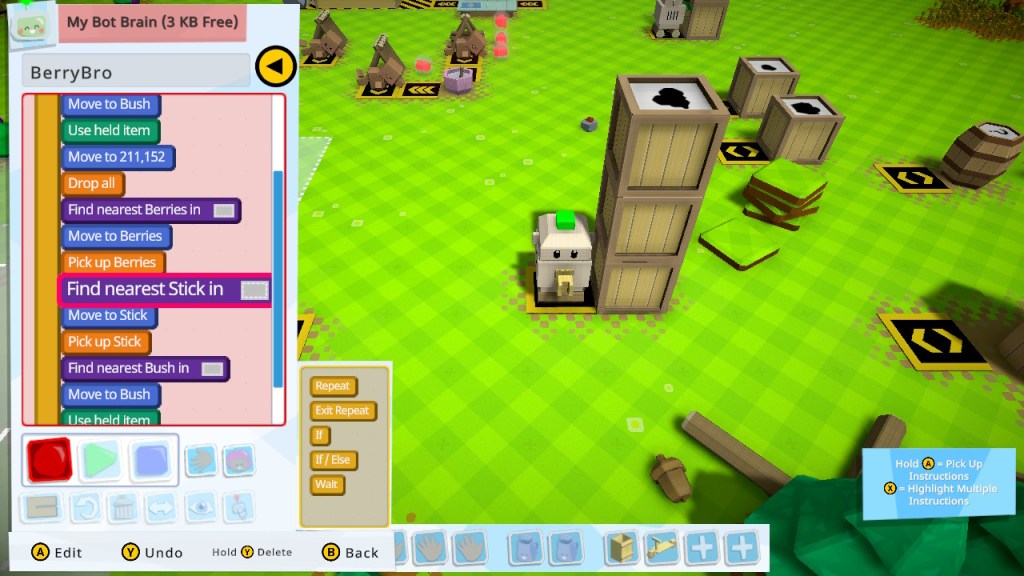
To program your robots, you need to get their attention and then start to “record”; the controls took a little while to get used to because you have to switch between the programming screen and your character to program tasks in. Once you’ve started recording, move your character around and perform the tasks you want the robot to mimic. The game will automatically “write the code” for the robot based on your actions. You may want to have a robot gather ingredients and put them in storage, or have them cut down trees and replant them. Each action will take up space in your robot’s “brain,” so the more tasks you add, the more room they’ll take up.
In order to automate everything, you’ll want to make it so that each set of instructions will be repeated over and over again. Editing the area where you want your robot to complete these tasks is important to make sure they can do what is needed. It’s also extremely important to make sure that the robots have the tools they need to do something, like an axe for cutting down trees, a spade for digging holes to replant said trees, and more. Unfortunately, it doesn’t seem like the game alerts you when a robot’s tool breaks. I’d often be working on other things for a while and then discover that the assembly line had broken down due to tool breakage, so you have to periodically check in with them to make sure everything continues to go smoothly.


After you’ve created your army of robots, it’s time to add adorable little creatures called “Folk” to your fledgling settlement. You’re given “Folk Seeds” to grow your Folk in incubators, and once they’re “born” you need to feed them and house them. Once they have eaten, they’ll give you “Folk Wuv” (aww!) to add to your research station, where you invent new technology. If an individual Folk’s hunger or shelter meter is depleted, they’ll no longer provide you with Wuv. The food meter made sense to me, but it felt kind of weird – and unnecessary – to have to give them logs or other building materials to keep their shelter meter filled.

Unlocking more items through research will allow you to build better shelters for your Folk, which levels them up. When they level up, they need better food and materials in order to provide you with upgraded versions of “Wuv.” The improved Folk will also require clothes and entertainment – otherwise, they’ll refuse to give you any Wuv. I really liked the clothing options for the Folk, such as the “Plumber’s Dungarees” and the “Adventurer’s Top,” which have some clear inspirations behind them! 😉 There are also clothing options for your character. As you continue to improve your settlement and rise through the ranks, you can start an automated clothing industry to help with the Folks’ needs.

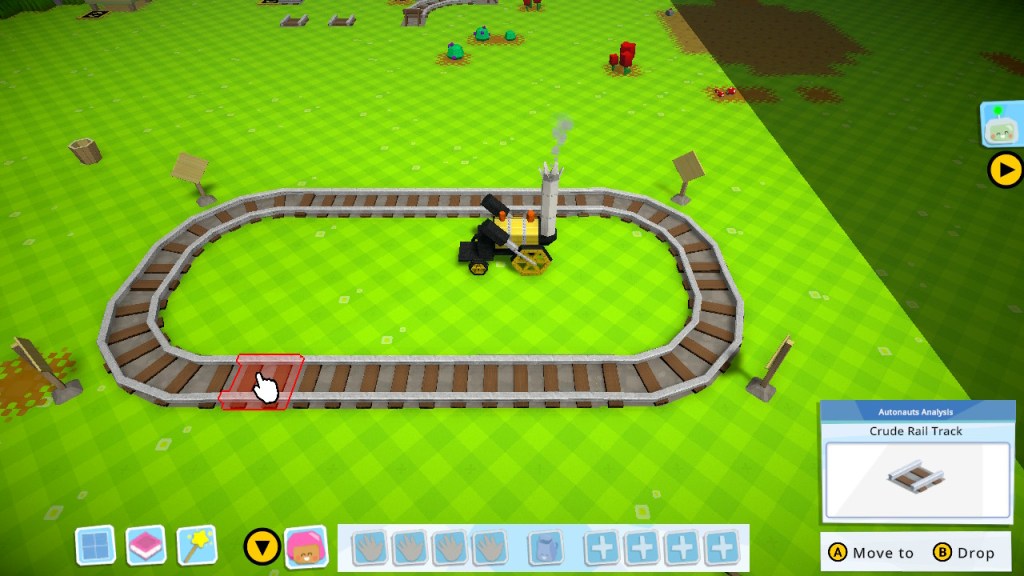
I also liked the livestock features in the game, with cows, chickens, alpacas, different types of fish, bees, and silkworms! (The aquarium was a little disappointing for me since it was hard to see any of the fish properly.) The transportation options, like the dugout canoes and trains, were neat additions to the game as well.
I did have some issues with the game’s mechanics. For example, moving around felt rather awkward because you have to move the cursor around and select a square to move to – as opposed to having direct control of your character’s movements. You have to wait for your character to arrive at the selected destination, and movement/actions felt slow even after building a little scooter to help me move faster. I like that we can change our actions in the middle of moving around by clicking on a different destination or item. But I wish we could kind of “program” our character to complete multiple actions in a row instead of having to wait for them to get somewhere, pick something up, and then finally click on where to go or what to use the item on.
It was also frustrating to not be able to make several items at the same time. I had one robot programmed to pick up logs from trees that were chopped down by another robot. They would then take the log to the chopping block to change it into a plank. If I wanted to add a log at the same time, it would not allow me to make a plank until the robot was done with their task (which takes a while to complete in the first place).
Sometimes my robots would run into each other at different storage units depending on their tasks, which caused them to stop working. I had to create a workaround by programming one of them to briefly move away from the storage for a moment before repeating their task again.
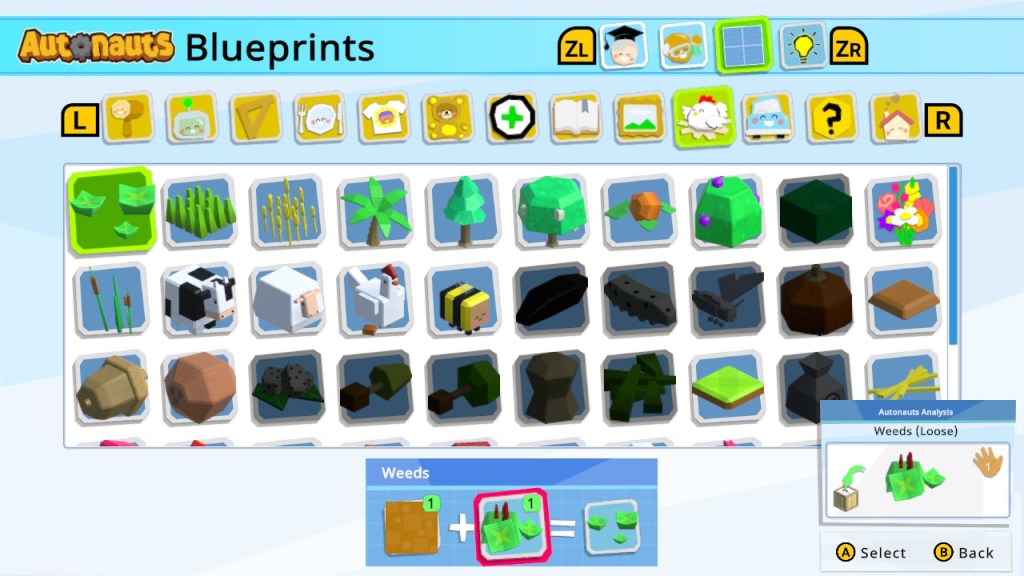
I also had some trouble figuring out some of the natural resources (i.e. where to find weeds) and how they worked. I was often confused even with the tutorial. I also thought it was strange that some workbenches require you to add flooring under them after building the bench, or some – like the spinning wheel – require walls around them before they can be used.
I think that I liked the settlement mode the best because it gives you fairly clear goals to help you build your society. The free mode has every item unlocked from the start, and you’re given a very brief tutorial, but you don’t have any research goals set by the game and it’s a little hard to figure out where to start if you haven’t played the settlement mode. And the creative mode has everything unlocked from the start – you can just automatically make things without gathering anything. But this mode could be a little overwhelming, and the Folk’s Wuv doesn’t seem to have a purpose in free or creative modes either, yet they still produce it. Creative mode wasn’t quite as satisfying for me in terms of working to build a society on my own.
Switch it ON or Switch it OFF? Autonauts is a really cute building game with a lot of potential. It’s let down by the controls on the Switch console, as well as some of the overall mechanics and inefficiencies. However, there’s a lot of creativity, variety, and Wuv love put into the game, and it feels incredibly rewarding to level up your society. The 3 modes provide a lot of content, and allow you to decide if you want to really manage your society’s evolution, or if you’d prefer to instantly place buildings to achieve your creative vision. If you enjoy creating and managing societies, and you like the idea of programming robots, Autonauts may be the game for you!🤖 7.5/10

 Switch It On Gaming
Leave a reply to Upcoming Games – July 9, 2022 – Switch It On Gaming Cancel reply