- Price: $49.99 (digital & physical)
- Developer: Idea Factory
- Publisher: Aksys Games
- Release Date: March 26, 2026
A review code was kindly provided by Aksys Games on behalf of Idea Factory. We thank them for allowing us to cover something they’ve worked so hard on.
Content warning: Rated T; kidnapping, mentioned dismemberment, murder, abuse of power, capital punishment
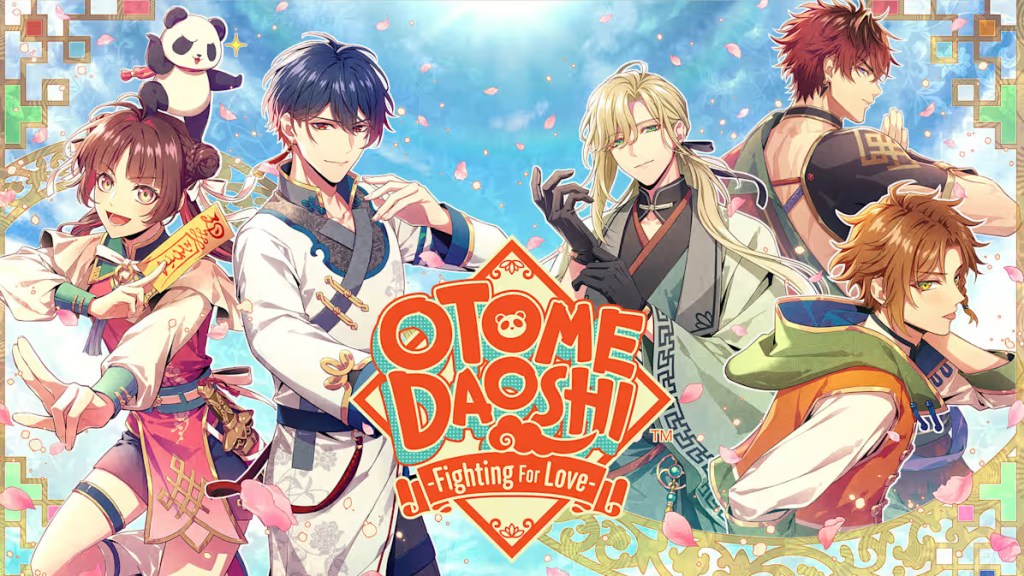
There are a lot of things about Otome Daoshi -Fighting for Love- that caught my attention. The name itself is interesting, seeming to roughly translate to “Dao Maiden.” The art style is gorgeous – I loved the preview images on the eShop, with unusual manga-style panels in some scenes and an adorable panda as the game’s mascot.
As far as the story is concerned, it takes place in the kingdom of Kayu, where martial arts enjoy widespread popularity. Our heroine Shunlin is a daoshi (Daoist priestess) in training under her grandfather. She has some training in martial arts, but for the upcoming Tournament of Valor she intends to serve as a spectator as her friend participates.
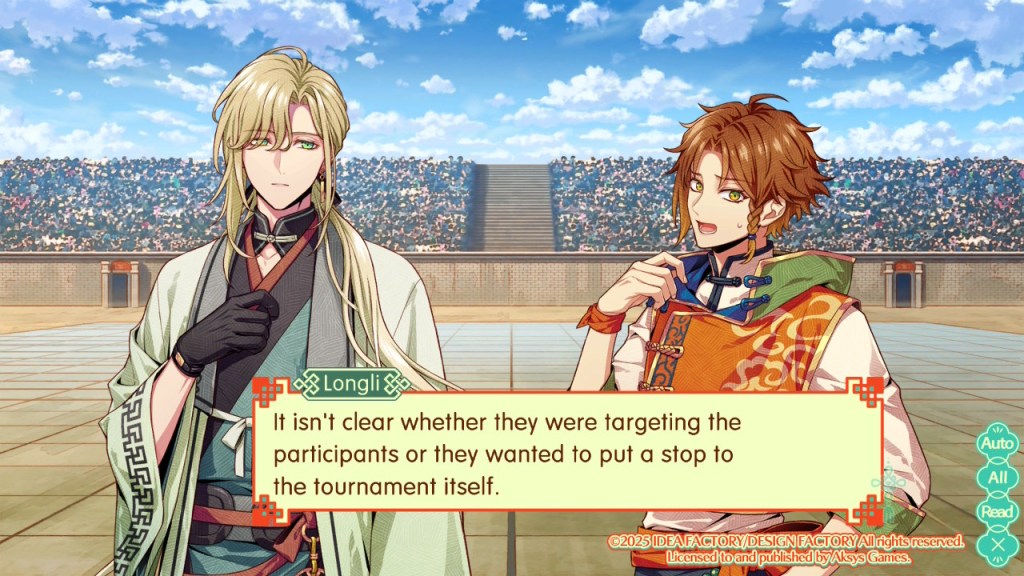
Unfortunately, during the semifinals an army of jiangshi (undead creatures) attack the arena, and while Shunlin helps protect the spectators, the government still decides to cancel the tournament. In the meantime, the unidentified perpetrators behind the attack have yet to be found.
Shunlin will investigate the attack with each love interest in their route, along with palace officials and her grandfather. I really appreciate how they wrote Shunlin as a strong heroine. Through her work as a daoshi, she helps the souls of the dead pass on.
Note: In Japanese “daoshi” is written 道士 (どうし), roughly pronounced “dough-she” in English. In Mandarin it would be pronounced dàoshì, “dow-sure.”
In addition to martial arts, as a daoshi Shunlin also carries a peach wood sword and the talismans she’s made. There’s a neat ability called “shared sight” that allows her to attach a talisman to her panda bestie to scout ahead so she can see what the cute critter sees.
In this kingdom strength is valued above all – to the extent that it can influence how high up you are as a government official. It seems to be the complete opposite of the Confucian examination system that actually existed in China hundreds of years ago. The good news for Shunlin is that unlike in that system, women can advance in Kayu based on their strength.
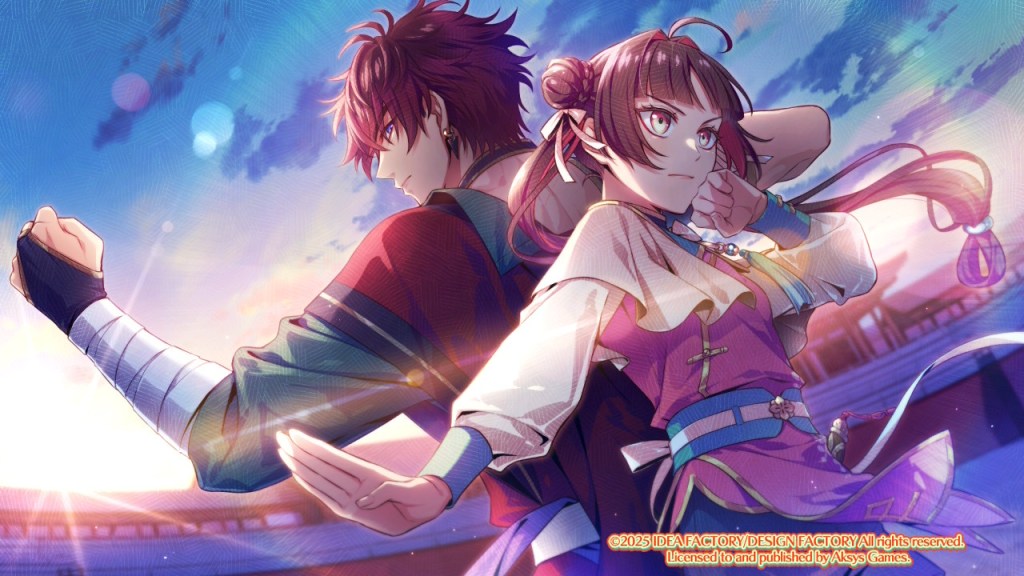
What this means is that all the love interests respect Shunlin for her abilities. There are moments where some of them are a bit overprotective, but ultimately she isn’t just standing behind them for protection wringing her hands. She actually participates in battles (and so does panda Mimi)!
Shunlin does have her flaws; she’s pretty stubborn, and she can be slightly immature at times (but to me those moments seemed age-appropriate). Yet her determination helps her not only in saving the day but also in her love life. She’s very straightforward and has good intuition that allows her to notice things about her love interests and develop key theories in their investigations.
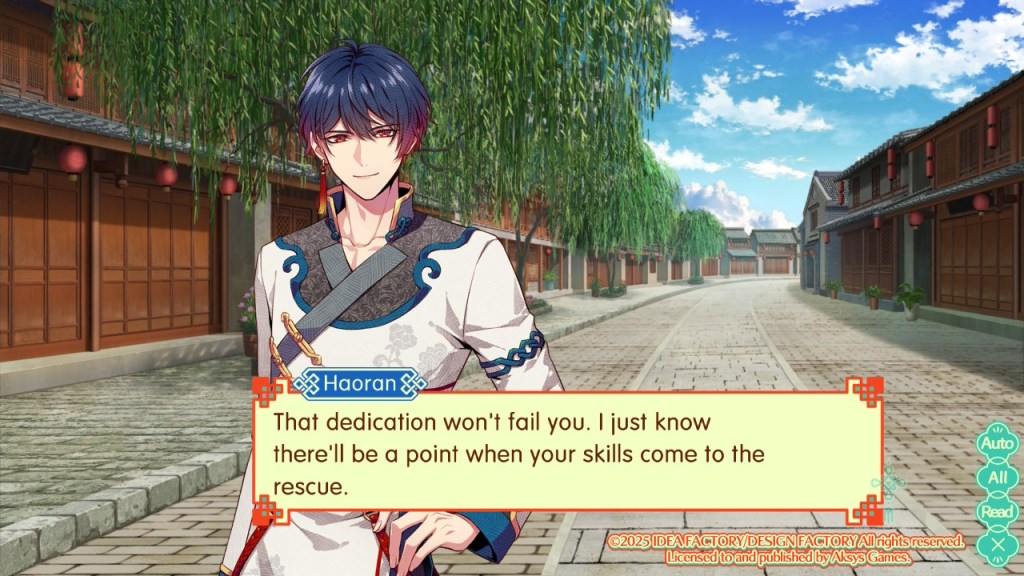
As one of her childhood friends, Haoran is initially seen as Shunlin’s “older brother,” and he’s used to her shenanigans. He’s observant and does his best to meet both her wants and needs. Haoran can be overprotective at times, but he recognizes when he is and doesn’t stop Shunlin from coming with him in potentially dangerous situations.
To be honest I’m usually uncomfortable during a lot of love interests’ routes where they’re “like family” at first; I find them quite awkward. But with the way they wrote it here it was actually somewhat silly while still having it make sense for the progression of their relationship. The biggest problem I had with Haoran’s route was how obvious the identity of the antagonist was.
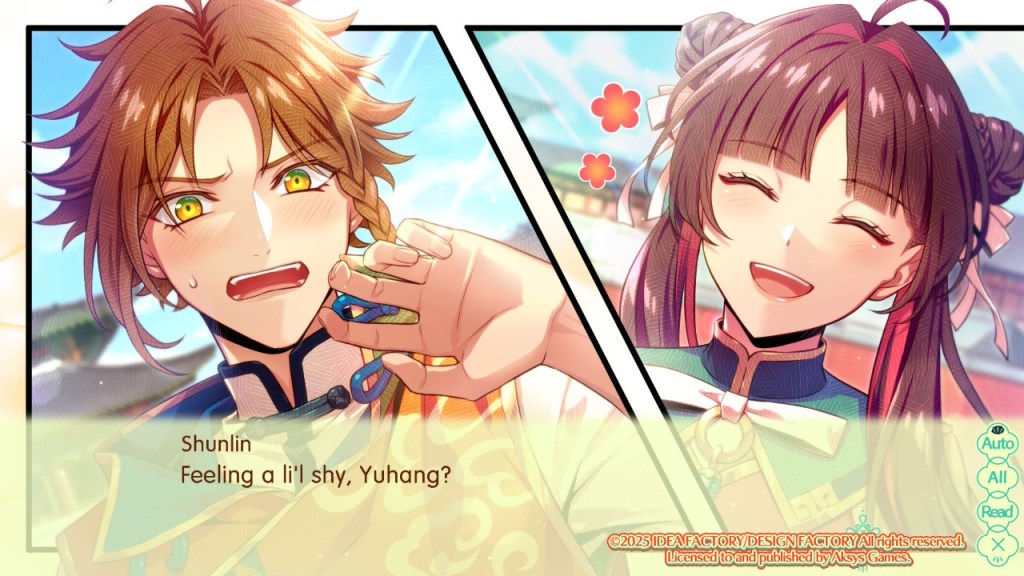
Now, while I liked Haoran well enough, I liked Yuhang much more. He was friends with Shunlin when they were kids, but they haven’t seen each other for more than a decade. The first scene with Yuhang is so funny and cute, and that just sets the tone for the rest of his route for me.
I loved how indignantly embarrassed he’d get when anyone complimented him. And the history behind his feelings for Shunlin is incredibly sweet. Again, the main storyline felt predictable, but there were aspects of both Haoran and Yuhang’s routes that I was surprised by. (I didn’t care for something Yuhang did towards the end of his route.)
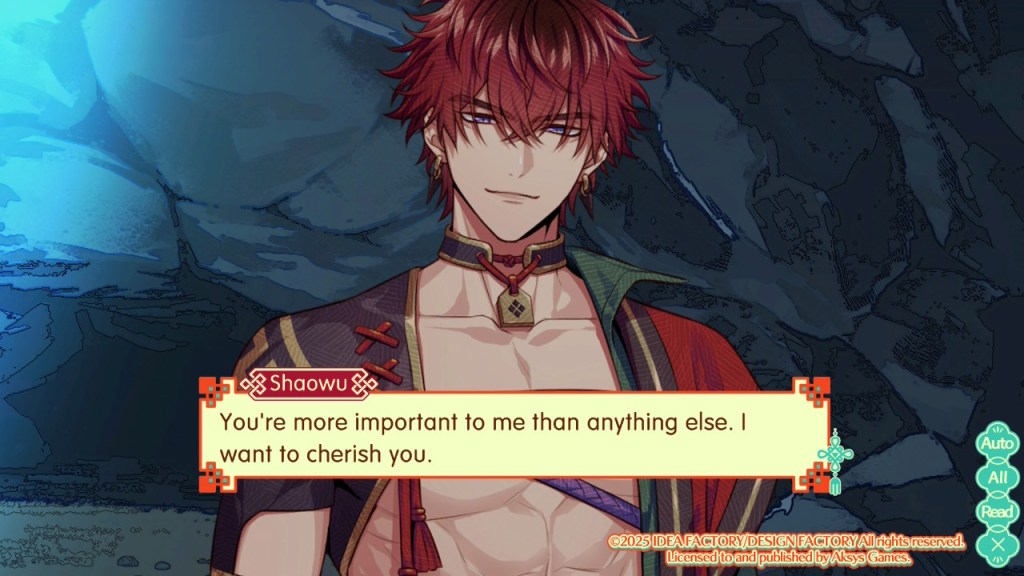
Yuhang was probably my second favorite love interest after Shaowu. Shaowu is a man of few words, but what he does say makes him very appealing as a love interest. I absolutely loved how he calls Shunlin “little lady” as a nickname at first. 😍
The misunderstanding in his first chapter is one of the funniest scenes in the entire game. I liked how Shaowu seemed to be the most impressed with Shunlin’s abilities out of all the love interests. He’s brusque and could be perceived as rude, but he’s really a nice guy who encourages Shunlin when she’s feeling down.
I thought that the story in Shaowu’s route was one of the more interesting ones, although the romance felt rushed. This is probably because some of the other characters knew Shunlin since they were children, so the development of their relationship didn’t feel as natural in comparison. Still, Shaowu remains my favorite.
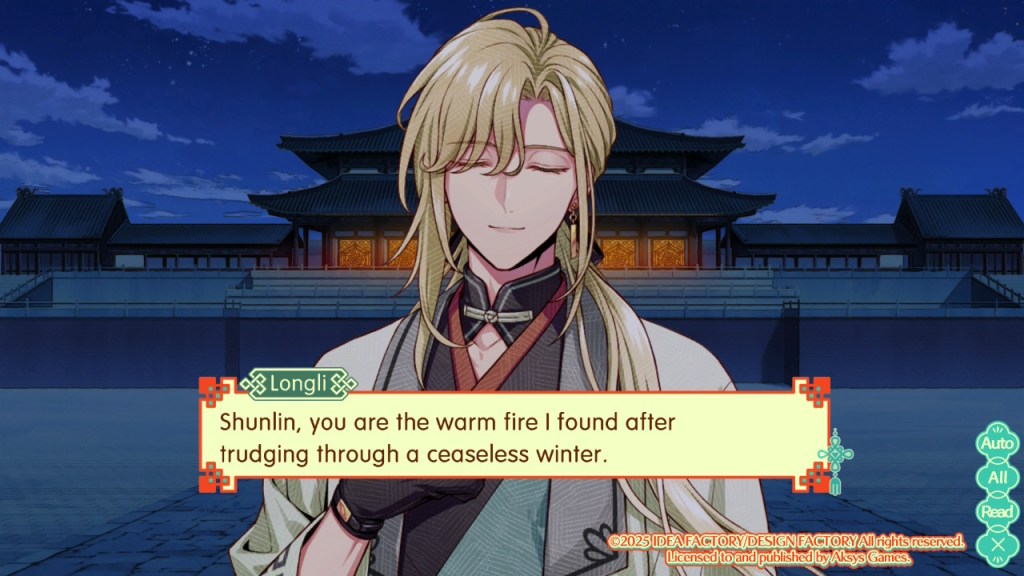
Next up, Longli works at the palace, and he comes to ask Shunlin and her grandfather for their help with the investigation. He acknowledges that Shunlin may not be a full-fledged daoshi yet, but that she is still very capable nonetheless. The way that Longli’s relationship with Shunlin developed was unexpected. His storyline had some interesting information, but the romance wasn’t my favorite.
There is a fifth route that unlocks after completing the aforementioned love interests’ routes, but I don’t remember any pop-up informing me that it had unlocked. Uro’s route can be accessed by starting Longli’s route again.
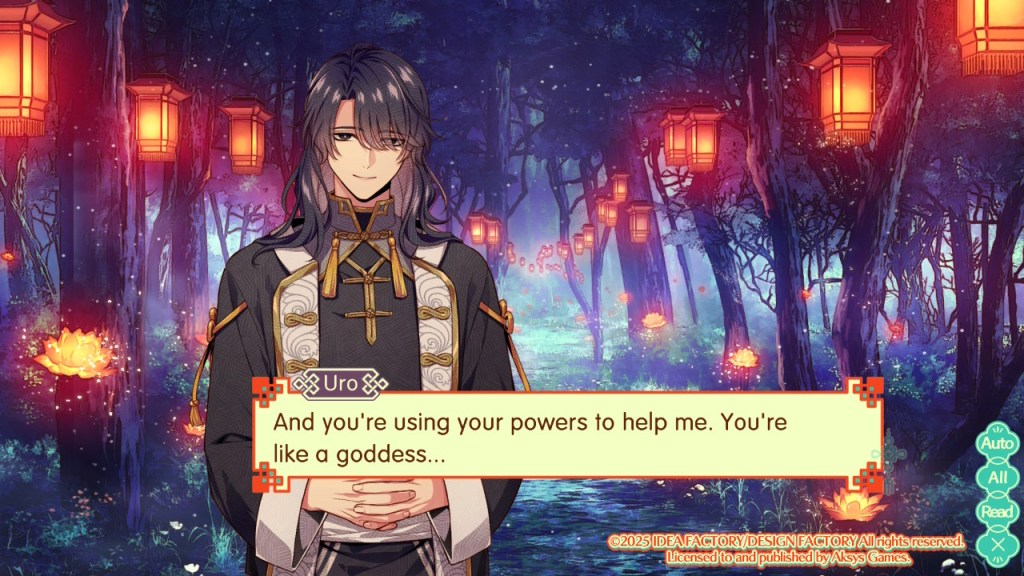
I liked how Shunlin seemed to have met her match in straightforwardness with Uro, who also says exactly what he’s thinking. This results in some especially entertaining scenes. Uro gets along the best with panda Mimi out of all the love interests, so in my book he gets a ton of bonus points for that. His route was similar to Houran in that it was super predictable from the very beginning, even with the twist at the end.
I liked all of the love interests; I didn’t dislike any of them, which is rare for me in an otome. From best to okay I’d rank them in this order: Shaowu, Yuhang, Haoran, Uro, and then Longli. Story-wise I thought Shaowu and Uro were the best.
The game is fairly short, and I don’t think they made it long enough to properly develop the storylines. They were smart to not include any bad endings in the game though. I feel like recent otome include so many bad endings per route that it feels like they take away from efforts elsewhere.
But in Otome Daoshi they wisely wrote only 2 endings per love interest: a true love ending and a romantic ending. I actually liked not having any bad endings. It did feel like everything worked out too easily for the characters in the end, and the predictability was a major problem for me.
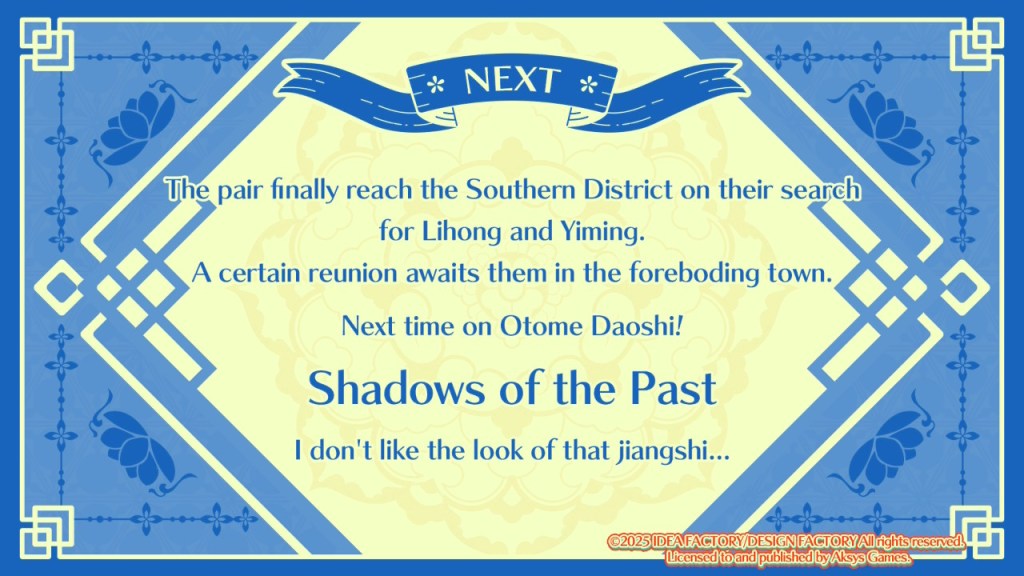
Despite my issues with the writing, I still enjoyed the experience. It reminded me of ‘90s Anime, perhaps? This is reflected in the fun little voiced previews/teasers for the next chapters, which reminded me of the format for shows like Dragon Ball Z. Even the intro cards for each chapter have different sound effects depending on the mood of the chapter.
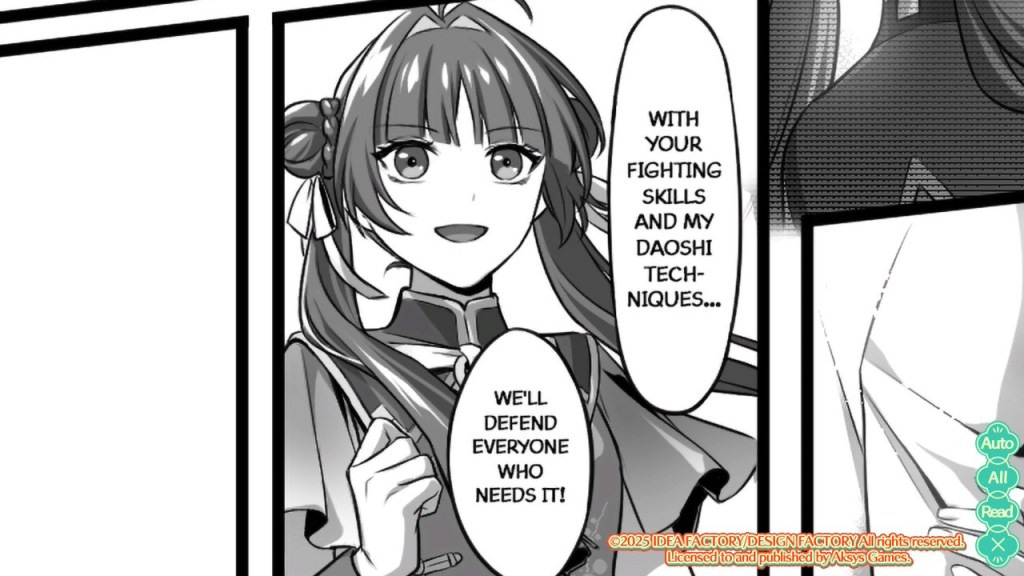
Otome Daoshi is unique in that it features several manga panels, which often depict the game’s combat scenes. There are “Classroom” comics on the menu that explain the world’s terminology some more, and adorable chibi CGs in between chapters.
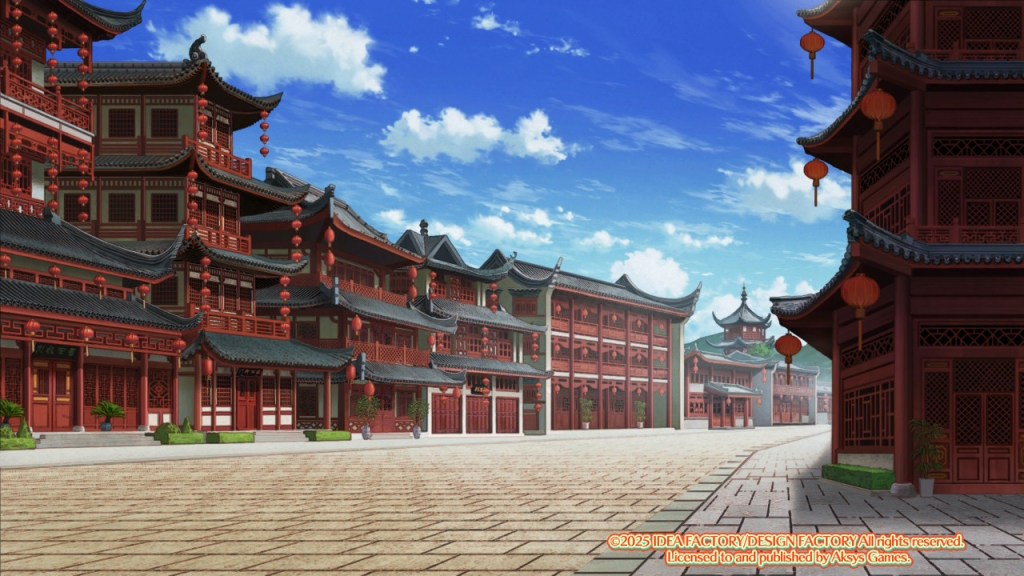
I think this is one of the most eye-catching otome out there. The characters are all gorgeous, and the technique used for the textures on their hair and clothing is unique. The backgrounds feature a lot of Asian architecture, and are some of the prettiest I’ve seen.
They extended the theme to the text boxes and menus, and it was great to have such large, legible font by default. I really enjoyed the soundtrack as well, which was well-suited for the themes. The opening and ending theme songs are very different from each other, but I liked them both.
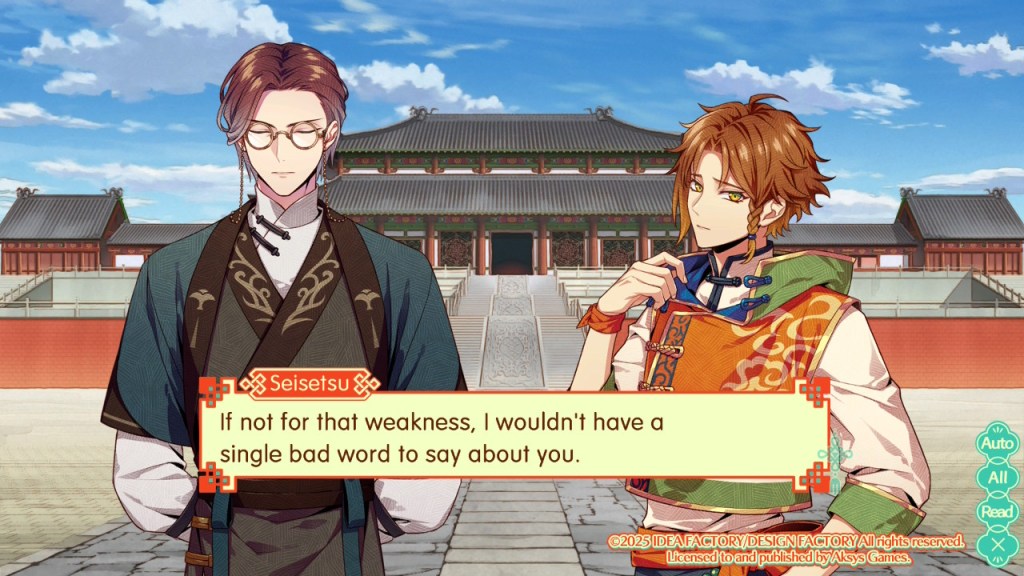
Otome Daoshi -Fighting for Love- isn’t perfect. It’s fairly simple and short as far as the plot is concerned, and it’s pretty predictable. However, I found it endearing regardless of its flaws. The Anime and manga design elements really appealed to me, and I appreciated having a story based on Daoist principles. I’d be interested in a sequel where we get to see Shunlin as a fully trained daoshi.
 Switch It On Gaming
Leave a comment