
- Price: $24.99 USD
- Developer: Ocean Drive Studio
- Publisher: Kakao Games
- Release Date: October 9, 2025
A review code was kindly provided by 1UP PR on behalf of Ocean Drive Studio and Kakao Games. We thank them for allowing us to cover something they’ve worked so hard on.
Content warning: Rated T for “Blood, Language, Violence.” Mass murder, human experimentation, undead.
Part of the reason I enjoy roguelites so much is because even if I fail, I still make some kind of progress that carries over to my next attempt at the game. I also like to play tactical RPGs, so when I saw that Lost Eidolons: Veil of the Witch combined both of those elements I was already sold on the game.
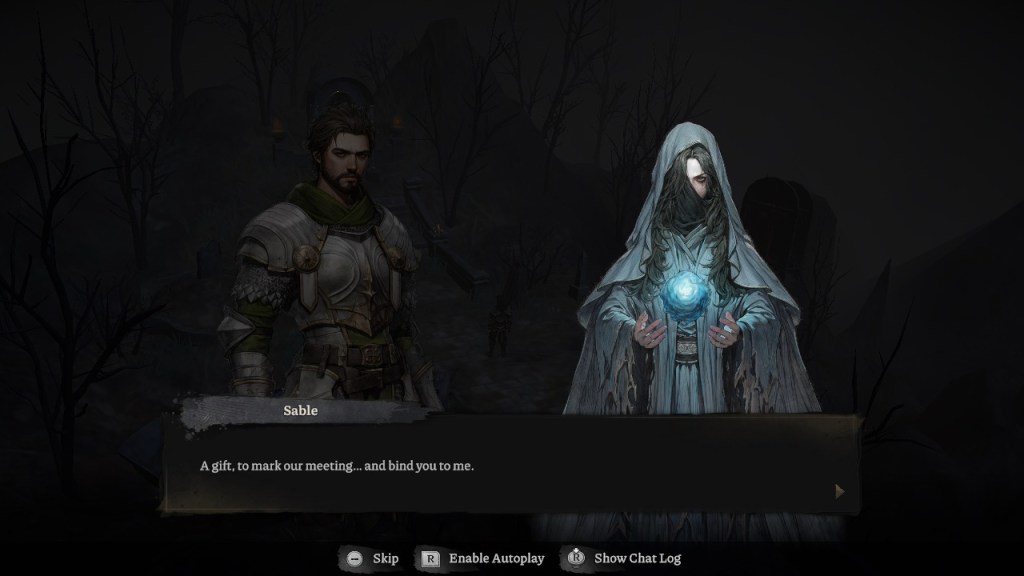
Choose to play as a male or female, and the story will begin. You play as a character who has washed ashore on a cursed island plagued by the undead; in a state between life and death, you make a deal with a witch to return to the land of the living. The catch? You have to defeat her enemies for her.
As if your luck wasn’t bad enough already, you’ve also lost your memories of everything from before arriving on the island. 😬 But at least your body still remembers how to wield a sword. Teaming up with a few others capable of fighting, you’ll journey into unknown territory to discover the secrets of the island…and your forgotten past.
The island is full of the undead as well as monsters (of both the beast and human variety). You’ll face them with a team of 5 party members, who each wield 2 weapons associated with their class. During the Player Phase you can decide the order of your team’s actions, and you also choose which weapon they’ll use for each turn.
With the exception of tome-based class abilities, every weapon has a regular attack that doesn’t require a cooldown period before reuse (in addition to abilities with cooldown periods). Using a regular attack or an ability will increase your characters’ Class Mastery (for that run only, as it resets after you’re defeated).

Class Mastery is limited to level 20, which seems fairly low, but it makes the game feel like more of a challenge because it means you have a limited opportunity to choose a character’s skill set and stat allocation for that run. When you’re given the chance to make these decisions the game provides you with 2 random skills (from a pool of 20 per character) or stat options, and you can either choose one of them or pay to reroll the options.

There are 4 different rarity levels for skills, and a higher rarity level means a stronger/“more unique” ability. You can upgrade your abilities to be more powerful or to be capable of reaching units who are farther away (whether that’s to attack an enemy or heal an ally). I particularly enjoyed using Evie and Laurent’s skills, as they had some of the more useful abilities (and the best animations).
Unlike many RPGs, you don’t have to deal with buying and selling equipment here because your party’s weapons and armor are the same for each run; they start out in their base form, and you have to upgrade them as you go along. Similar to abilities, there’s a rarity system for weapons as well.
After each battle or event, you get to choose which path to take next. Icons for each path option will tell you if you’ll fight another battle, reach a resting area, find some loot or Relics, etc. Sometimes you’ll get your hands on Resonance Stones, which improve stats and/or add a skill to one character’s weapon or armor.


The extent of the improvement depends on that specific stone’s “resonance” with each character’s equipment option (hence the name). Each piece of equipment has equipment effects (passives) and equipment abilities, and you can unlock the item’s full potential by unlocking all 3 enchantment slots of varying rarity levels. Again, all of these enchantments are taken away when a run ends.
There’s also a system similar to the weapons triangle in Fire Emblem, although it doesn’t seem like weapons are weak to other weapons. Instead, a unit’s only weakness seems to depend on the type of armor they wear. Additionally, some weapon types have different effects on the enemy when making critical hits, which I thought was pretty neat.
You can also use the environment to your advantage, like when you use lightning spells on enemies who have stepped on water tiles – or freezing them so they can’t move. Some maps have rocks for you to push onto enemies below, or ballistas to shoot distant enemies on the map. I was impressed with the variety of maps, which had different dialogue and win conditions. You’re often able to choose how to end a battle, whether it’s by fleeing or continuing to fight.
I did wish a few aspects of the battle system were different; for one thing, you don’t get to place your units where you want them to be in the starting position. You also can’t move characters after they act (with the exception of those with learnable passive abilities that allow it).
But overall I had a really good time on each expedition; I enjoyed experimenting with different abilities, weapons, and equipment each time I played. They also included great features such as the ability to speed up the battle animations (or skip them), and you even get to undo your actions in battle a number of times if you mess up – even going all the way back to the beginning of the battle!

Undoing your actions is completely optional, but it’s nice to have for some of the more difficult battles. It felt like the boss for Act II came with a massive spike in difficulty compared to the first one, but I eventually figured out how to beat them after many failed attempts. Battles are challenging, but not so much that you’re going to want to stop playing.
When you are inevitably defeated, you’re revived back in town with all of your equipment upgrades and abilities erased. However, there are a few items you get to keep from a failed run, which can be used to unlock permanent upgrades to help you on future expeditions.


Use the Sacred Embers at the Altar of Fire to activate blessings such as increased attack for characters who wear a certain type of armor, increasing the amount of gold you start with for each expedition, or increasing your chance of finding Resonance Stones or Relics. You can complete challenges to earn more Sacred Embers outside of expeditions.

You’ll also find items that allow you to promote your characters’ classes when you get back to town. The main character can be promoted to higher versions of their starting class, but they can also switch to different class lines and get promoted for those ones as well. By increasing your partnership levels with the party members you bring with you, you’ll unlock the ability to switch the main character to their class line.
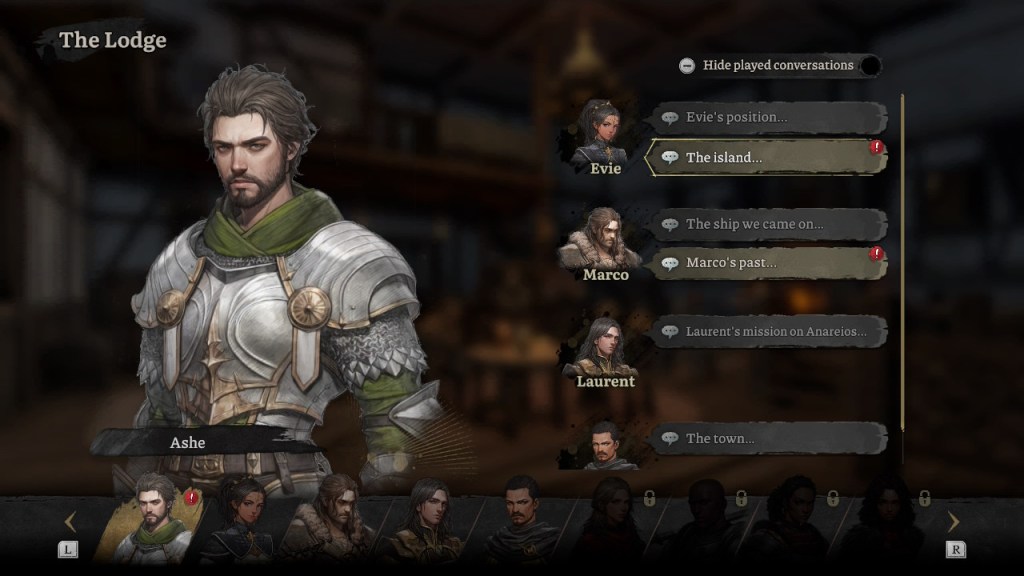
When you return to town you can talk to your party members to get to know them. I like that we can replay those conversations! You also get Memory Shards from each expedition, which you can use to regain some of Ashe’s memories. And you can unlock additional characters by bringing specific party members to find clues about their location.
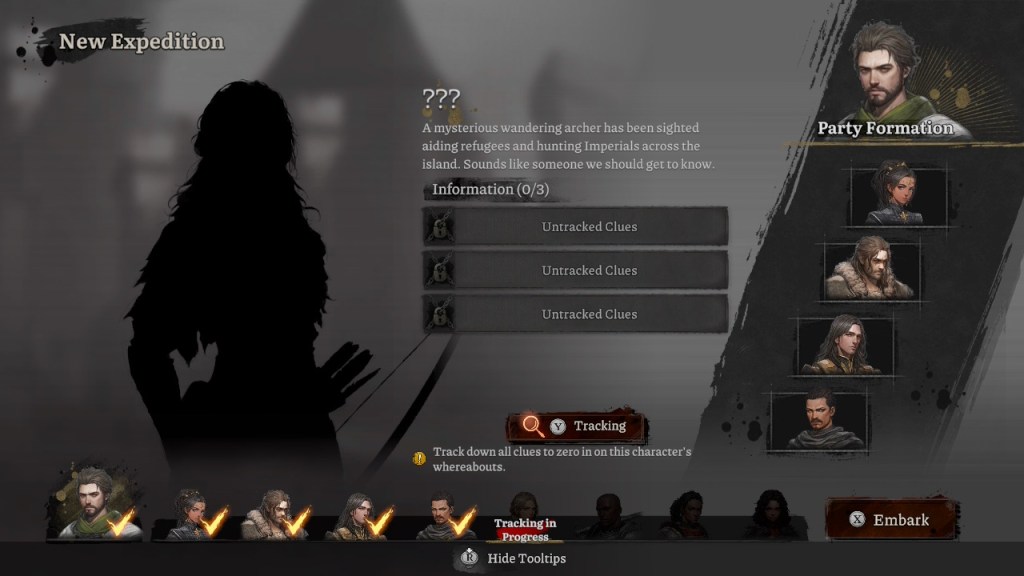
Recruiting these characters unlocks more conversations, and you can try out different party combinations to see whose abilities you like best. When you increase your bonds with each character, it unlocks support attacks and healing when units are next to each other.
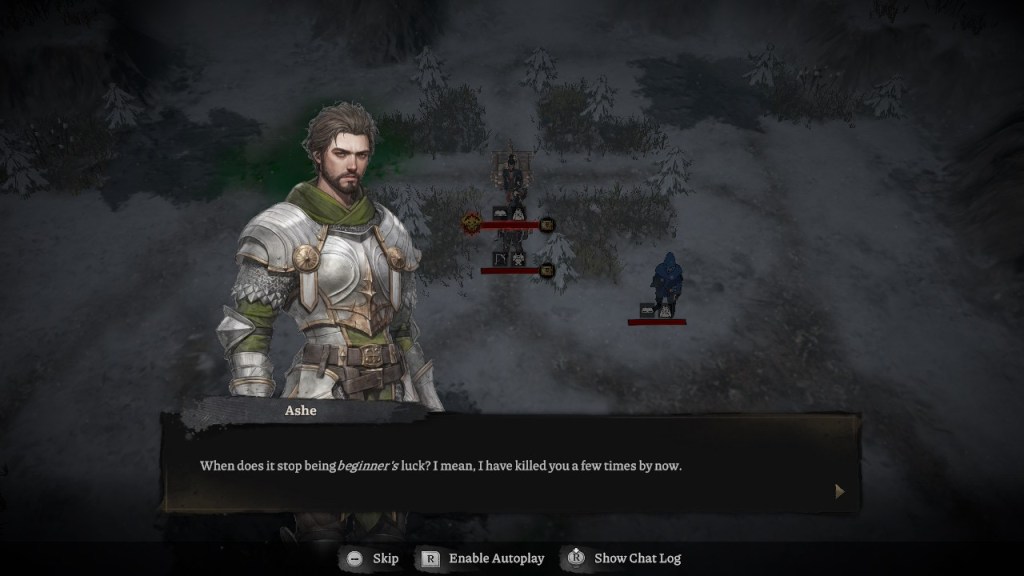
I liked the characters, as they all had unique personalities and backstories. The extensive voice acting really helped bring the characters to life. Laurent and Ashe (default name) were probably my favorite characters. The dialogue in the repeated boss battles often changes when you meet the boss again, and I enjoyed the snarky comments. For a game with such dark themes, I sure found a lot of the dialogue amusing.
It took me 13 expeditions to get through all 3 acts and bosses before I reached the credits. After the credits you gain access to Act IV, as well as the Chamber of Trials, which allows you to play at higher difficulties to earn rewards. The bosses you faced before also change their strategies when you face them again after the credits.
I played for approximately 50 hours to reach the game’s True Ending, which gave me some closure on Ashe’s story, although I don’t know if it answered all of my questions. That being said, I still really appreciated the quality of the writing and the gameplay overall. There’s so much content in this game, and players can make a lot of different choices and face even harder challenges if they’d like.
I would definitely recommend Lost Eidolons: Veil of the Witch to fans of tactical RPGs. It’s a high quality experience that’s very reasonably priced at $24.99. I’d love to see Ocean Drive Studio bring their other game, Lost Eidolons, to Switch someday because of how much I enjoyed this one.
 Switch It On Gaming
Leave a comment