
- Price: $17.99 USD
- Developer: Hakaba Bunko
- Publisher: SHUEISHA GAMES
- Release Date: February 12, 2025
A review code was kindly provided by Plan of Attack on behalf of Hakaba Bunko and SHUEISHA GAMES. We thank them for allowing us to cover something they’ve worked so hard on.
Content warning: Rated T. Online harassment, doxxing, jump scare-ish moments, murder, suicide, etc.
I was intrigued by Urban Myth Dissolution Center when I saw it in the Indie World Showcase videos. With “urban myth” in the title, it caught my attention because I really appreciate “…how interesting it is that they reflect cultures and customs,” and I love seeing urban myths explored in fiction.
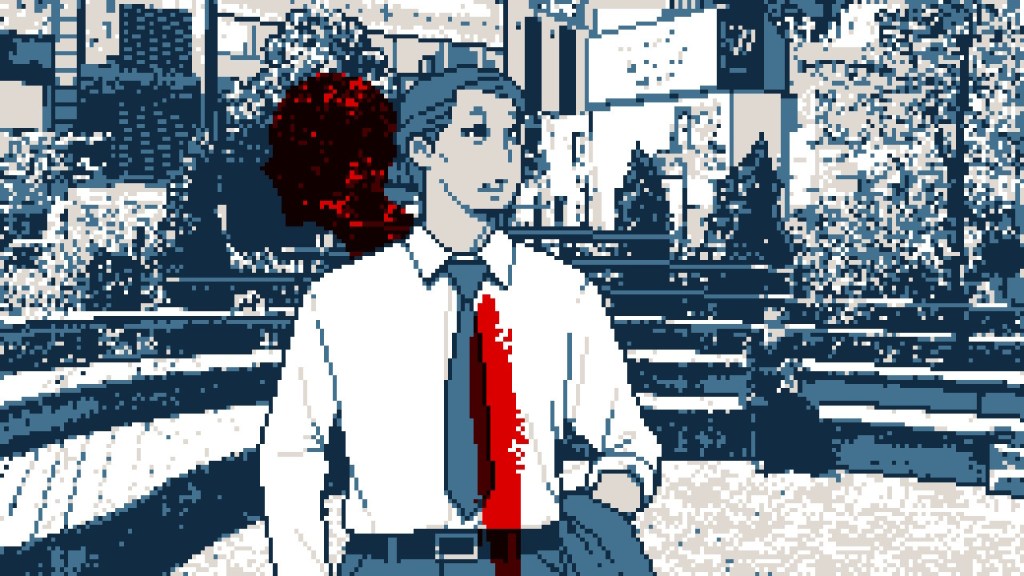
Starting the game, we meet Azami, a woman who can see things that others can’t; she is distressed by these abilities. One day she sees some posters advertising “Anomaly Checkups” at a place called the Urban Myth Dissolution Center. Wanting to rid herself of this ability, she goes to the center not knowing what to expect.
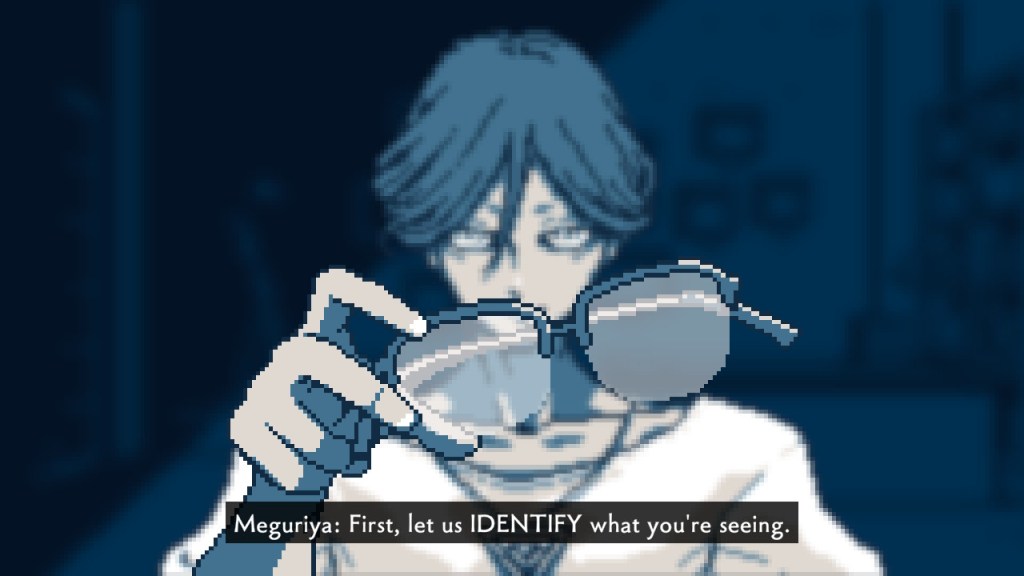
She meets Ayumu Meguriya, the director of the center, who tells her that she is clairvoyant – meaning she can see lingering impressions of the people and objects that were recently there. He gives her some special glasses that put whatever she sees into focus.
Meguriya (“Director-san!”) ends up conning her into working for the center, and puts her to work right away. Jasmine, who works as a driver for the center, takes Azami to the site of her first investigation.
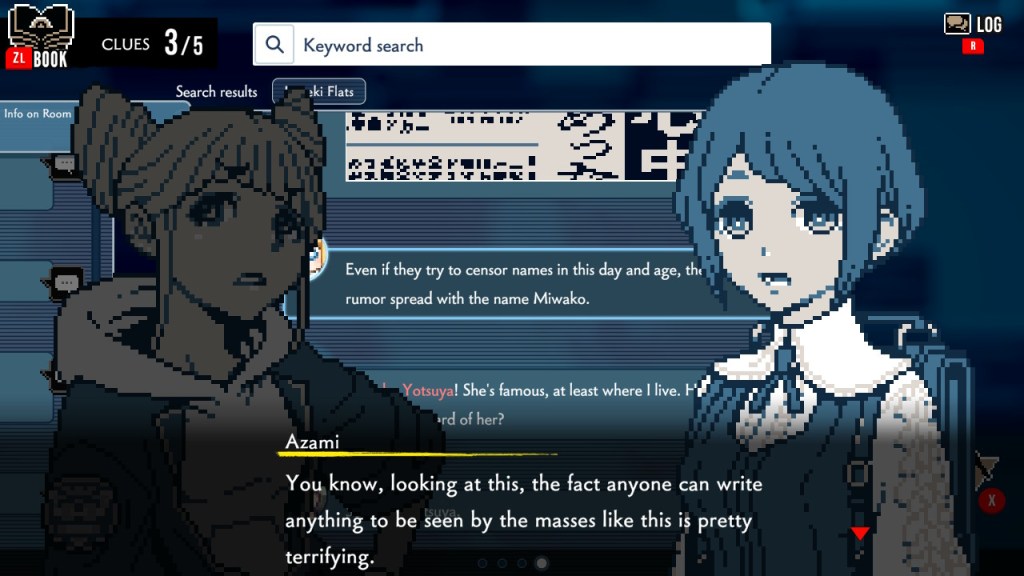
On the way, she explains how they must first gather information on cases by checking social media for details – such as the source of the rumors that generate the urban myths. By putting on her new glasses, Azami can determine which key words should be used in additional searches.
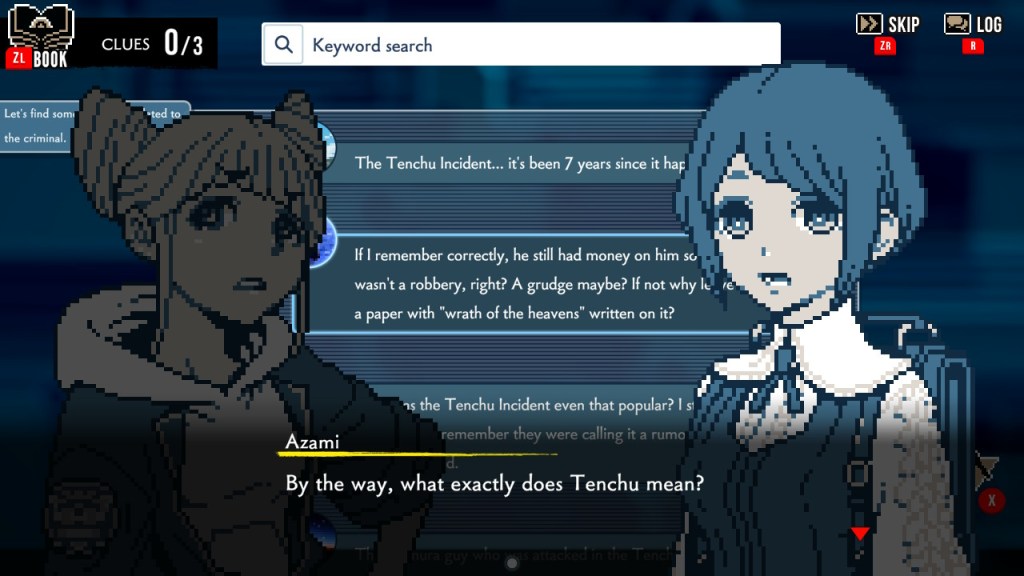
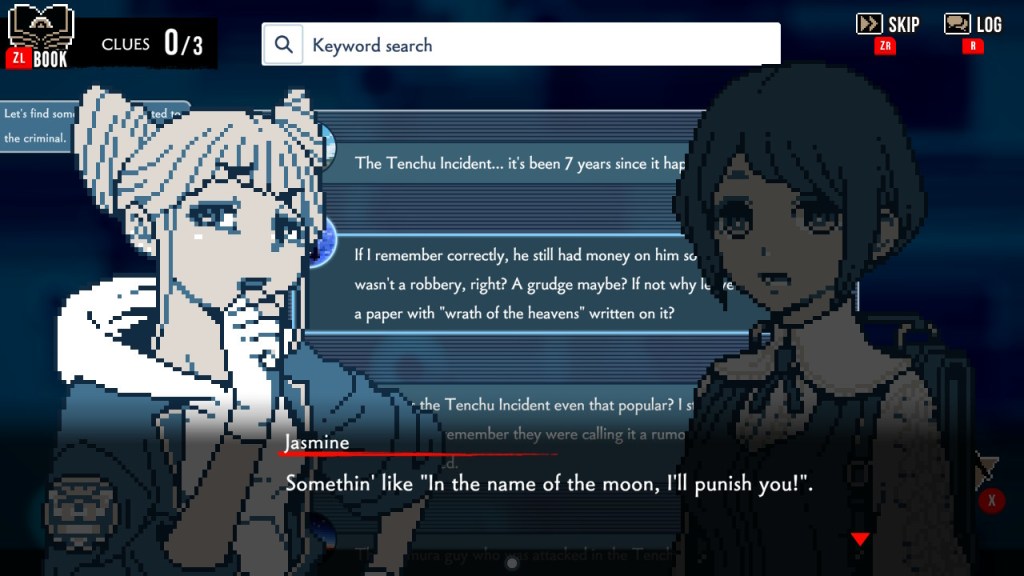
I thought that including the social media research was a really clever and fun way of having the team get some background on a case. Azami and Jasmine’s commentary as they scroll through posts is insightful and often entertaining.
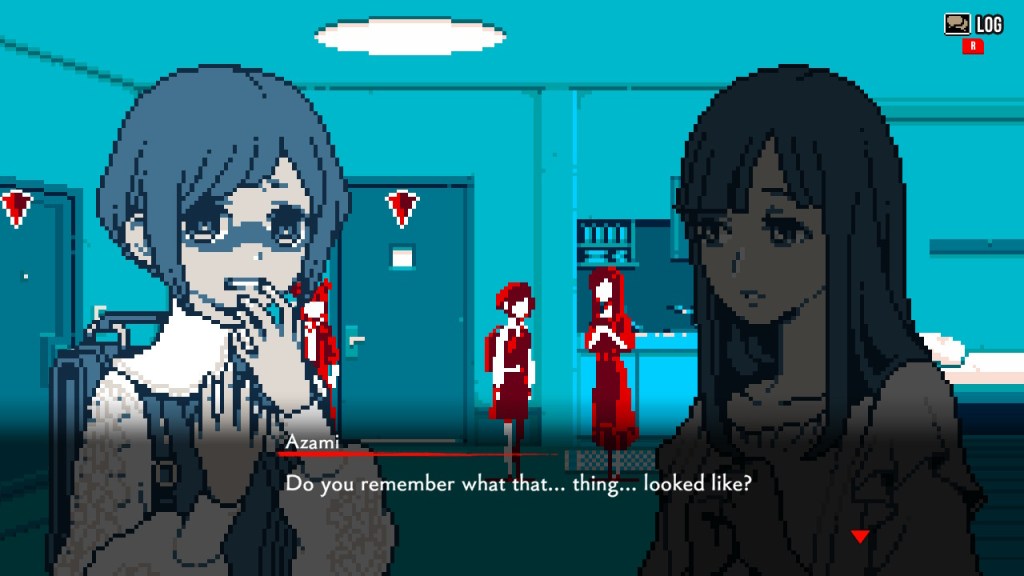
Upon arriving at the investigation site, you must question any witnesses and check the highlighted areas for any clues. Additional prompts may appear after talking to someone or checking an item, and it’s important to examine everything again to make sure you don’t miss anything.
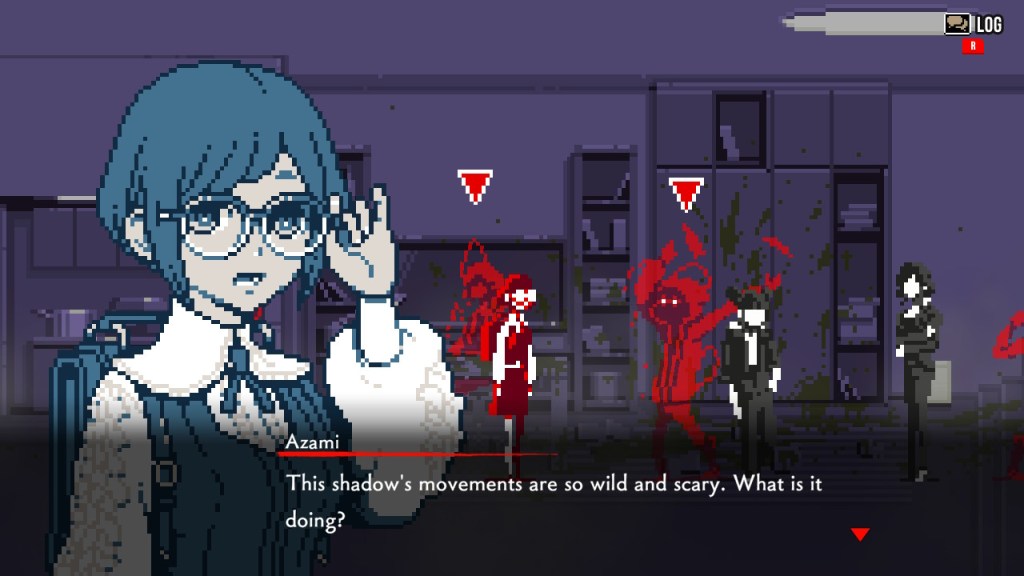
Once you run out of things to check, it’s time to put the glasses on again to see who – or what – was there before, as well as the actions they took. You’ll go back and forth between investigative modes, putting the glasses on and taking them off until you’ve gathered all of the information needed to identify the urban myth affecting the client.
Our dear director doesn’t come onsite with us, but he’ll be there “in spirit” using an ability that allows him to see what’s going on from a distance. When he’s satisfied that you have enough evidence, he’ll give you a call and ask you questions that lead you to develop hypotheses about the urban myth you’re investigating.

You’re given word banks to fill in the blanks for your hypotheses, and Meguriya will also ask some multiple choice questions until you complete the process and identify the relevant urban myth. Each investigation takes place over the course of several days, with identification on the first day and the dissolution on the last day.
For the most part, developing hypotheses and answering the multiple choice questions seems pretty easy (as long as you’ve been paying attention). The word bank sections felt easier because there were only so many options that made grammatical sense for each blank. Even if you do get things wrong, there don’t seem to be any consequences because you can just try again right away.
You do get a notebook to fill in details on people, the urban myths, and case notes that summarize the events of the case so far. I liked how they provided us with so much information; they even included some bonus entries about urban myths unrelated to the cases!
I never needed to refer back to the notebook, but it was nice to have. Personally, I didn’t mind the lower difficulty. I think I was able to enjoy the story and atmosphere more without stressing about “ruining” a playthrough (considering the single save slot and lack of manual saves).
To the best of my knowledge, there’s only one ending. There aren’t any difficulty levels either. For players who do prefer more of a challenge, it may have been interesting to include some “red herring” options such as extra – and irrelevant – clues and word bank options. Perhaps they could have even tracked the number of answer attempts and given you a score at the end.
But like I said, I quite liked the more “chill” gameplay, which contrasts nicely with the chilling events of each case. I didn’t expect the cases and overarching story to go where they did. When they tied everything together at the end, the twist blew my mind. I did have certain theories and unanswered questions along the way, but was still pretty far from calling what actually ended up happening.
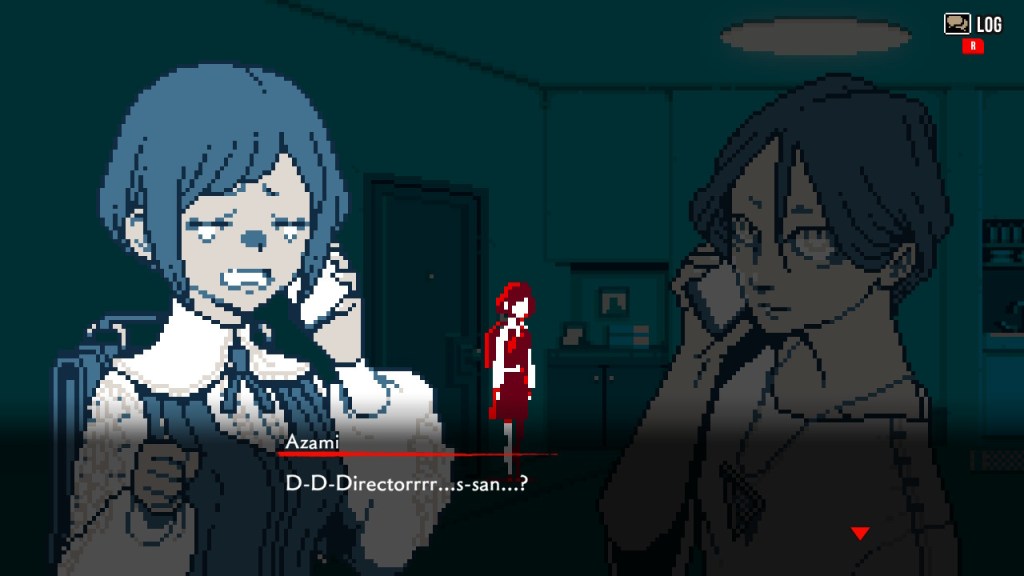
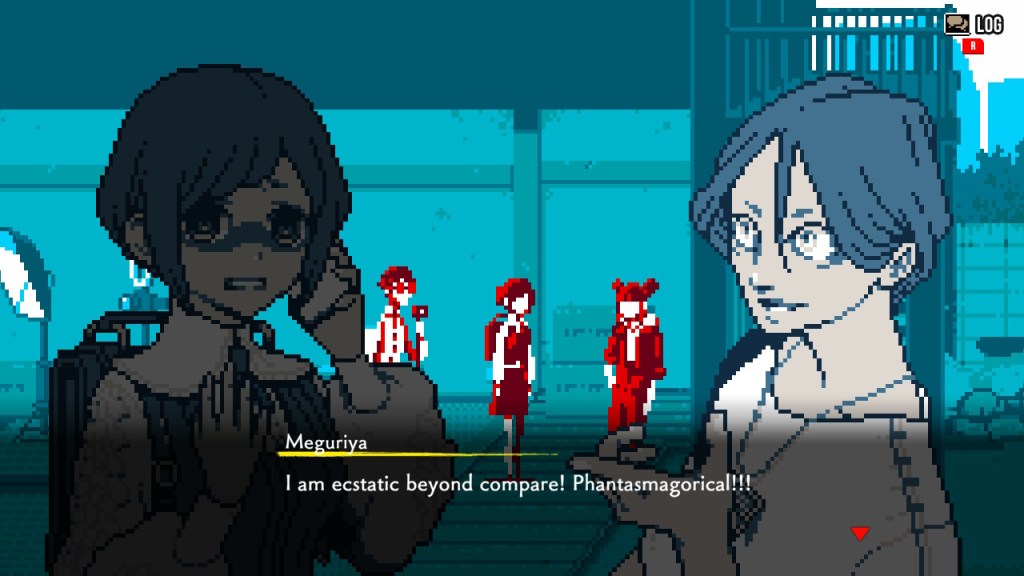
The story is great, and the cast that brought it to life was no less impressive. Azami is such an expressive protagonist – her facial expressions are hilarious. Director Meguriya is amusing in a different way because of how creepily excited he gets about the urban myths. I took a while to warm up to the more aloof Jasmine, but I ended up liking her as she helped Azami despite “just” being a driver.
Overall the writing was very well done. However, for some odd reason the English translation quality suffered greatly in the last scenes of the sixth – and final – episode. Thankfully it wasn’t a widespread issue, and it didn’t affect my understanding of the story’s big reveal in the climax.
Another small issue was the way that the audio occasionally cuts out as the game transitions into another scene. This also wasn’t a major concern, as it didn’t affect the scenes themselves.
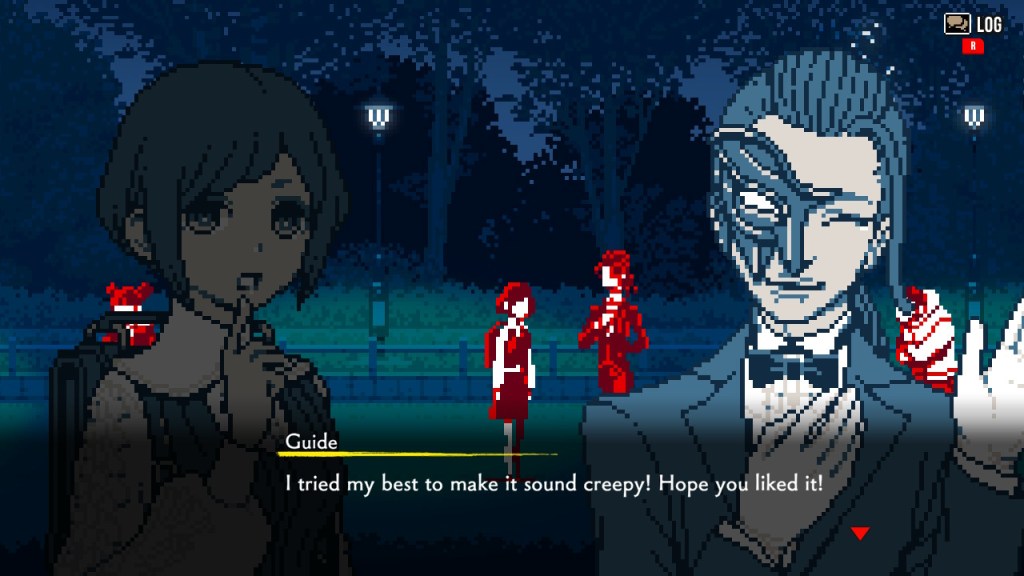
I thought that the soundtrack was excellent; it was very effective in setting the tone of each scene – especially when things get tense. The song that plays at the end of each episode (“KIKI KAITAI”) is so good.
The grayscale “bluescale” color scheme was used effectively, with the occasional pop of red to highlight important details in a scene. I really liked the animated scenes, as well as the cute, brief little animation every time Azami puts on the glasses.
While Urban Myth Dissolution Center has a few minor issues, the fantastic combination of storytelling, music, and art make it easy to recommend. I’d absolutely love to see a sequel or spin-off game.
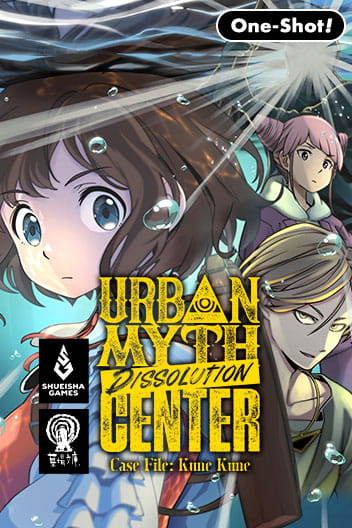
Want more UMDC content? Click below to check out the manga one-shot on Manga Plus!
 Switch It On Gaming
Leave a comment