
- Price: $24.99 USD (currently on sale for $22.49 until February 14th)
- First Citizen Sleeper is $5.99 on sale until February 10th; In Other Waters (diff. series, same dev) $3.74 on sale
- Developer: Jump Over the Age
- Publisher: Fellow Traveller
- Release Date: January 31, 2025
A review code was kindly provided by Fellow Traveller on behalf of Jump Over the Age. We thank them for allowing us to cover something they’ve worked so hard on.
Check out the developer’s recent AMA on Reddit!
After the 2022 release of the critically acclaimed tabletop RPG-inspired Citizen Sleeper, Jump Over the Age has added a second game to the series with Citizen Sleeper 2: Starward Vector. You don’t have to have played the first game to enjoy the sequel, although I would recommend it (especially since it’s on sale right now).
In both games, you play as a Sleeper, a being with an artificial body that contains an emulated copy of a “real” person’s mind. The real version is said to be sleeping in a facility belonging to the corporation behind this technology, which is why the emulated versions are called “Sleepers.”
Apparently, people allow the corporation to copy their minds and install them in artificial bodies to have their Sleeper work to clear their debts and earn money for them while the originals get to chill out and sleep. Sleepers are considered corporate property instead of a being with rights, and are meant to be destroyed by the end of the contract.
Naturally, they aren’t terribly enthused about their working conditions. Our Sleeper characters each escape from corporate control in Citizen Sleeper and Citizen Sleeper 2, but with some differences. The corporation makes it very difficult for any escaped Sleeper to survive for very long.
This is because Sleepers must take a special drug to prevent both their body and mind from deteriorating. Thankfully, this Sleeper managed to remove that dependence while escaping from yet another master. Yet a Sleeper’s body seems to lose its stability when their stress builds up.
When you start a new playthrough, you must choose between 3 difficulty options, which can be changed on the pause menu at your discretion. Safe difficulty is for players who want to focus on the story, and is the mode with the highest stress tolerance. Risky difficulty is the hardest, with very low stress tolerance and double the energy consumption!
There are quite a few ways to increase your stress levels, and you also have to manage your energy levels. You have your own ship to use as a home base at each port, where you can rest to reduce stress and use your supplies (food) to restore your energy.
Each turn is called a cycle, and you lose a certain amount of energy with each cycle; if your energy levels hit zero, you begin to starve, which increases stress levels for every cycle you continue to starve.

To purchase the necessary items for survival, you’ll need to take contracts to earn money. At every new port, you must first use “Dice Actions” to complete tasks that help familiarize you with the local hotspots before you can really get down to business.
Dice Actions are a major part of the game. You get a maximum of 5 dice to use for each cycle, and they can have positive, neutral, and negative outcomes for each action you take. The game also tells you if an action will be safe, risky, or dangerous based on the projected outcome.
Positive and neutral outcomes will add progress to “clocks,” which are meters divided into sections that, once full, will trigger new dialogue or unlock new locations. (Allowing more cycles to pass can also fill some of a clock’s meter.)
Positive results tend to add 2-3 bars of progress to a clock, so of course you’ll want to aim for that instead of neutral (+1 bar) or negative outcomes, which can end up reducing your energy meter and/or add stress to that meter as well. There are different factors that influence the outcome of a Dice Action.
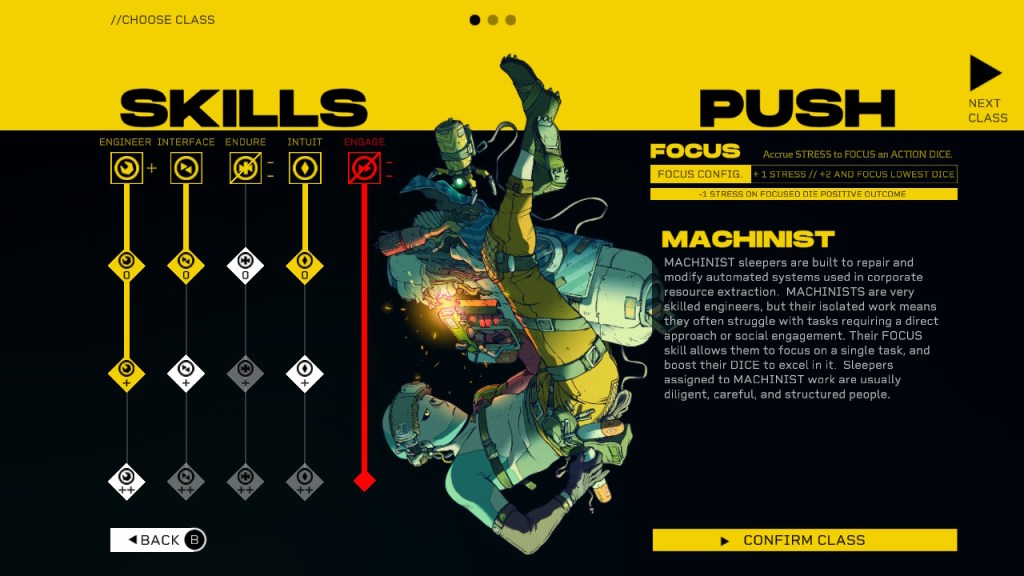
In addition to difficulty levels, you choose between 3 class options at the beginning of the game. They each have their own strengths and weaknesses, starting with a bonus in 1 of 5 skills and permanently denying access to another.
These skills increase your chances of a positive outcome in Dice Actions; the dice with an added color seem to be more successful. You earn upgrade points by completing “Drives,” or major quests, and upgrading your skills increases the value of skill modifiers for Dice Actions.
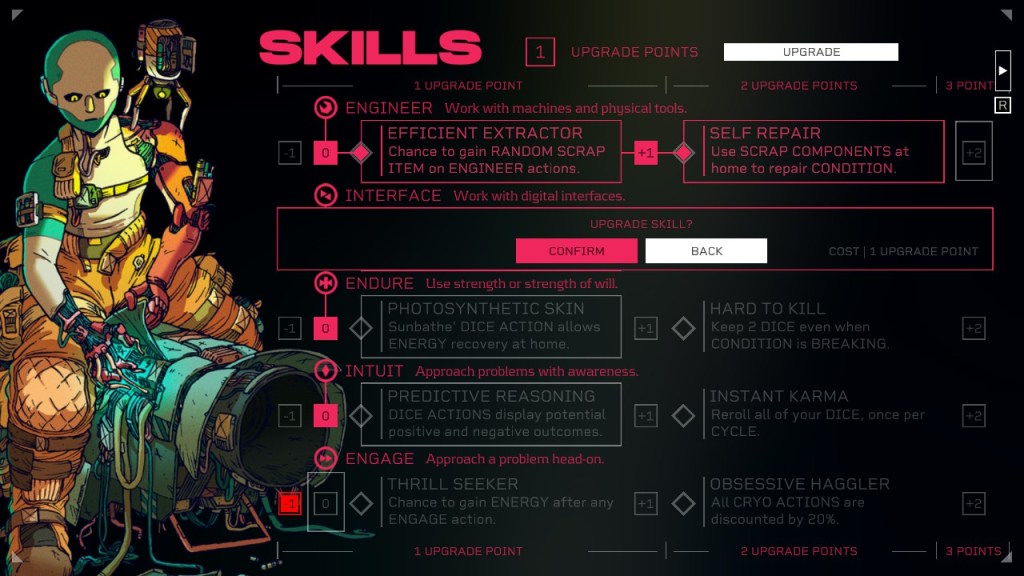
I think I preferred the skills in the first game over the ones in the sequel, as I felt that the upgrades were more helpful and interesting there. You could also fix your weak skill and upgrade it, compared to the new skill tree that prevents that. The sequel’s gameplay is more challenging as a result – even on the lowest difficulty if the dice rolls are against you.
Now, once you’ve used up your allotted Dice Actions in a cycle, you have to return to your ship and end the cycle manually to reroll and get fresh dice. You’re not guaranteed to get all 5 dice in each cycle though, as your dice can break or glitch. This is another way that Jump Over the Age amped up the difficulty for the sequel.
The higher your stress levels, the more likely it is that one of your dice will take some damage; whether you can use a broken die depends on the difficulty level you selected. However, it’s best to repair broken dice as soon as possible to maximize your actions every turn – especially on time-critical jobs.
I wasn’t quite sure if we could restore dice HP, or if we just have to let them break first then fix them. I preferred to get a glitched die over a broken one, as those at least give you a 20% chance of a positive outcome versus no possible action. Glitched dice are likely to appear when you gain glitch levels, which I believe is also connected to stress.
The outcome of regular jobs at a hub is important because you earn more money (and/or materials) with positive results. You’ll meet new people as you explore each hub, and they’ll often offer you something you need in exchange for your help with something; this could be a local job, or they might request your assistance with a contract. Are these people trustworthy? Take them along and see for yourself…
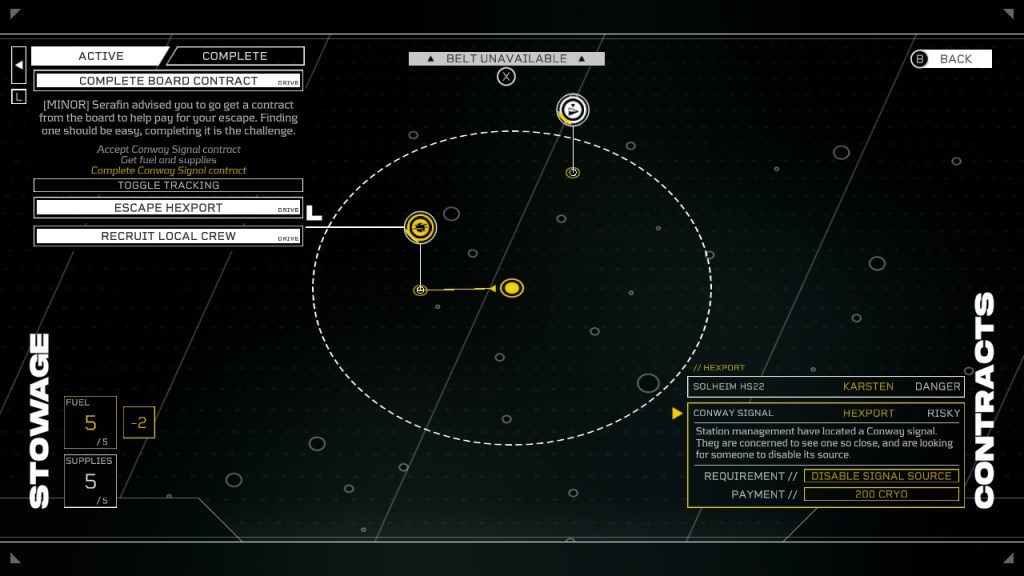
Contract jobs offer high compensation, but they’re much more complicated and risky. You can recruit new (temporary or permanent) crew members to bring on these jobs, and they each come with 2 dice to use per cycle, increasing your actions every turn. (Unfortunately, we can’t use their dice “in town,” and can only use them on contracts.)

Only 2 crew members can come with you on contract jobs. They have different skill specializations and stress meters with varying maximum values. You need to make sure you have enough fuel to get to and from the job, and also enough supplies (food).
If the team goes through all of your supplies before you finish the job, each member starts to take on a point of stress for every cycle that passes. When the contract stress meter completely fills up, you fail the contract.
Additionally, should you mess up on a part of the job that has an individual stress meter, that can trigger a crisis at that location. A crisis adds more stress to the meter until you resolve the issue. Contract jobs can be pretty challenging depending on your luck with the dice.
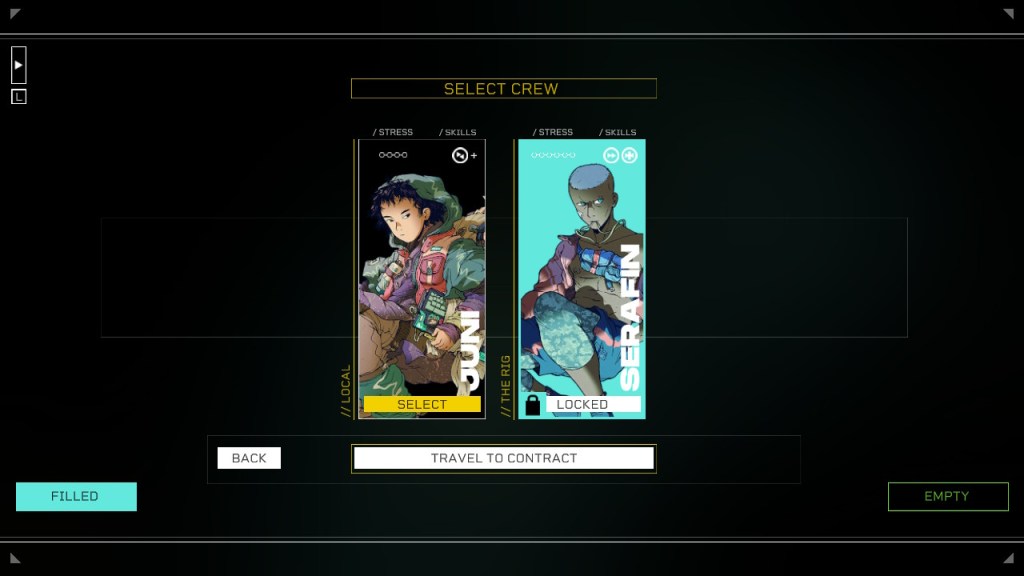
Something I didn’t realize in my first playthrough was that if a potential crew member says they want to come with you, you apparently need to select them for the contract in that area – otherwise you end up rejecting them and possibly not seeing them again? I missed out on 2 crew members/possible plot lines the first time around.
After completing your first contract or two, you end up traveling to the next stop on the “Belt” and starting the process of exploring, working, and meeting new people again. Citizen Sleeper 2 has a more expansive setting than its predecessor, as this time you get a ship that allows you to travel in between locations on the Belt.

When traveling to another node on the Belt, you need to make sure you have enough fuel and supplies – especially since you don’t know if you will be able to purchase or scavenge some more at the new location. The game is a combination of resource/status management, strategy, and a lot of luck.
At first you can only travel to places that are fairly close to your current location – both due to fuel limits and hazards such as debris or asteroid fields. Eventually you get your hands on a HazNav unit that allows you to make it through those debris fields.
It was just really nice getting to make decisions on where to go instead of staying in one location the whole time. And traveling is both engaging and an urgent priority, as you’re still on the run. There’s a clock that indicates how many cycles you have until your pursuer catches up with you, but traveling to a new location slightly decreases that meter, giving you more time.
The system you’re in seems pretty dystopian, with corporations and gangs controlling everything. In both Citizen Sleeper games, I thought that they could have given a more explicit explanation of concepts, entities, and events like the Solheim collapse – perhaps in an introduction or glossary. (What came before Solheim? Earth?)

I think I have an okay understanding of everything, but I’m not great with more indirectly expressed information. The endings also seemed more fleshed out in the first game, which could perhaps be partially attributed to it taking place in one location for the entire story. (I do really appreciate how some familiar faces from the first game appear again, and that we get to hear a little bit about what they’ve been up to since last time.)
Overall though, we really don’t get much closure when it comes to the big picture in the solar system the stories take place in. The corporate wars continue on, and even if a gang loses control over their domain, another will take their place in the power vacuum that follows. The endings cover what happens on more of a local/personal level with our Sleepers and their crew members.
As Kadet so aptly observes towards the end of the game: “We can’t stop these people. We can’t stop the war. I want to build something here, in spite of everything, in spite of the fact that they could take it all away. Because that’s the point. To go on living, without conceding. To go on building, or trying to build, something where we can find it.”
Citizen Sleeper and Citizen Sleeper 2 both tell the stories of people who are just doing the best they can to survive without much of a support system in the harsh conditions of space. All you can do is hope that things go your way (and here we’re at least “lucky” enough to see the probability that we’ll succeed using the dice).
Despite my occasional confusion and desire for closure on the larger scale, I still really like the writing style and ideas in both games. Even when I didn’t quite grasp an idea, I still found it really interesting. I’m honestly sad that there apparently won’t be any more Citizen Sleeper games after this one.
While there are some key differences between both games in the series, they each have their own strengths. Citizen Sleeper 2: Starward Vector is more complex in both its mechanics and its setting, with a slightly longer play time than the first at an estimated time of ~12 hours. If you’re at all interested in the sci-fi genre and/or tabletop RPGs, I would recommend making some “space” on your Switch for both. 😉
 Switch It On Gaming
Leave a comment