
- Price: $24.99 USD
- Developer/Publisher: Love Conquers All Games
- Release Date: September 16, 2024
A review code was kindly provided by Love Conquers All Games. We thank them for allowing us to cover something they’ve worked so hard on.
Content warning: Rated M. Villains using homophobic, transphobic, misogynistic language. Protagonists with self-confidence issues related to gender and sexuality.
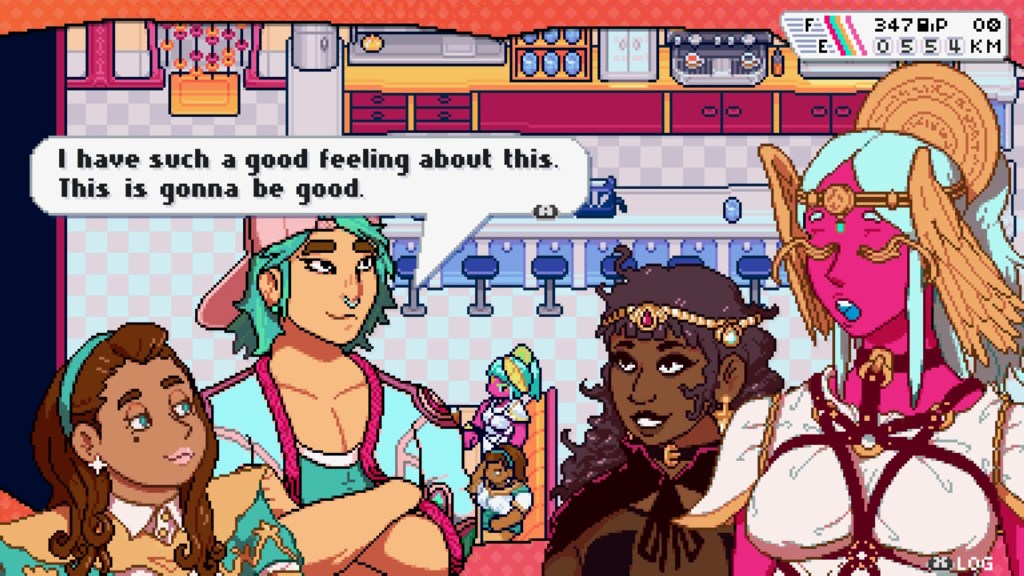
Get in loser, we’re going “e-Shopping”! Lesbian road trip RPG Get in the Car, Loser! is now available on Switch. We’ve been slowly but surely getting more and more LGBTQIA+ content on the Switch console, with varying degrees of focus on members of the community in each of those games. It’s nice to see that Love Conquers All Games went “full throttle” and made gender and sexuality a key aspect of the story in Get in the Car, Loser!.
The premise of the story is that a trans lesbian named Sam is invited by her friend Grace on a road trip. Grace’s non-binary partner Valentin picks up Sam, and Grace suddenly appears and tells Valentin to start driving. The Divine Order is after her because she’s stolen the legendary Sword of Fate.

In this world, the evil Machine Devil must be sealed away using that sword every thousand years. The hero meant to reseal him must first hear the call from the sword. But the cultists who worship the Machine Devil have become more and more outspoken, and want to actually summon him. They’re a major source of hatred in the world, using homophobic, transphobic, and misogynistic slurs against our heroes and others.
The Divine Order refuses to interfere with the cultists or the Machine Devil issue. Fed up with the intolerance and inaction, Grace steals the Sword of Fate ahead of the cyclical schedule and decides to go on this road trip with Valentin and Sam to stop the Machine Devil from rising again any time soon.

As you drive towards your destination, you’ll see 3 lane options that tell you how many regular machine enemies await you in each lane, their level, and how much you cash you’ll earn for that battle.
This allows you to switch lanes and avoid enemies that may be too strong for you. The game displays how many kilometers you must drive to reach the next “event” in a lane, whether it’s a battle or a stop at the gas station.

There are 3 difficulty levels to choose from: Easy, Normal, or a much easier Story Mode for fans of visual novels. I like that we can change the difficulty at any time. Destroy your enemies using the active time battle system, pressing a button (A, B, X, or Y) that corresponds with each of the four party members to use their abilities.
Sam, Valentin, Grace, and Angela each have their own specialties; Sam is the only one who doesn’t have heavy attack capabilities, instead taking on a support role. The other 3 can all use Exploit attacks that deal a lot of damage, but then they have different secondary abilities.
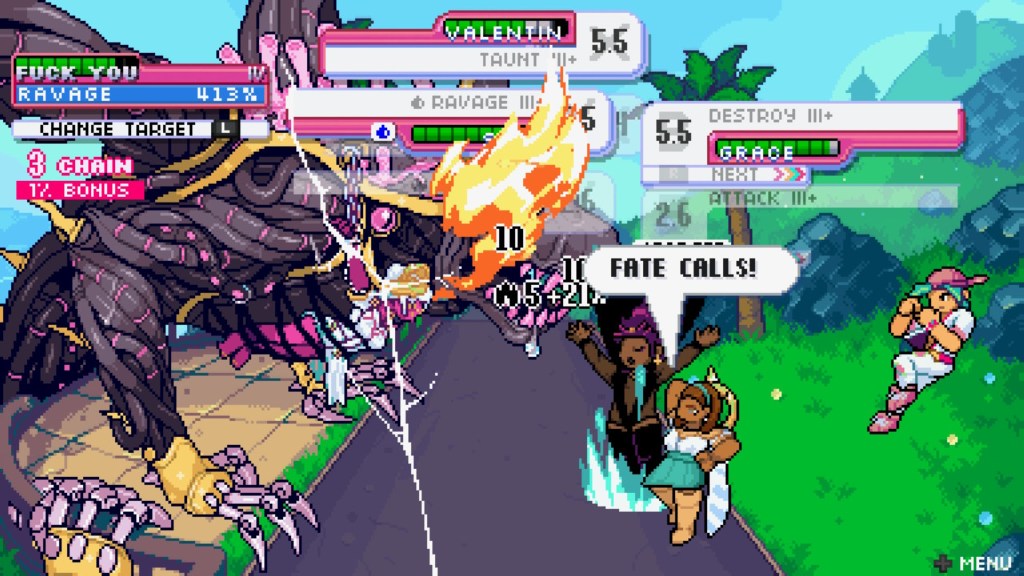
Some enemies are too sturdy to damage without “staggering” them first by using Sam (or Angela’s) Ravage abilities to fill the Stagger Meter until it’s full. Once an enemy is staggered, your party’s Exploit and Destruction attacks’ damage gets multiplied by the meter’s current percentage. The meter eventually goes back down, so you’ll have to repeat the process until you’ve defeated the enemy.
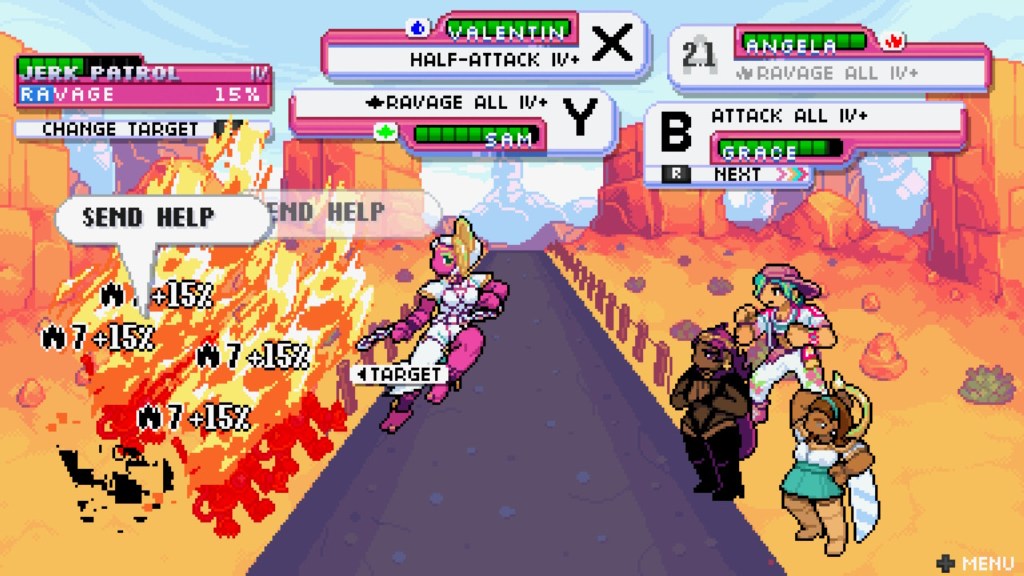
You also need to consider elemental affinities; enemies might have a static affinity that doesn’t change, or they could possess an ability that allows them to switch up their affinities. If you use an ability that’s the same element as the enemy’s affinity, it will heal them instead of doing damage.
Sometimes it can be a bit difficult to keep track of the affinities because the battles are rather fast-paced. Your party members have to wait until their abilities cool down before they can use them again, but you can reset the cooldown period and switch to their 2 other ability sets to attack/heal again right away. I often had to rush to heal injured characters before an enemy could defeat them.
If you feel like you’re about to be defeated, you can always run away. Defeat isn’t the end of the world, though, as you can choose to retry that battle, or you can choose to return to the last healing shrine or gas station.
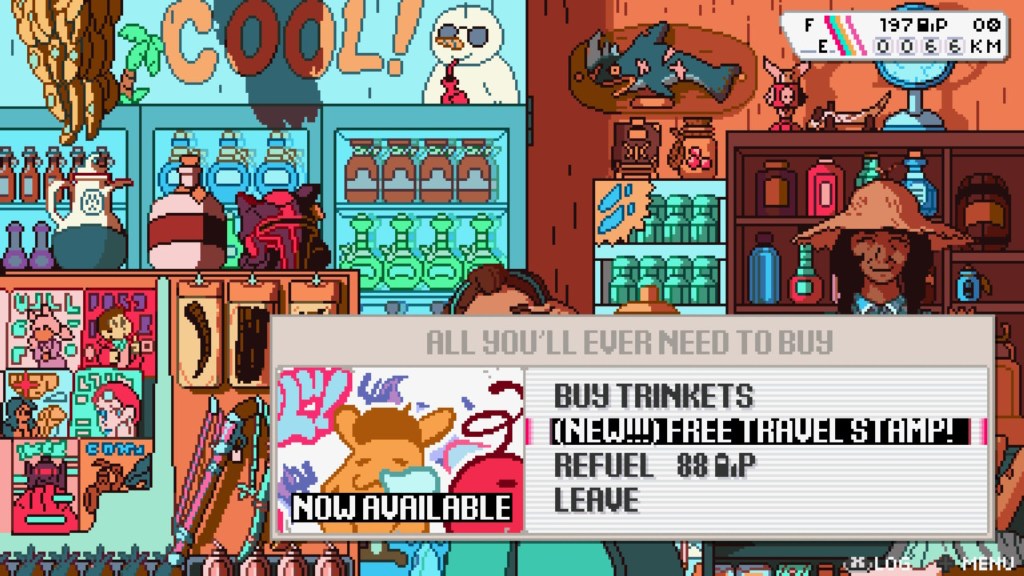
Gas stations are extremely important, so I’d stop at one every time I saw one. It seemed like it did something to my team’s HP if I didn’t refuel. But gas stations also sell consumable items and trinkets, which are the only equipment items in the game.
Party members get different abilities from the same trinket. You buy them in blind bags of sorts that contain 10 trinkets at a time. Trinkets are the way that you strengthen your characters, as you don’t level up in the traditional sense by grinding.

Instead, you must upgrade trinkets by sacrificing other items; this is what increases your party members’ levels and therefore strength. You can only buy higher level trinket packs once everyone in the party has reached the required average trinket level to do so. It takes more sacrificed trinkets for upgrades as you continue to level up.
I thought that the trinket system was a clever way of handling levels, as battles are more limited on the road, so you couldn’t really grind even if you wanted to. What’s also pretty neat is that upgrading trinkets and then using them in battle unlocks entries in the “Lore Bible.” (These entries are a combination of interesting, entertaining, and confusing.)
I do think that the trinkets could have been explained better – I’d been spending more money on higher level trinkets thinking I needed to sacrifice them to get to the next level, but it turns out that you can just buy a bunch of (cheaper) level 1 trinkets to sacrifice instead.
Additionally, while I did like the inclusion of elemental affinities and eventual addition of multi-target abilities, I wish we had some more unique abilities to unlock. Unless a trinket has an affinity, the animation for its ability is a little boring. A larger variety of elemental “spells” or something might have been nice.
There’s a decent variety of consumable items, but you can only equip 5 of them instead of having unlimited access to our inventory. I often forgot to equip new ones after using my items, so this wasn’t my favorite design choice. It does make the game more challenging, which you may or may not like.
It’s a little difficult to make enough money to upgrade all of your trinkets and buy healing items at first. You might want to participate in as many battles as possible to earn more money. (That’s what I did!) It gets easier by the end though – especially when you unlock the ability to complete quests for rewards.
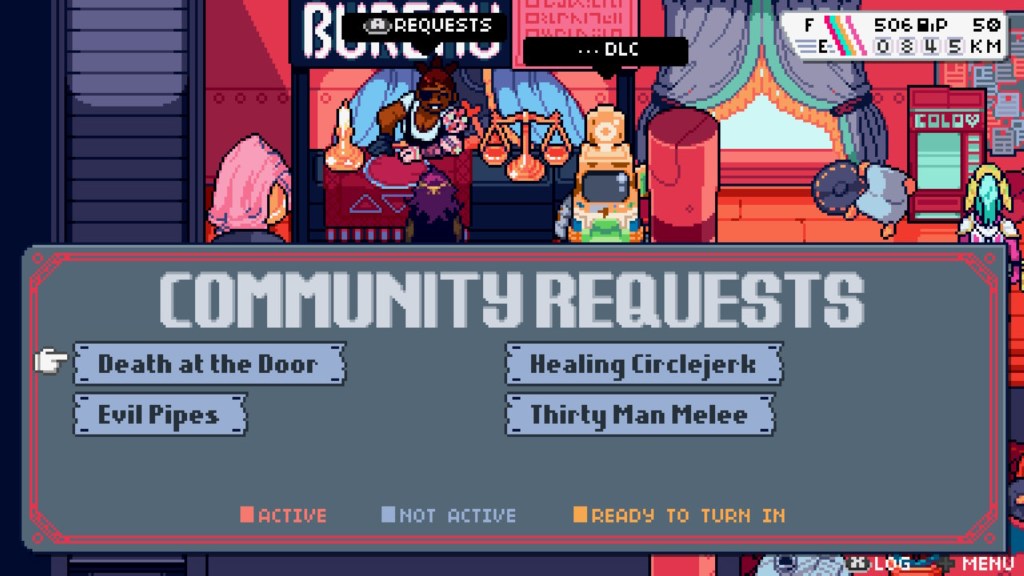
I really appreciated how they clearly indicate if a lane has a quest battle coming up soon. Quests require you to defeat specific monsters, and you earn a special currency, app unlocks, or vouchers for some equipment. The apps are a fun, convenient addition that help keep you fully stocked and in tip-top shape.
Every time you advance the dialogue, you move forward another kilometer and get closer to the next battle or gas station/quest giving location combination. It took some focus to pay attention to the content of upcoming lanes and the conversations, but I managed.
I really love how they described this game as “The Disaster Lesbian Representation We Need.” A lot of the dialogue does have to do with the party members’ genders and sexualities; Sam and Valentin only know Grace in the beginning, and Angela is new to everyone. They’ll get to know each other more on this road trip.
Discussing these factors is important because it allows them to relate to each other more not only in terms of their internal struggles and breakthroughs, but also the external issues like the harassment they face physically, mentally, in person, and/or online.
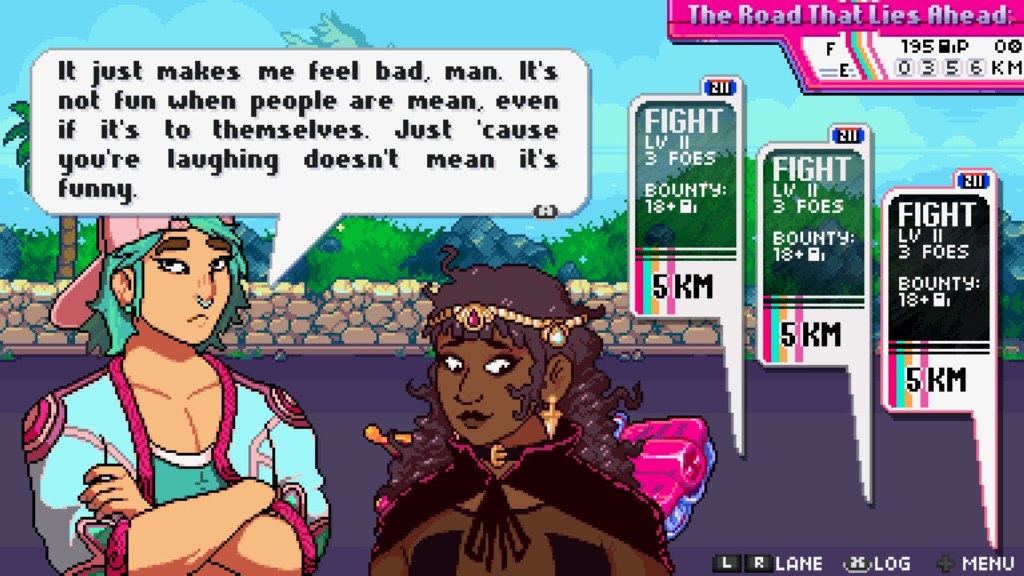
Sam seems to be the main character of the story, and she struggles greatly with her confidence (related to her gender, sexuality, and otherwise). The writing explores the way that the others appear more self-assured in comparison. That doesn’t necessarily mean that they really feel that way.

However, we get to experience more of Sam’s insecurities than the others. She’s effectively fighting herself in addition to the Machine Devil and his followers, who represent outdated thinking full of irrational hatred.

The subject matter is certainly addressed in a serious manner in many scenes. Yet that doesn’t mean that the characters are devoid of humor. The dialogue is often fun, flirty, and funny, too. I laughed a lot.
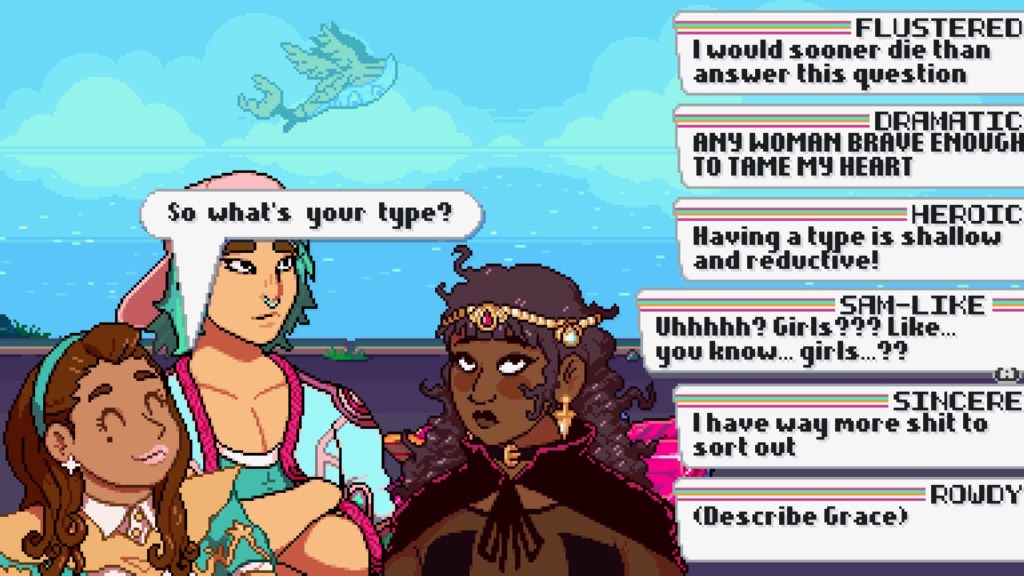
I thought they did a nice job of balancing the serious aspects with the entertaining moments. You even get a few opportunities to make dialogue choices based on different emotions, so you can choose to have Sam respond sincerely or in a silly, overdramatized tone.

This version of Get in the Car, Loser! includes the DLC episodes as well. There’s a carefree beach episode, and then the second episode takes place in a more grim setting. I do tend to enjoy happier storylines, but I thought that the second DLC was better because of its more interesting story and mechanics.
Including the main game and DLC, it took me about 12 hours to beat the game. Besides a couple of crashes, it performs pretty well. My main issues were that some aspects needed better explanations, and sometimes there are difficulty spikes in odd places (the boss in Act III was much harder than the final boss).
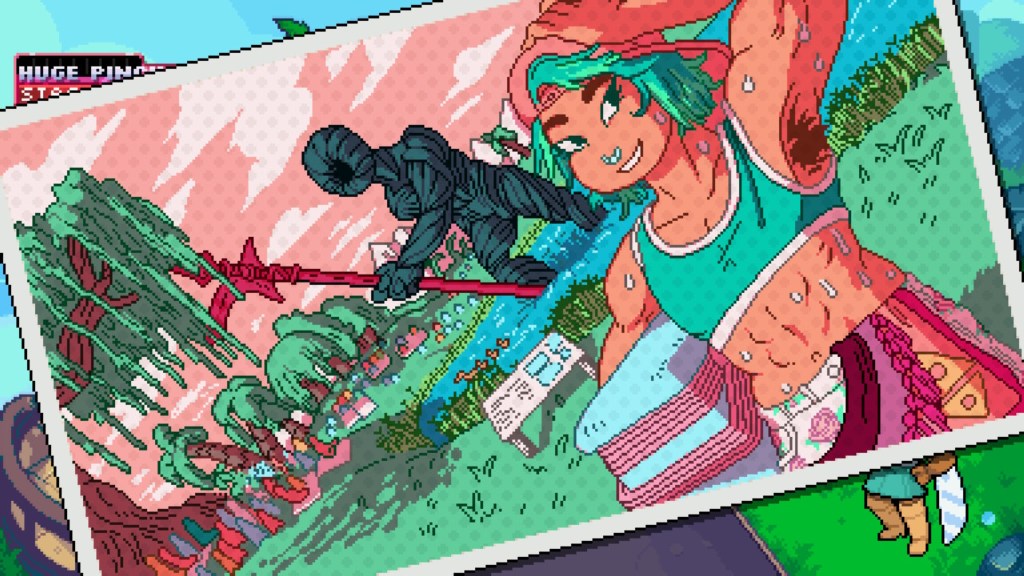
Overall I enjoyed my time with the game. It’s got great representation and themes, and I liked the characters. I liked the colorful graphics style; the character models and portrait art were visually appealing to me, and they even included some photos from the road trip on the post-battle screen, which was a nice touch.
The music was one of my favorite parts, with some incredibly catchy songs with lyrics playing during battles. Another cool thing about the game is that there are guest writers – including Toby Fox (Undertale, Deltarune) for part of the beach DLC – plus a cameo from Russian Subway Dogs.
Get in the Car, Loser! has some room for improvement here and there, but I think it’s a great experience for players who are able to play M-rated games. It may focus on important LGBT+ issues, but regardless of how you identify, many players can still relate to Sam’s struggles with self confidence and worries about social interactions.
I’d love to see more from Love Conquers All Games in the future – perhaps a mixture of M and T-rated games so that some younger players could access their LGBT+ positive content as well.
 Switch It On Gaming
Leave a comment