- Price: $24.99 USD (digital); $34.99 (physical)
- Developer: Studio Kumiho
- Publisher: PM Studios
- Release Date: September 19, 2024
A review code was kindly provided by Team Critical Hit on behalf of Studio Kumiho and PM Studios. We thank them for allowing us to cover something they’ve worked so hard on.
Content warnings: The game “contains material that may be upsetting for some,” with “many parts…presented in a lighthearted and uplifting tone” based on the development team’s personal experiences. Possible triggers include terminal illness, death of a parent, racism, bullying, abuse, neglect.

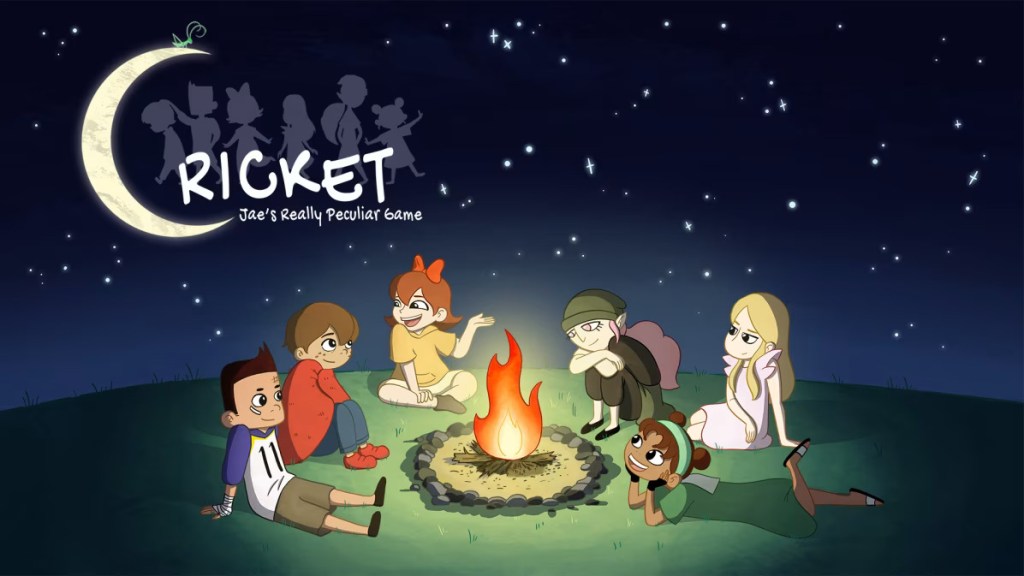
I’m always down to try new JRPGs, and the hand-animated graphics in Cricket: Jae’s Really Peculiar Game reminded me of the great cartoons I watched as a kid. Covering some heavy topics from the perspective of children, the game begins with a focus on the titular Jae, a young boy who has recently lost someone.
Jae’s good friend Zack drags him out of the house one day, and something happens that requires them to chase after some sentient flowers. The boys are disrupting the flowers’ secret plan. (And they would have gotten away with it, if it wasn’t for those meddling kids! 😂)
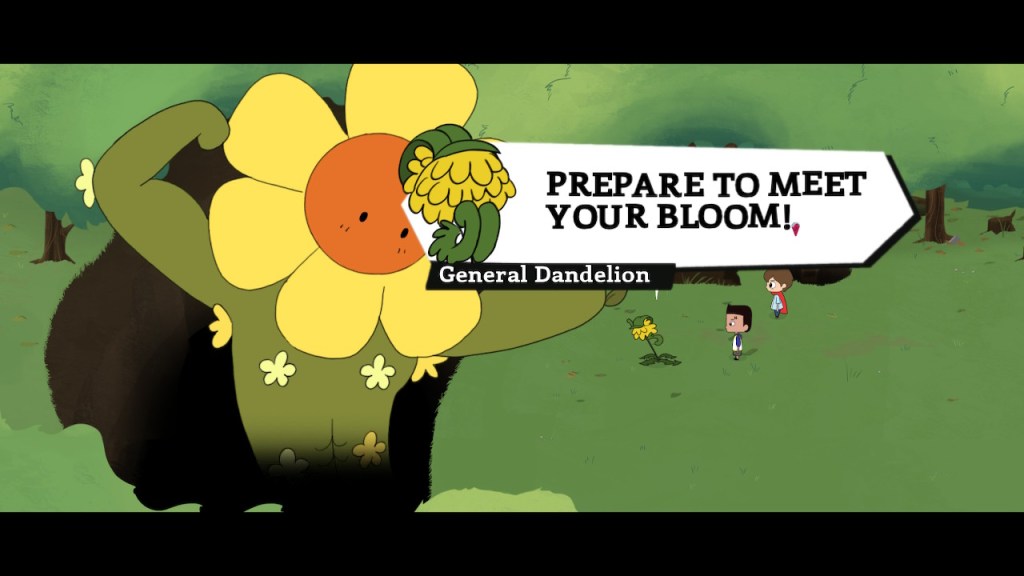
As the game’s title would suggest, we’re in for a weird time in this world. I’m all for it! You have to fight the flowers and many other quirky (yet “oddly” adorable) enemies as you make your way to your final destination. Battles are turn-based with timed-hit mechanics.
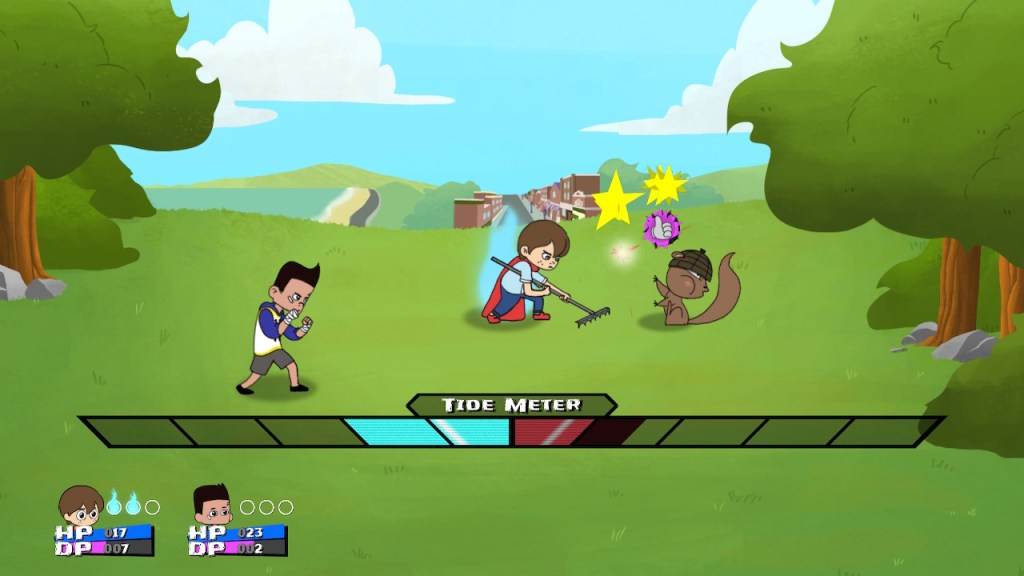
Enemies appear on the map, so there aren’t any random encounters. If you sprint and slam into them, you catch them off guard and they can’t act for a turn. You choose what moves each party member will use every turn. When a character attacks or defends, you can press A for the timed-hit prompts (or B to increase/reduce damage even more).
Using an ability to attack individually builds up the “Tide meter,” which can be used to deal more damage, make status effects last longer, and slow down time. Teaming up with party members to attack uses up some of the Tide meter.
Enemies also have access to this meter, although I don’t remember them ever really using it to their advantage. The meter doesn’t maintain its charge after each battle, so it’s best to use it when you have it.
At the end of each battle the game rates your performance based on how many times you blocked attacks, missed hitting the target, and more. You level up as a team instead of individually, and each party member occasionally learns a new ability (such as healing) when the team levels up.
I found character-specific tokens around the maps, which are said to have something to do with learning skills, but it was never explained so I have no idea how they work. But I really appreciated the team leveling mechanic – especially because it means you don’t have to grind to get new party members up to the same level as the others. That’s a definite plus for me!
Separate from the team level, there are also friendship levels to take into consideration. I’m not certain if friendship levels require a specific number of battles or defeated enemies, but at the end of some battles the friendship between characters will become stronger.
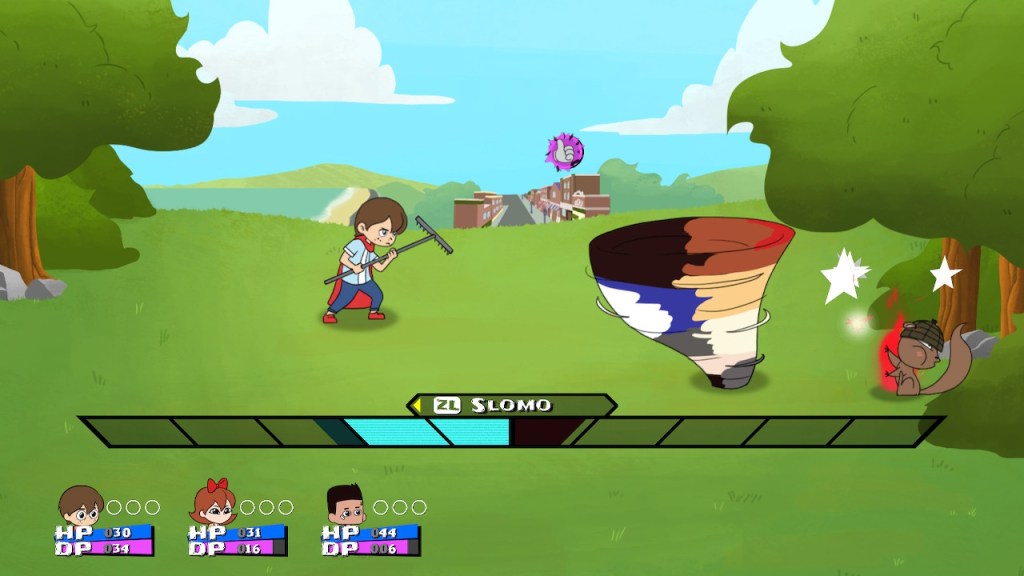
They don’t explain friendship levels, but it seems like party members learn new team up abilities as they become closer. These abilities are stronger than anything they can use by themselves, including both attack and healing team ups.
You do have to grind for friendship levels when new characters join you. I switched up my party a lot to make sure everyone had around the same friendship levels with each other. Characters in your battle party seem to level up their friendships separately from the characters “on the bench,” but those not participating in battle will still level up their friendships with other inactive party members.
Despite the timed-hit components, I think this is a pretty accessible game. The timed-hit mechanics are important to deal more damage (and take less), but I don’t think it’s a huge deal if you aren’t good at them. I have fairly poor instincts and dexterity myself but managed to do okay. There’s also an automatic win feature under tactics in battle (which I found close to the end 😅).
You can only use 3 party members in battle, but over the course of the game you meet 4 new characters besides Jae and Zack. I absolutely loved the way they animated them in battle, armed with “weapons” such as a rake or traffic cone. The way that enemies react to your attacks is pretty funny, too!

New equipment can be found by searching every nook and cranny of the maps. The maps aren’t too big so it doesn’t take very long to find the treasure stored in some very familiar blue cookie tins. (I love their “treasure tins” so much.)
Other equipment and healing items can be purchased in a store, coffee shop, or vending machines in town. I really like the characters who sell you these items – especially the one who sells equipment. The game takes place in a world where talking animals is normal, and they also created different countries and cultures.

It’s fun to talk to people around town. I picked up on a few references that made me laugh (like the one about a certain coffee commercial). At first glance, this might seem like a kid’s game. But as an adult I found the writing quite entertaining.
One character has an ability that references Happy Gilmore without explicitly stating that’s what they’re talking about. There are a lot of subtle references and jokes for adults to appreciate too. Thematically this reminds me a little of Ni no Kuni, while the clever writing reminds me of Gravity Falls and/or Phineas and Ferb.
They incorporated additional hijinks in the form of the “Notoriety Meter.” (This was another element that wasn’t explained in the game; I only found it when I was looking at the Steam page.) If you walk away from someone mid-conversation, slam into them while sprinting, or throw something at them, the meter goes up.
When the Notoriety Meter is full, enemies get stronger and you earn more experience. This meter will decrease as time passes. The development team apparently wanted to add the ability to mess with NPCs – which is pretty hilarious – but it also ties into the battle system.


There are a lot of great, convenient features in the game. The old school cell phone menu was a cute touch, and they also pin current objectives to that menu. Having a mini map was helpful, although I wish it was a little more detailed for some areas.
I only had a couple of complaints; for one, the saving system. Similar to Earthbound, you can only save at a pay phone. This would be okay if the game didn’t crash sometimes. It only crashed about 6 times in the ~14 hours I played, but it’s still inconvenient and upsetting to lose progress. And there isn’t an auto save feature, either. (The good news is that the maps are fairly small and you can skip cutscenes you’ve already seen.)
Other than that the frame rate and overall performance seemed fine to me. My primary issue was that some systems aren’t explained at all, but it’s not to the point that you can’t figure out most of the game mechanics.
Cricket: Jae’s Peculiar Game does a lot right in my opinion. I appreciated the partial voice acting and whimsical music. The art style makes me smile, and so does the writing. As mentioned in the content warnings, it does cover some serious topics. There are a lot of family/social issues and insecurities among this group of kids.

I thought they did a good job of handling these issues in a kid-friendly way. Some adults still struggle with a lot of issues mentioned in the game. It’s got a relatable message about overcoming insecurities together and growing as people, and it’s wrapped in a cute, cartoonish, and lighthearted package. I’m a fan of what they’ve done here, and would love to see a sequel with Jae and his new friends.
 Switch It On Gaming
Leave a comment