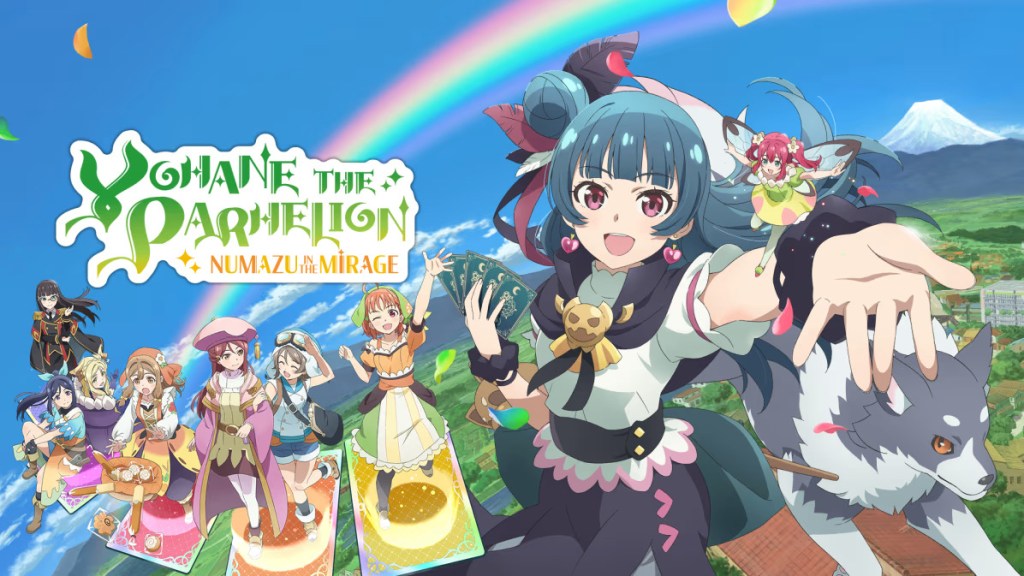
- Price: $29.99 USD
- Developer/Publisher: BeXide
- Release Date: February 22, 2024
A review code was kindly provided by BeXide. We thank them for being able to cover something they’ve worked so hard on.
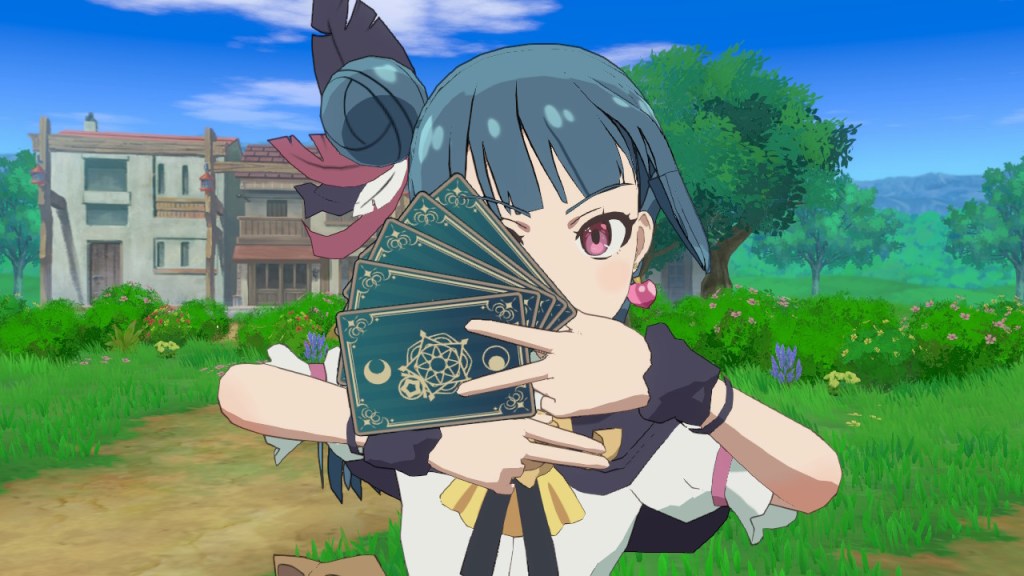
I reviewed Yohane the Parhelion -Blaze in the Deepblue- back in November, a 2D Metroidvania game based on the Love Live! Sunshine spinoff. Now Yohane returns to Nintendo Switch in Yohane the Parhelion -Numazu in the Mirage-, a roguelite deck-building game. Is repelling the “DARKNESS” in the cards for Yohane?
Yohane receives a mysterious mirror as a reward for helping someone. Her fortune telling isn’t going very well, so at a get-together with her friends she announces a new fortune telling idea that’s based on a popular book. Her friends aren’t sure about her using such an obvious inspiration, but wish her luck anyways.

After Yohane’s party, she runs into Hanamaru, who has fallen ill. Lailaps helps her home as Yohane gathers items to help her feel better. When Yohane attempts to use her fortune-telling to find out why Hanamaru is sick, she’s suddenly sucked into her new mirror! She notices that she’s in a Reverse Numazu where everything is backwards! To return to her Numazu in the real world, she’ll have to explore and find the way out.
Fight against the “Nightwicked” monsters in each area using a deck of cards you acquire along the way. There are 3 difficulty options:
- Normal: no additional charms
- Easy: start with the “Pyosuke Badge,” which gives you +30 Max HP, +1 Energy, +1 Attack, + 1 Defense, +1 draw permanently
- Very Easy: start with the “Hime-Poyo Badge,” which gives you +50 Max HP, +1 Energy permanently, +2 Attack, +2 Defense, +2 draw permanently
Some requests are unavailable in Easy & Very Easy mode, so I decided to play in Normal mode. I like how we can change the difficulty level in between dungeon sessions.
After Chapter 3, you unlock a second battle style. The Style Select screen gives you the choice between Balanced Style: “a flexible, all-around play style that selects your hand according to current battle conditions” or Power Style: “a high impact play style that prioritizes combined card effects to bring out their ultimate firepower.” I think I generally preferred Power Style.
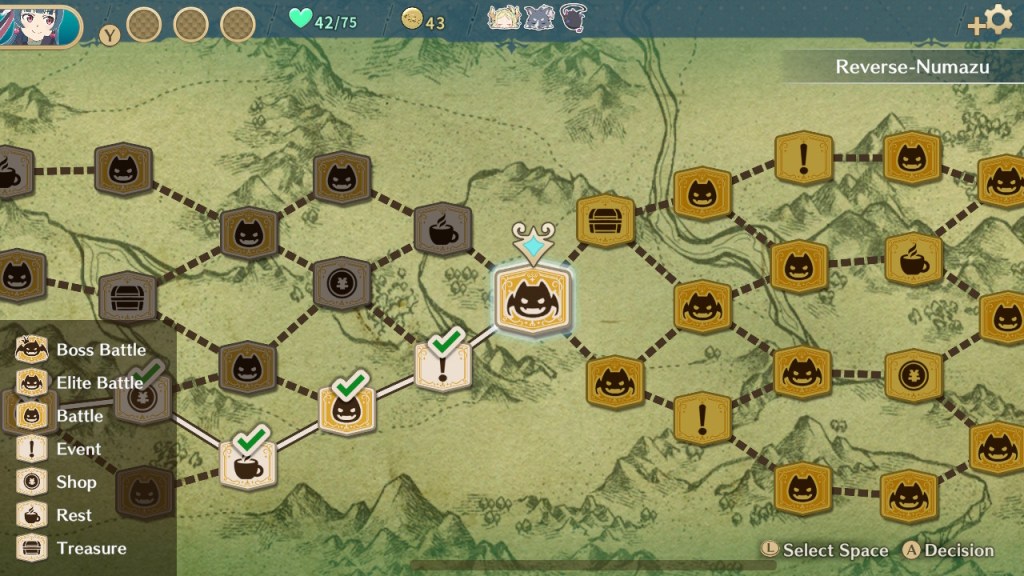
Every time you enter Reverse Numazu for a new run, you get a new map. You get to choose which direction you go on the map, with square options including:
- (Regular) Battle
- Elite Battle
- Boss Battle (one at the end of each section of Reverse Numazu)
- Event: Some have positive or negative effects depending on options and the choices you make
- Shop: purchase new cards and Charms, remove cards from deck with disposal service
- Rest: restore some HP or upgrade 1 card
- Treasure (3 rarity levels)
You start each run with 12 cards; this starter deck includes 1 Summon Card and a random assortment of 11 Magic Cards. Summon Cards are special – and powerful – cards with unique effects that last a certain number of turns, and each time you get one it can only be used once. Using multiple Summon Cards at once may result in bonus effects depending on which combinations you use.
Regular cards remain in your deck for the entirety of a run unless you dispose of them at a shop. Each time you start a new run, you get a new deck and you only start with charm(s) associated with your costume and/or difficulty level. Your funds do not carry over between dungeon attempts.

Combat is turn-based using these cards. You get a small pool of energy points to use on regular cards (Summon Cards cost nothing to use). Cards usually cost 0-3 energy points to play, but there are some with larger costs. Card costs may fluctuate depending on their requirements.
Your energy points are restored every turn, but not your Shield value. The Shield effect reduces the direct damage to Yohane’s HP, but the Shield value reverts to zero at the beginning of each turn. It’s important to balance your attacks with shielding against the enemy onslaught; you can figure out what you need to do by glancing at the icons next to the enemy’s HP bar.
These icons show you what the enemy will do for their next turn. The sword icon displays the number with next turn’s attack value, a heart indicates that they plan to heal, arrows for buffs/debuffs, etc. You can move the cursor over to the icons to see what they mean. This might take some of the challenge away for some players, but I liked being able to see their next moves and plan accordingly.
Considering whether you should make sacrifices for greater rewards is a key part of the game. Certain charms have negative effects alongside the positive ones, and some cards will damage your HP or add cursed cards to your hand in exchange for some benefit(s).

It’s not a necessarily a good idea to only use your attack cards – especially because healing is limited. There’s a fairly decent variety of attack and shield cards, positive and negative effects in one card, etc., but outside of the occasional rest square or one of the Summon Cards, I can only remember one or two regular cards that provide any healing.
Rest squares have you decide if you want to have some HP restored, if you want to upgrade one card, or if you want to skip over either option. You can make up for a lack of direct healing options with certain Charms acquired as battle rewards, purchased from a shop square, or discovered on a treasure square.
There seems to be no limit to the number of Charms you can have active in each run. Like your enemies, the Charms are all really cute! But don’t let the cuteness fool you – the game does pose something of a challenge to its players. I was defeated many times in Normal Mode and had to start a new run each time. This means you have to go through every section of Reverse Numazu and defeat every boss in that chapter all over again.

You don’t level up Yohane, and only keep permanent HP upgrades obtained from exchanging points for rewards. Completing requests will provide you with points to purchase permanent rewards such as new cards, charms, or costumes that can be used in future runs. Or you can use points on temporary bonuses for one run (such as extra starting money).
Some bosses – or even just elite enemies – can hit you pretty hard; the ones who can bypass your Shield to attack your HP directly and the ones who can take away your ability to use shield cards for several turns are the enemies to keep an eye on. I think it’s probably best to increase your HP before purchasing the other rewards.
I really appreciated how challenging the game could be. However, I had a few issues with the game design. For one thing, there are a few bosses that make repeat appearances in subsequent chapters. I wish there was more variety there.

My biggest issue was that it can get a little “grindy” when it comes to the requests and rewards. By the time I beat the game on Normal difficulty, I still hadn’t unlocked several cards, charms, and costumes from the request rewards. You need to earn 20,000 points for the Witch costume, and the “China Dress” costume requires 30,000 points. The card and charm points requirements are manageable, but the costumes seemed excessive.
I like being able to continue playing after the credits, but considering that there’s no post-game story content or New Game+, it can be difficult to justify continuing the game for the rewards you haven’t unlocked yet. You can view the story events again on the main menu under Challenge Record -> Story, but I would have liked an option to replay the chapters with the story included in the dungeon run.
As far as the writing goes, I enjoyed Yohane’s interactions with her friends, and I loved the glorious puns. The actual dialogue seemed like it was well-localized, but there were a few issues with some minor details. One or two things were left in Japanese (i.e. チャーム when choosing from 3 charms in battle rewards and スキップ in end credits) but that doesn’t really affect the game at all.
Where it can get a little confusing is with a couple of card and request translations. For example, some requests ask you to “add more than 3 [character] cards to the deck, ” which makes it sound like you just have to have them in the deck. But it seems like you have to use 3 different cards related to that character in one battle instead of merely having them in your deck. Another example would be the Chant card, which says it does “8 damage to the whole body” – meaning 8 damage to all enemies.
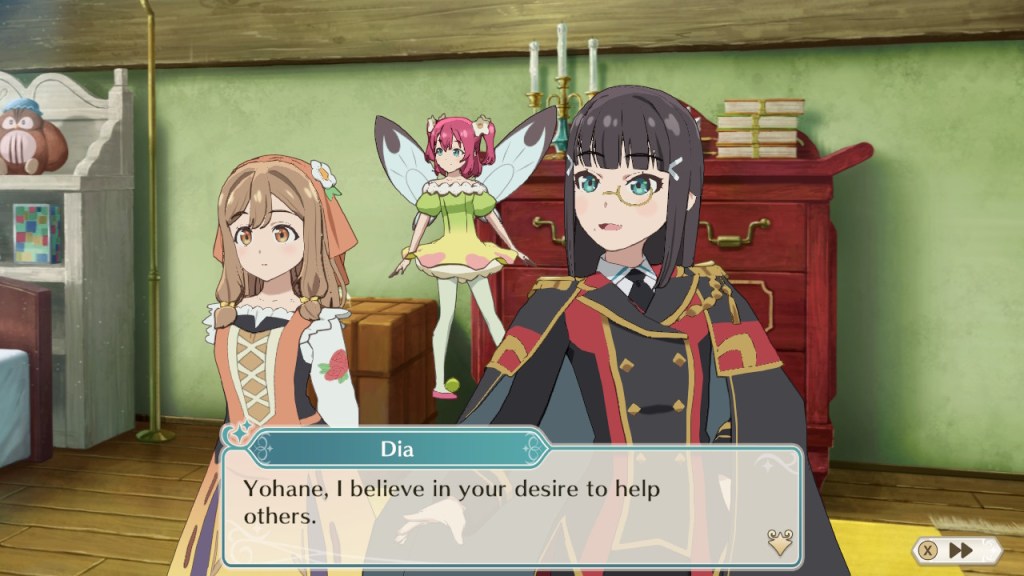
These issues didn’t prevent me from enjoying the game overall, though. The story was rather short (compared to the longer deck-building play time) but worked well for me. Similar to –Blaze in the Deepblue-, I don’t think you need to be familiar with the Anime to play this (although that would surely enhance the experience). Pre-existing fans of the series will no doubt rejoice that they can “do their Rubesty” to help Yohane and her friends!
Yohane the Parhelion -Numazu in the Mirage- is a pretty decent deck-building game, in my opinion. I loved how they gave players so much choice, from the squares you choose in Reverse-Numazu to the difficulty levels, multiple play styles with different cards in each deck, costumes, card and charm purchases, etc. You need a combination of good strategy and luck to succeed.


It’s a challenging yet charming game that does a good job of setting the tone for scenes with expressive animated models, voice acting, and a pleasant soundtrack reminiscent of the music heard in Atelier games. I think it’s great that they’re branching out with different genres for these Yohane games. I’d be interested in seeing a visual novel or tactics RPG next!

 Switch It On Gaming
Leave a comment