
- Price: $14.99 USD (currently on sale for $13.49 until December 29th)
- Developer: Softstar Entertainment
- Publisher: eastasiasoft
- Release Date: December 8, 2023
A review code was kindly provided by eastasiasoft on behalf of Softstar Entertainment. We thank them for being able to cover something they’ve worked so hard on.
Content warnings: Heavy religious themes (including questioning of one’s faith and attacking “heretics”) as well as depictions of war and slavery.
We’ve previously reviewed Sword & Fairy Inn 2, another Switch game developed by Softstar Entertainment and published by eastasiasoft. They’ve joined forces once again with Xuan Yuan Sword: Mists Beyond the Mountains, a Chinese turn-based RPG in which Eastern and Western cultures collide.

The story opens in 749 A.D. in Venice. The Pope has launched a crusade against so-called “heretics,” which has decimated the city’s foreign merchant population with religion-based executions. A man named Septem aims to free some Arab merchants held in Venice because he needs their sailing skills. As an intelligence agent for the Frankish Kingdom, Septem has been tasked with traveling to “Arabia” as they allegedly have superior strategies for winning wars.
As you infiltrate the prison where the merchants are being held, a frail old man in the cells summons a demon who Satan has ordered to serve Septem for some reason. Conveniently, Septem happens to have a special heirloom that allows him to tame and fuse demons. That will certainly come in handy as you travel the world throughout the game!

You won’t rescue the merchants and make it out of Venice without a fight, though. Combat is turn-based with an Active Time Battle gauge for each character in your party. Your party starts out small, with only Septem and Nicole – the demon summoned on his behalf – as active combatants you can control.
When I read that the game involved capturing and fusing demons, I was pretty excited – especially since the description talked about combining both Western and Eastern mythologies. Unfortunately, I don’t think that they explained the mechanics very well for these systems.
Decreasing an untamed demon’s HP helps you tame it, but it almost seemed like there was some unwritten level requirement for capturing some of them. (Also, not every enemy will be a demon you can tame, which is indicated by a red X when you attempt to tame it.) From what I could tell, once you’ve captured a demon once, all future attempts will succeed. I kind of liked that, and I also appreciated that we can tame multiple demons in the same battle.

It actually took me a while to realize that you do not directly use the heirloom item to fuse demons. Instead, you do so from the item section of the menu. You can fuse demons, items, and/or equipment together. Initially you’ll only have access to the “Western altar,” but as you travel eastward you’ll eventually unlock the Eastern one as well. This could have been a really interesting system, but ultimately it felt like the fusion results didn’t change too much between the two altars.
It was odd but kind of cool to see some demons fuse together to become an item instead. But I often saw Demon A and Demon B result in…Demon A again? That didn’t make much sense to me. I didn’t understand the rules behind fusion – what affects the end result?
For example, I determined that switching the side you place a demon on (left vs right, unrelated to Western vs Eastern) seems to affect the end result. Does combining different demon categories (i.e. devil or fairy) affect the process? I have no idea.

I do have some positive things to say about the fusion process. I thought the demon designs were lovely, although there were a decent amount of demons with similar designs but in different colors or sizes. It was also nice to see previews of fusion results before committing to a combination instead of having to guess.
Sadly, the lack of explanations extended to actually using your tamed or fused demons. I don’t remember them explaining that you can equip two demons per character, or how equipping them affects your stats and abilities. Unequipped demons remain in your inventory, and function as “one time use” items in battle.
Due to a lackluster implementation of the demon system, battles can get a little boring. I also found that the majority of the enemies I faced posed little threat to me. There’s an auto battle function, and I often found myself using it because of how easy the fights were.
The game doesn’t include different difficulty level options, but there’s a high encounter rate that no doubt compounds the lack of difficulty if you don’t flee some battles. You can’t reduce the encounter rate, and you also can’t speed up battles. Your party’s sprites – and those of your enemies – actually move forward and have blinking/attacking animations, which is at least a nice touch.
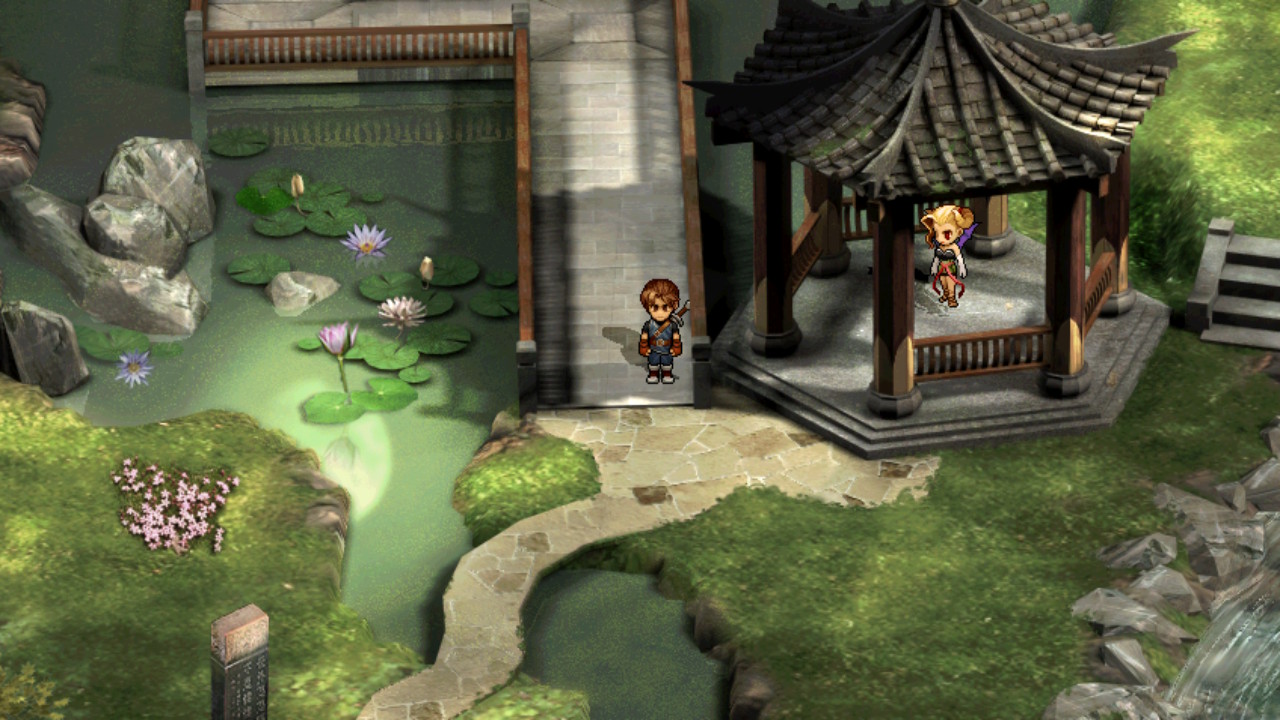


For me, the graphics are one of the game’s major strengths. They may not appeal to everyone, but I liked them a lot. The animated cutscenes were okay (given that this was originally published in 1999, I’ll give them a pass here). But the character and demon art plus the environments really appealed to me. I loved their depiction of each culture’s architecture!
I can’t speak to the accuracy of the historical setting, clothing, etc., but I absolutely appreciated that the plot was at least based on important events and places in the real world. History has always been one of my favorite subjects, so it’s great to see the way it inspired this story. That being said, the translation quality leaves something to be desired.

I understood the basics of the story, but the translation doesn’t allow the reader to fully understand the concepts or events they’ll come across. There are errors in the basic English, so understanding any complexities in the characters and plot will be even harder. Septem does occasionally have some lines that still made me laugh despite the awkwardness of the translation, but other than that they don’t manage to inject much personality.

There are also some side quests, which mainly consist of NPCs asking you questions. This would be fine – if it wasn’t for the math. Multiple characters ask for the answer to riddles containing fractions (often without common denominators), which…are not my strong suit in these scenarios.
Honestly, I Googled most of the questions, and used a Chinese Steam guide for a music puzzle. I was so happy when they threw me a bone and asked who betrayed Jesus. On the plus side, they’re multiple choice, but there are a lot of multi-step answers for the math riddles. And they repeat the lengthy question prompts before you can try again.
The game crashed occasionally, but that was mitigated by the helpful auto-save slot. I managed to complete most of the side quests as I traveled the world and met new characters. Xuan Yuan Sword: Mists Beyond the Mountains isn’t a bad game, but it fails to live up to its potential. Certain plot elements – such as Septem’s supposed powers – felt like an afterthought. The abrupt ending was a bit disappointing, in my opinion.
I think if they took the time to fix the translation and riddles, update the user interface, and add some modern quality of life features, it would come across better. There isn’t a New Game+ function, which bummed me out. But the structure of a proper RPG is there. It isn’t perfect by any means, but I do think that it’s still worth trying out if you’re an avid RPG fan.

For $14.99 (or a little less when on sale), you can play through a neat part of video game history. This is technically the third entry in the Xuan Yuan Sword series, which is developed by a Taiwanese company. I responded well to the art and soundtrack, and liked the overall concept of the game. Considering that it’s almost a quarter of a century old, I think it’s aged relatively well despite its flaws. If you need something interesting to play in between your other games, you may enjoy this ~40 hour game if you can look past its issues. I’d be curious to see more of the series brought over.
 Switch It On Gaming
Leave a comment