
- Price: $19.99 USD
- Developer: Gambir Studio
- Publisher: PQube
- Release Date: October 5, 2023
A review code was kindly provided by PQube on behalf of Gambir Studio. We thank them for being able to cover something they’ve worked so hard on.
The legend of King Arthur and his Knights of the Round Table has influenced the creation of a large variety of media, ranging from a BBC TV show (Merlin, 2008) to a smaller mention in game/Anime series like Fate. Gambir Studio decided to write their own interpretation of the legend in Knight vs Giant: The Broken Excalibur, an action rogue-lite with procedurally generated dungeons.

The game opens with a voiced animated scene narrated by Merlin, who says that King Arthur and his Knights were killed by a Void Giant they accidentally released from the Holy Grail. Without their strongest warriors, there’s no one left to protect Camelot from this threat. Merlin casts a spell to return the Void Giant to the Astral Dimension, but something goes wrong, and Camelot ends up transported there with it… 😱
Merlin decides to bring out his necromancy party trick and revive King Arthur so that he’ll deal with the Void Giant. The Void Giant’s soul was broken into pieces when the spell malfunctioned, so Arthur must defeat every piece before they can safely return Camelot to its proper dimension without bringing the monster back with them.
Things look pretty grim for Camelot right now – the kingdom itself is in shambles both physically and mentally. Many of Camelot’s citizens were killed, and the survivors are scattered in the wilderness surrounding the kingdom. Houses and businesses were completely destroyed as well.
With Arthur back, there’s hope that the Void Giant will be vanquished and that Camelot will be restored. But, uh…Slight problem. Excalibur is Excali-broken. How can Arthur face the monsters without a proper weapon?
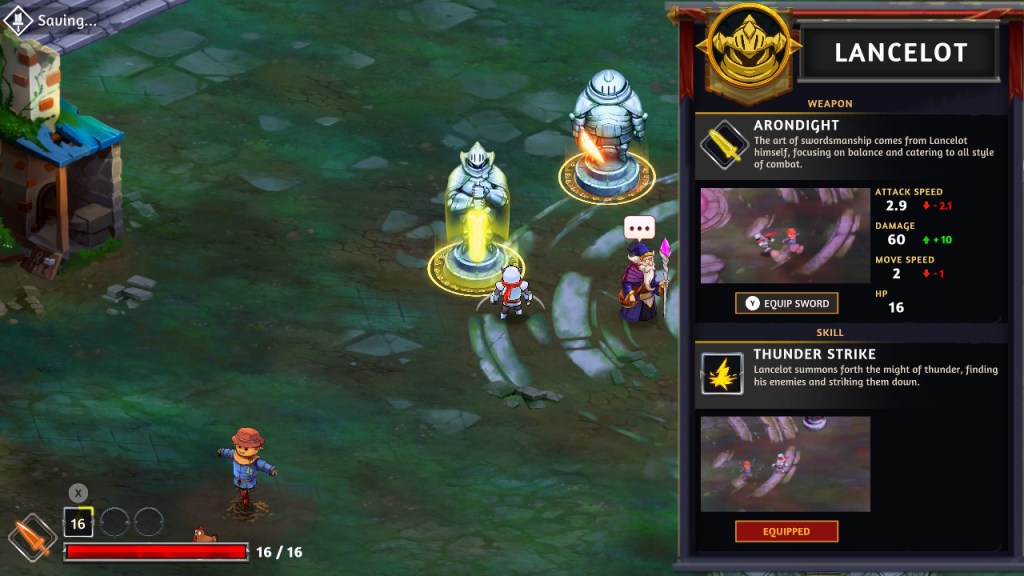
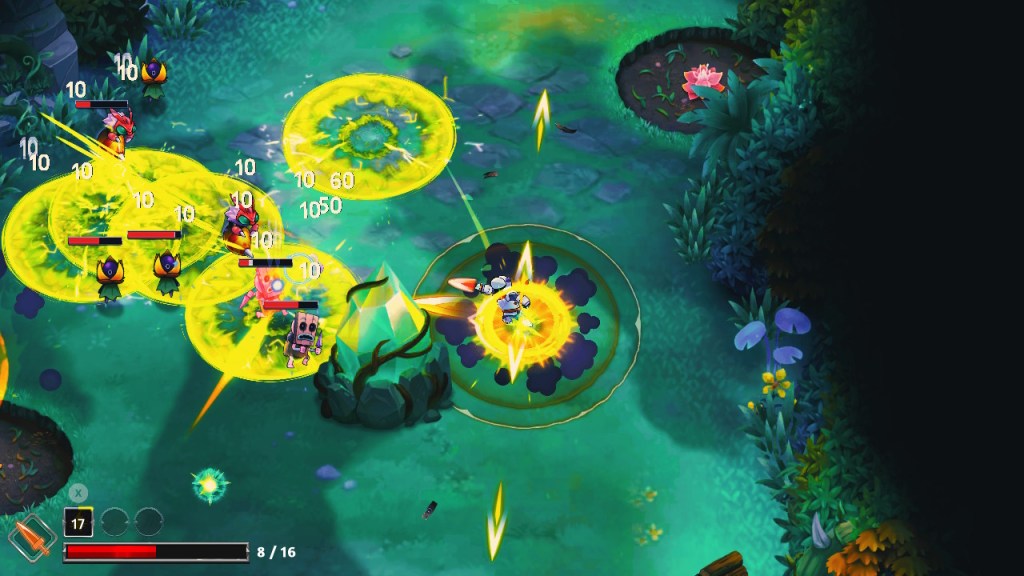
Well, the Knights may be dead, but their spirits live on inside of statues in the center of Camelot. Arthur can channel the Knights’ weapons and skills through the broken Excalibur. At first you can only choose between 2 weapons and 2 skills until more Knights become available, but you can mix and match one weapon and one skill.
Leaving Camelot, you’ll find yourself fighting monsters in the forest. There are 3 dungeons with different biomes, and 2 “floors” in each biome. The first floor in a biome has a mini boss at the end, while the second floor has the big boss. There are multiple “rooms” on each floor, which usually contain enemies.
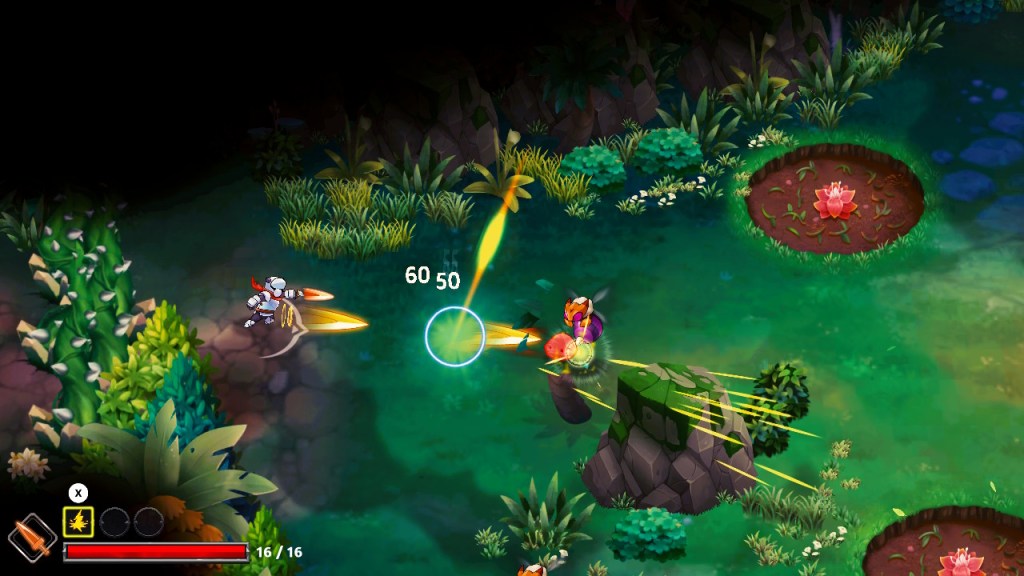
Monsters generally project where they’re going to move and attack. They aren’t the only factor you have to worry about, though – environmental hazards such as fireballs, quicksand, or swamps with spikes can damage you, too. (Ignoring their status as a nuisance in battle, the water lilies were lovely!)

Once you clear a room of enemies, you get a reward of some sort. Sometimes you’ll run into a copy of one of the Knights’ statues, which will give you 3 blessing options to choose from. You can increase your weapon or skill’s attack, add status effects to your attacks, and more. Deciding which blessing to apply can make or break you. Similarly, if you run into Morgana, you can accept or refuse a blessing at the cost of a curse. Or the Pan Piper, who offers gold for surviving waves of enemies.

Occasionally you’ll find one of the missing citizens and teleport them back to Camelot. And in every floor you’ll run into the merchant, who sells healing items for immediate use and accessories for use in that run only. (You earn “Soul Orbs” and gold by defeating enemies or destroying objects; the merchant only takes Soul Orbs, which disappear after each run. Gold stays with you when you return to Camelot.)
I did wish that we could purchase even one or two potions to use at any time in a run, but it does add to the challenge when we can’t. There’s at least a healing fountain on each floor, which fully restores your HP. It’s up to you to decide if you want to use it before or after a boss battle, depending on how much damage you took on that floor prior to the boss. Since you don’t have immediate access to healing on the next floor, if your HP is relatively full before the boss you may want to wait.
I always made sure to fully explore a floor before facing its boss – that way I could gather as many blessings and accessories as possible. I figured out that if you only slightly enter a new room, you can see if it leads towards the boss or not. The path towards a boss often has a wooden fence or a longer walkway in between rooms. If you see breakable objects like boxes or pots, you’re good to go in.
The bosses were all pretty challenging for me the first few runs – until I got a hang of their attack patterns. Be prepared to lose a lot at first! They got the best of me several times, which sent Arthur back to Camelot via the “Merlin Express.” Upon your return, you can speak to any rescued citizens to see what they need repaired.

One of my favorite elements in the game is the kingdom restoration and the way they incorporated it into the plot and the gameplay. Bizarre creatures known as “Regetins” – the “primeval sons of the Architect” – help you rebuild Camelot after you rescue them. Their dialogue is written in “decimal,” so I had to look up a translator for that. You don’t need to understand them to use their services, but it’s an interesting detail.
If you have enough crystals (obtained by defeating the major bosses) and gold, they’ll restore destroyed buildings and upgrade the ones you’ve already fixed. You’ll need to find enough Regetins to manage the larger jobs. Camelot’s citizens also provide useful services once you’ve found them one-by-one in each run.
Some citizens don’t appear to do anything, but they do contribute to the world-building when you restore the civilian homes. Most of the citizens you rescue work at facilities that help you in some way in your next runs when you take advantage of what they offer.
These facilities include:


- Anvil to upgrade Knights’ weapons and abilities (require them to be used to earn experience before upgrade)
- Hunter’s Hut for monster slaying quests
- Florist that provides random bonuses each run
- Sculptor who you can eventually bring mementos to for having statues built of the missing knights
- Training camp where you can spend crystals on learning stat-increasing abilities
- Gem Trader where you can purchase equippable gems for bonuses
- Librarian who keeps track of completed rebuilt facilities
- Bard allows you to listen to game soundtrack
- Historian where you can view stats on past runs
- Oracle where you flip over some tarot cards for benefits and disadvantages for the next run
My only real complaint about the kingdom upgrades is that you can only find mementos to unlock additional knights after completing the first story arc. I had the sculptor unlocked before then and was really confused when I couldn’t find the mementos she kept asking for. As I had already invested a lot in the first two weapons, I didn’t want to start from the beginning with the others and try them out. It would have been better if players could find mementos from the start.
Anyways, even though you don’t level up at all in this game, because it’s a rogue-LITE you keep some benefits obtained from the services in the kingdom to use in each run. (This is why I “like” rogue-lites better than rogue-likes. 😉) Any blessings or accessories obtained in the field disappear upon defeat, but anything from the kingdom is here to stay! It’s just so satisfying to make progress each time even if you don’t make it through a complete run.
When you’re sent back to Camelot upon defeat, you have to start from the very first biome all over again, and you go through them in the exact same order each time. It could have been interesting to switch the order in which we attempt each biome. In my opinion, the game could use a bit more diversity in its enemies and stages – especially given the requirements in the second arc.
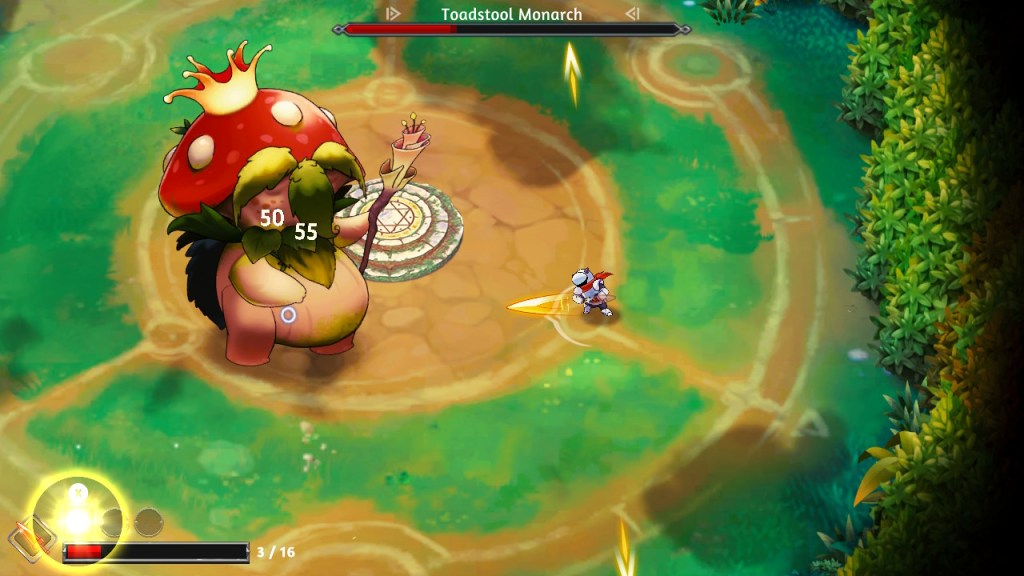
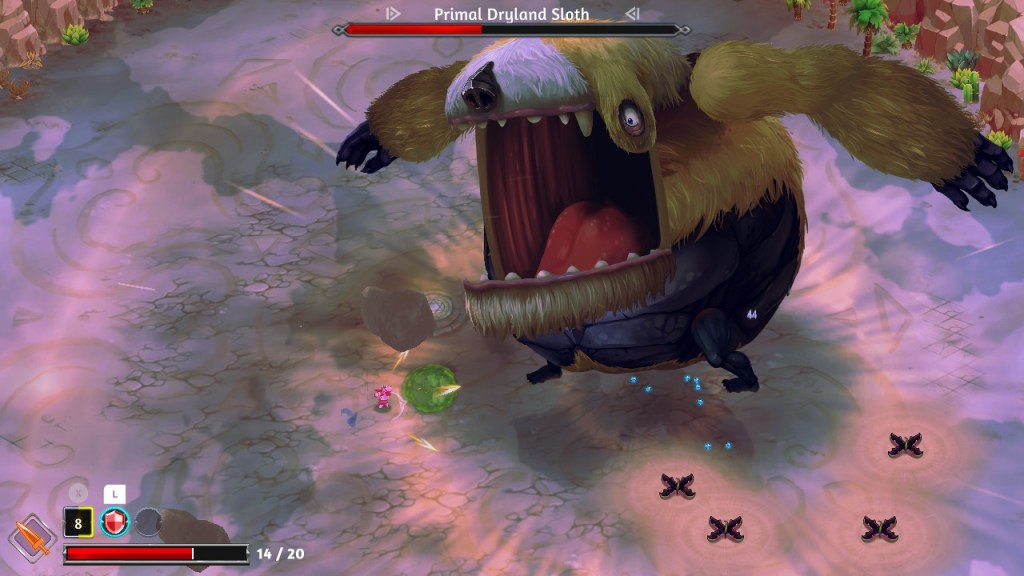
They do alternate mini bosses for each biome, at least. The major bosses stay the same. I liked the enemy designs – especially the second major boss, who reminds me of one of those Minions. They’ll do their best to defeat you by throwing boulders, summoning monsters, spawning thorns, and more.
If you’re having too much trouble with them, there’s no shame in turning on God Mode, which doubles your HP and makes you sturdier. (You have to exit to the main menu to turn on God Mode for some reason, and you have to turn it on every time you start up the game if you want it.)
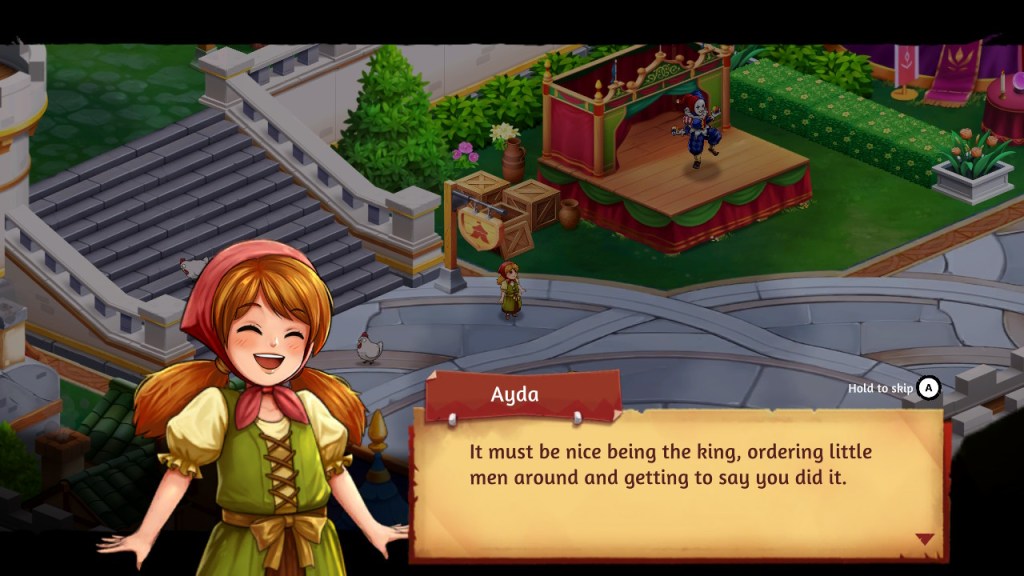
I really liked that the writers changed up some of Arthur’s dialogue for when he met the same bosses again and again. I found the writing really clever, and often found myself laughing at banter between characters and silly lines referencing Monty Python. It was hilarious to see King Arthur and the other characters using more modern language (Merlin’s usage of “throwing shade” made me cackle).
Many of the lines are voiced, including the animated cutscenes. I was grateful for the inclusion of subtitles. The animation and the static character portraits were all lovely, and the music tracks suited the game’s theme well. My main issues with the game were the limited range of enemies and environments, slightly repetitive gameplay, and the way that additional weapons are locked for too long. I also don’t think the ending is very strong. Other than that, I really enjoyed my experience with King Arthur and making progress with rebuilding Camelot.
 Switch It On Gaming
Leave a comment