
- Price: $49.99 (digital & physical)
- Developer: BROCCOLI
- Publisher: Aksys Games
- Release Date: June 15, 2023
A review code was kindly provided by MMPR on behalf of Idea Factory and Broccoli. We thank them for being able to cover something they’ve worked so hard on.
Tokyo Ghoul creator Sui Ishida worked with developer Broccoli to combine the visual novel genre with rhythm game elements in Jack Jeanne. Set at an acclaimed theater school, Jack Jeanne’s story follows the journey of students working to become well-trained actors. The students at Univeil Drama School are all male, and play both male and female roles – the Jacks and the Jeannes.

Kisa Tachibana may be a girl, but she’s always dreamed of attending Univeil like her brother Tsuki, who became the gold standard at the school. Conveniently for Kisa, she bumps into the Univeil principal, who offers her the chance to enter Univeil like Tsuki – but with some conditions that could result in expulsion if she fails. She must disguise herself as a male without anyone finding out, establish bonds with her fellow students, and be cast as the lead role for the final performance of the year.
Univeil has four classes: Quartz, Onyx, Rhodonite, and Amber. Kisa is placed in Quartz once she’s passed the entrance exam. Each class has a different focus; Rhodonite tends to excel at training singing “Jeannes,” while Onyx emphasizes their dancing Jacks. Amber is a somewhat mysterious yet strong class, while Quartz is apparently more of a “jack of all trades” class for the less experienced students.

Regardless of which class students are in, they’re given a decent amount of autonomy for what lessons they take and how they spend their time. You get to choose the lessons that Kisa takes from Monday through Friday. There are 6 different lessons, and they each have a stat that corresponds with one of the game’s 6 love interests.
Kisa earns experience points for each lesson, leveling up until she hits the maximum level (30) for a stat. It’s best to focus on only one stat in each playthrough because I believe you need it maxed out for the best ending with that love interest.
Feel the Rhythm! 🎶

On weekdays, you’ll get to watch brief scenes with Kisa’s classmates before and after class, and also watch them prepare for the five performances they’ll put on throughout the school year. These include the Newcomer, Summer, Autumn, Winter, and all-important Univeil performances. Sometimes you’ll get the chance to practice the songs and dances for that term’s show by completing rhythm game sections.
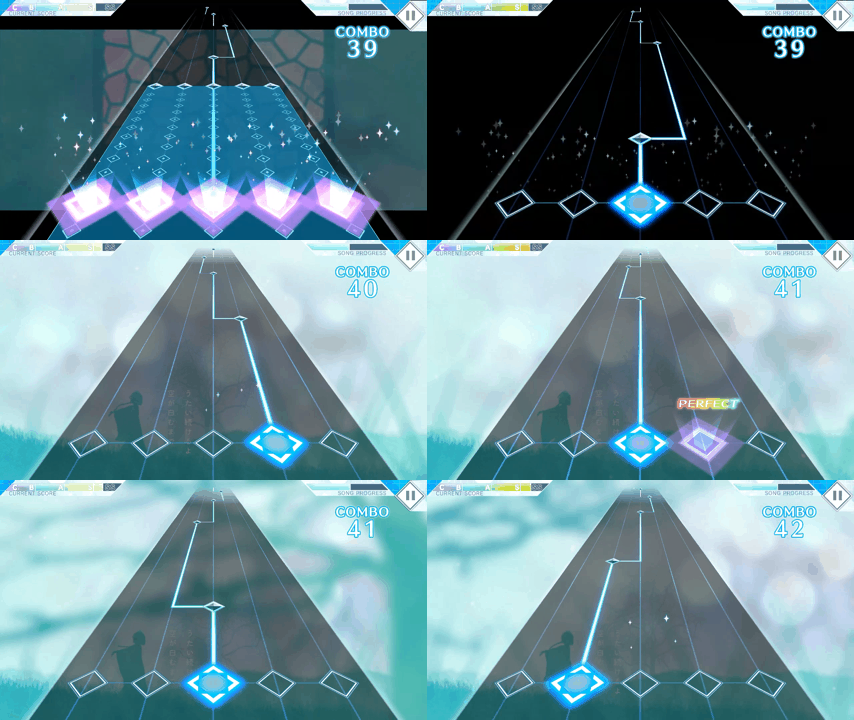
The controls for the singing rhythm game sections confused me at first. If a straight line comes toward you, you don’t move the cursor. The moment that the dot on a horizontal line hits the diamonds at the bottom of the screen, you have to move the cursor to the opposite end of that line, if that makes sense. Once I figured out how it was supposed to work, it was pretty easy in Normal mode since you just press left or right.

The controls for the dancing rhythm sections were easier to understand. I really liked being able to remap the buttons for the rhythm games. I didn’t have much trouble with any of the rhythm games because I always played on the lowest difficulty (normal). There’s also hard or expert modes, and you unlock Jack Jeanne mode after playing through it once in the story, I believe. (That mode is so much harder!)
You can also replay rhythm games under the gallery section. There’s a retry option in the gallery rhythm games, but not one for the rhythm sections in the main game. It’s possible to skip the rhythm practices in the main game, although I’d recommend doing them to get used to the harder ones – and listen to the music more!
There are 2 rhythm game sections in the Newcomer Performance, 3 in summer, 3 in autumn, 3 in winter, and 4 in the Univeil Performance. I’ve been humming those songs since I started reviewing the game; they’re all really catchy! Some of the music is in English, while other songs are in Japanese (voice acting is all in Japanese). I did find some of the choreography in the background a little distracting – yet still enjoyable – while trying to hit each note in the rhythm games.
Kind “Drama Kings” 👑
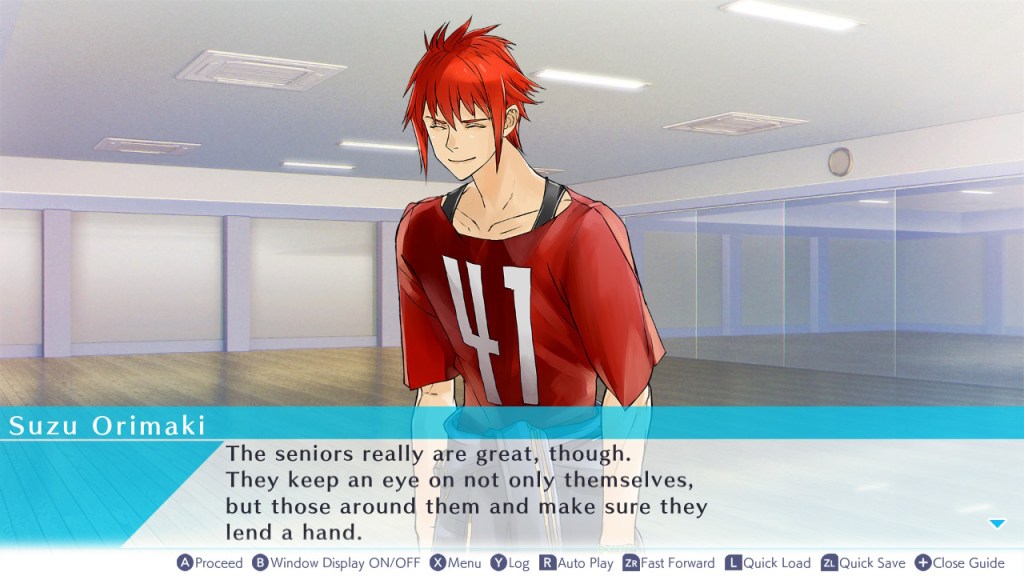
The story involves a lot of preparation for each performance checkpoint. Kisa and her classmates grow by working together to learn lines, adapting to different roles, and learning how to shine while still allowing others to do so. Each performance is a competition between Univeil’s four classes. However, most students are very supportive of their fellow actors – regardless of their class affiliation. They’ll help each other train even though it could result in the other class winning first place.
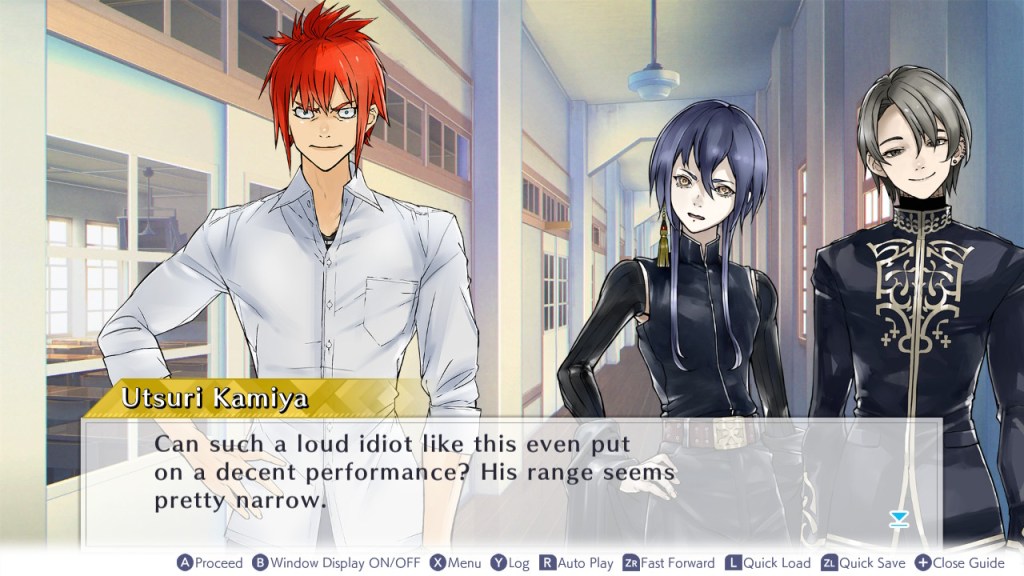
Normally I don’t like having a lot of conflict in stories like this, but I thought that for a story set at a drama school, it was lacking any real drama. One of Kisa’s Quartz classmates can be a little abrasive, but he’s really not a major antagonist. The main Amber students seemed like they had the potential to do something nasty, but they didn’t really do much.
To be fair, the Quartz students do have their own personal struggles that they go through as they rehearse for each performance. It was great to see them improve by overcoming their issues. But most of those difficulties seemed fairly tame, and the similarities between each playthrough didn’t help matters.
The plays are the same in each playthrough, and every character has the exact same role in each play except for the last one, where the lead opposite of Kisa changes depending on what route you’re in. Perhaps they could have written two extra plays with different stories (but reusing the same music and choreography to reduce the developer’s burden) to alternate in different routes?
I think I’d describe this as more of a “common route” heavy otome with bits and pieces of love interest routes sprinkled in than a traditional otome with more separate love interest storylines. It’s kind of got an “otome-lite” feel to it.
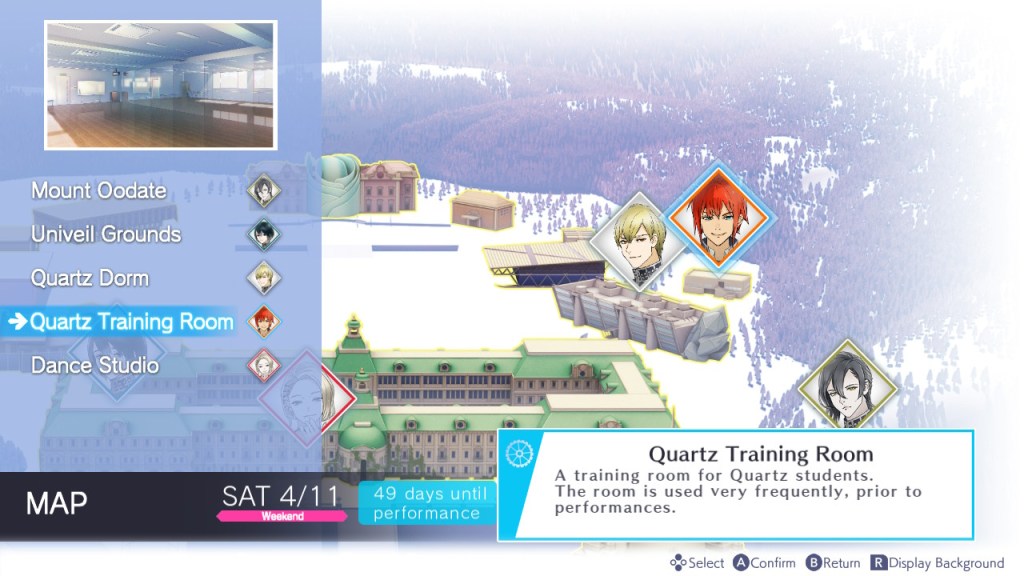
Most of the focus is on the performance preparations, but on weekends you can leave the school and explore the city or school grounds. As you interact with the love interests and continue to increase their corresponding stat, you’ll be able to view their affection events. The romance is more on the shallow side, but some of the scenes are really sweet.
Quartz Courting 🌹
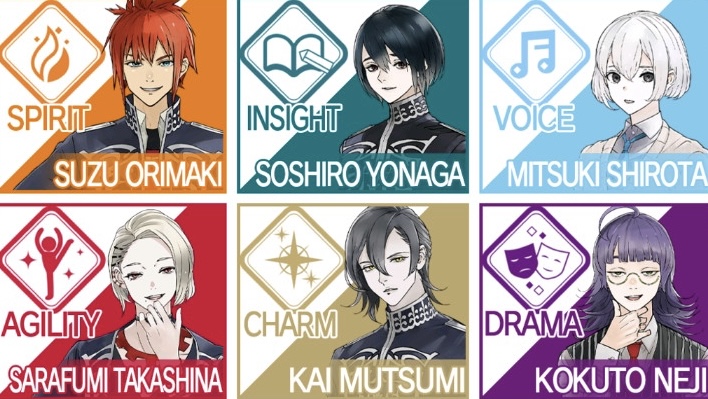
Kisa has six potential love interests in the Quartz class. (Walkthroughs linked here.)

Suzu is a first year like Kisa, and he’s very friendly and collaborative. He’s competitive in a healthy way, affectionately calling Kisa his rival and partner. I liked him, and thought he was sweet.
Soshiro is another first year, and he was childhood friends with Kisa and her brother before he moved away. I thought his route was the second least interesting, with some redemption in the Univeil Performance chapter due to a twist there. I liked that he was nice to Kisa, but he was just kind of boring for me.
Mitsuki is the only highlighted second year in Quartz, and I didn’t dislike him. He’s somewhat antisocial but means well. I just didn’t think they went deep enough with his character.
Third year Fumi acts as the main Jeanne for Quartz most of the time. He’s quite elegant, and is very supportive of his underclassmen. We get a glimpse into his background, and I liked getting to know him.
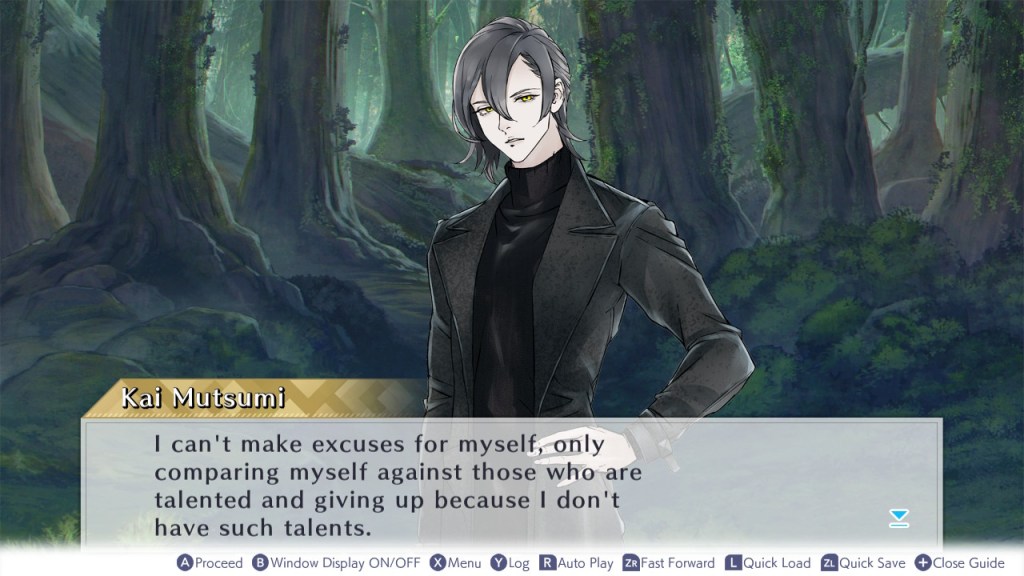

I was pretty torn between Kai and Neji as my favorite love interest. Both of them are third years with drastically different personalities. Kai doesn’t seem to think much of himself, and always puts others first. He’s kind, and good with kids and animals. (And he’s so pretty! 😍) Neji, on the other hand, is the excitable oddball who writes the scripts and casts the roles for Quartz. I loved his wacky antics, and he does have a serious side.
To me, it seemed like there was a lot of emphasis on developing the third years because I learned more of their backstories and felt that they were more fleshed out as characters. Soshiro and Mitsuki were the least successful in my eyes, but were pleasant enough. The game’s romance is light but nice, and I really liked how players can obtain both the good and best endings for a character in the same playthrough without having to mess around with reloading different save data.
I did think that they could have made it so that Kisa joined one of the other classes from the start, and it could have been fun to have a love interest from each of the other classes, too. (Minorikawa from Rhodonite, please and thank you. 😍) They did at least try to shake things up with a special route that unlocks after viewing all of the best endings for the love interests. I wasn’t entirely satisfied with the limited information on Kisa’s family situation, but I did like Kisa as a considerate main character who does her best to improve.
English & Extras
I think that the overall translation is pretty decent. There were a couple of missing words or typos here and there, though, and sometimes the translations sounded awkward to me as a native (U.S.) English speaker.
One section had you choose to “Belittle Mary” or “Ridicule Mary”; to me, those have close enough meanings that it was confusing to choose between them. Another example would be when Kisa has the option to say “I’m going to fulfill my role” – I thought that “I’ll do my part” would have sounded more authentic.
Most of the English seemed okay besides some of the dialogue choice sections sounding odd. And speaking of dialogue, they have a fantastic Extras section on the main menu, which even includes the scripts for each of the plays performed by Kisa’s class!

There are the standard CGs, and they also included the performance videos without the rhythm game covering parts of the screen. Then there’s a section for the BGM, trophies, and a history section that allows you to experience each love interest’s Affection Events again outside of the main game. I think this has one of my favorite Extras sections in an otome game; there’s so much great content!
Overall Impression
Jack Jeanne is a fun, feel-good otome-lite. If I had to describe it, I’d probably say it’s a mixture of elements from Ouran High School Host Club, maybe kind of High School Musical/Pitch Perfect, and Persona (from the socialization and schedule management side) with Kisa as a cross-dressing female character who acts and sings. (Univeil’s performance budget also seems like it’s decent enough to match Ouran without being gaudy. 😂)
The vast majority of the characters are so likable (except for Amber). Although the minimal romance and constant repetition of the same performances in all seven routes was disappointing, I still found myself wanting another year at Univeil. I’d love to see an alternate universe edition where Kisa gets to know the other classes even more, and I’d definitely welcome a fan disc with more romantic tones for the love interests.
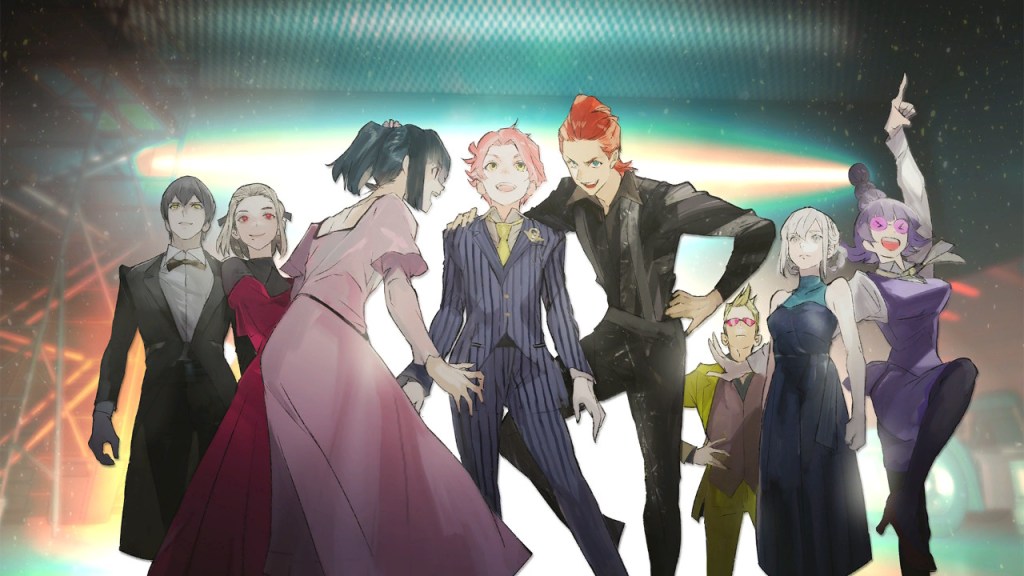
Jack Jeanne isn’t perfect, but I still enjoyed it despite what I viewed as its flaws. If you go in expecting a grand romance with many varied routes you’ll be a little disappointed in that regard. But if you go in knowing that Jack Jeanne is more about a group of students that support each other as they grow together, I think you’ll get more out of the experience. (And be prepared for a toe-tapping soundtrack!)

 Switch It On Gaming
Leave a comment