
Content warning: Rated T; includes suggestive humor, and ethical issues in “science” are an underlying theme.
- Price: $49.99 USD (digital and physical; digital currently on sale for $44.99 until May 9th)
- Developers: Idea Factory, Compile Heart, and Sting
- Publisher: Idea Factory
- Release Date: April 25, 2023
A review code was kindly provided by Idea Factory on behalf of Compile Heart and Sting. We thank them for being able to cover something they’ve worked so hard on.
It’s been a while since I’ve played Fairy Fencer F: Advent Dark Force (2019), a game that tells the story of Fang, a (Fairy) Fencer who had to choose between resurrecting either the Goddess or the Vile God. Fencers collect Furies, which are weapons containing fairies that allow the user to “Fairize” and merge with them in battle.

In Refrain Chord, the newest entry in the Fairy Fencer F series, Fang and the cast from the last game continue to gather Furies. Suddenly, the group triggers a trap after finding a broken Fury and some mind-altering hijinks ensue. The group is only able to break free from the mind control thanks to a woman named Fleur, a Muse who uses the power of music in battles. Muses are apparently similar to Fencers, but they are incapable of using normal Furies or much magic.
Dorfa Corporation is up to no good again, and you control an ever-growing group of “meddling kids” and their fairies in turn-based tactical combat. Fleur plays a major role in your party, as well as in helping to foil Dorfa Corporation’s plans. You can choose between Easy, Normal, and Hard difficulty modes, which you can always change. I tried swapping between Easy and Normal every once in a while, and it seems like Normal mode could pose some challenge.
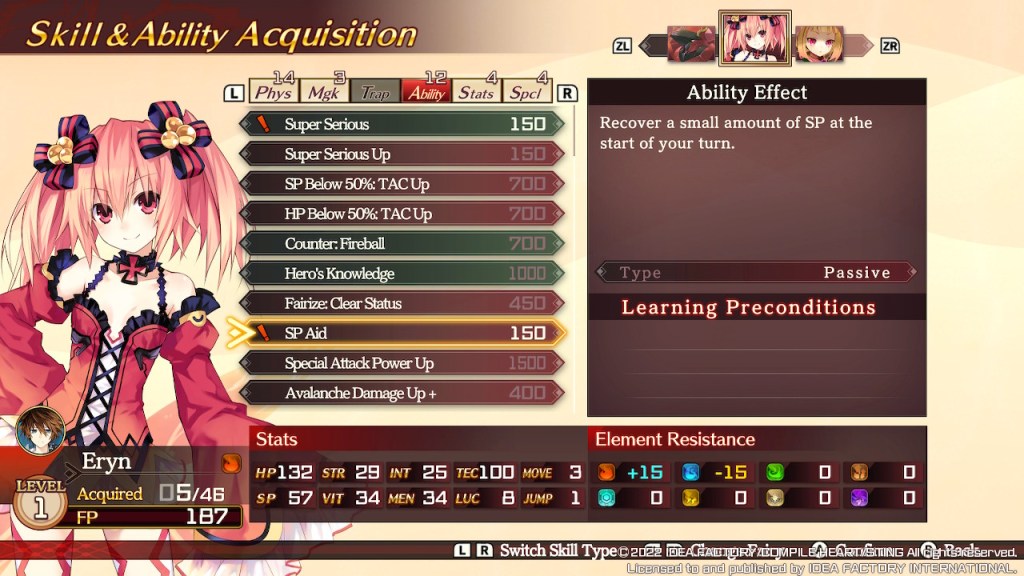
It’s not the same kind of turn-based gameplay as Advent Dark Force. The combat in this game is slower due to the tactical gameplay, but I do think I enjoy it more. Your characters still have their main (locked) fairies equipped like last time, and then you equip a sub-fairy on each Fencer to increase their stats and supplement their ability pool.
I really like that we can decide on the order that both the main and sub-fairies can learn new skills. As the main fairies originate from weapons in the form of Furies, it makes it really convenient because you don’t have to buy new weapons. Your characters can also learn new weapons and their associated skills through their fairies. There’s a decent amount of choice and customization for you to play with in the party of six you take into battle with you (out of around fourteen or so possible party members).
The real difference between Advent Dark Force and Refrain Chord – besides the battle style – is the use of music. Due to the emphasis on the music, RC reminds me a little bit of Stella Glow (3DS) and Tokyo Mirage Sessions #FE – both of which are games I love. Fleur has Al as her main fairy, but she can also equip special fairies that are exclusive to her, and they help her learn additional songs.
The tactical gameplay is pretty standard, with your team of six battling enemies in turns on a grid-based map. As is the norm, a unit’s direction is important to consider when it comes to how much damage they’ll take. With Fleur’s catalog of music, she can strengthen your units’ physical/magical attacks, their defenses, and also allow them to regenerate health each turn.
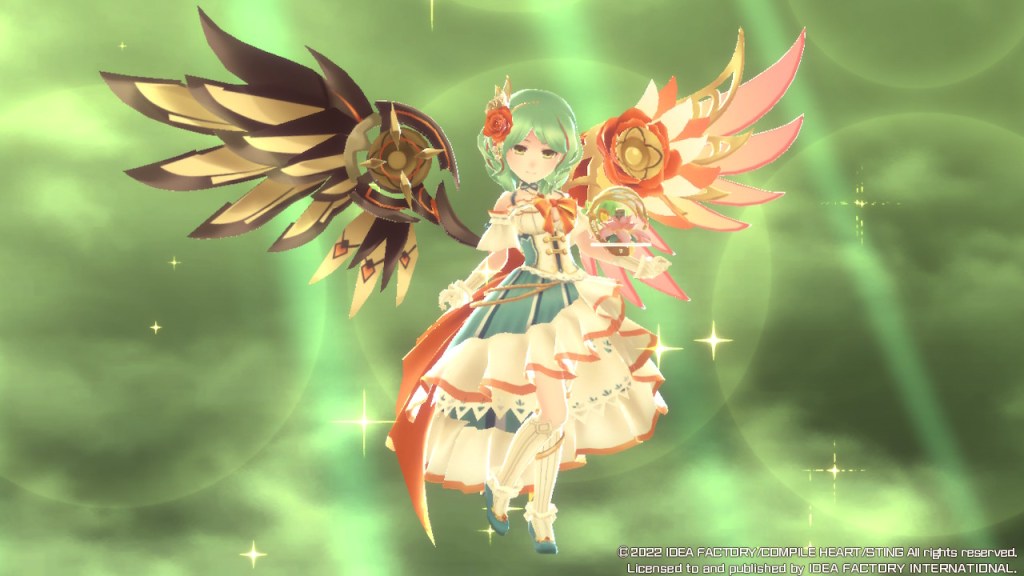
Fleur’s singing, like the game’s voice acting, is all in Japanese. Personally, I really enjoy this kind of pop music. It may not be for everyone, but my feet were tapping up and down as I played, and the songs got stuck in my head a lot. I consider the soundtrack to be a real strength here, and it was interesting to read about the complicated yet rewarding development of the mashups they created for the game.
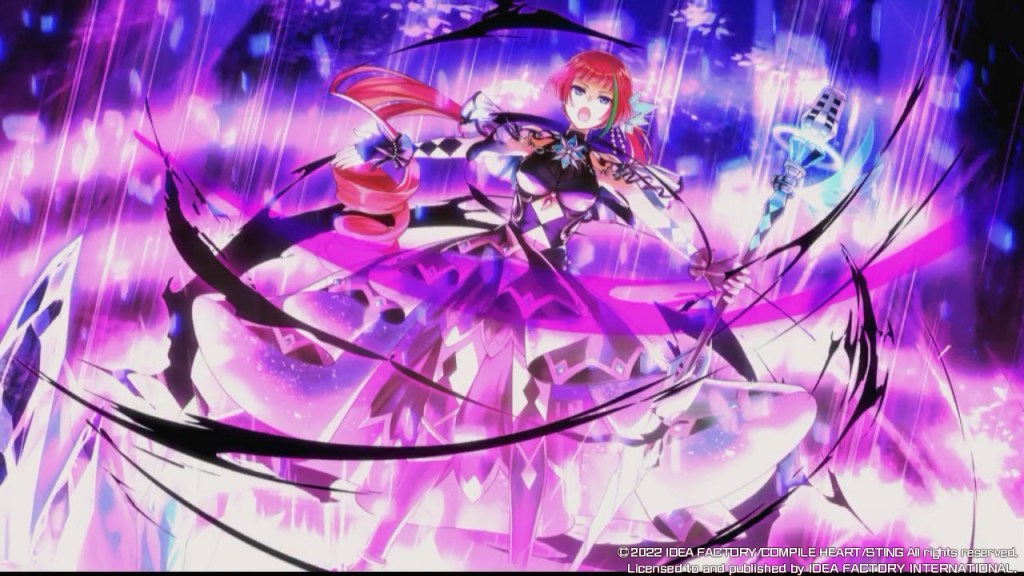
Fleur isn’t the only Muse though – she must share the (battle) stage(s) with the Muse antagonist named Glace. There are multiple singers who sing Fleur and Glace’s songs, but they all did a good job making them cohesive, I thought. Fleur’s songs seemed to be on the higher end of the scale, while Glace’s had some deeper tones to them. It seemed like a good contrast between the two opposing Muses.
When controlling Fleur, you have to wait for her Aria Gauge to fill up, and then you can use the Fairy Aria command. The gauge is always full at the beginning of battle, so you’ll be able to start a stage with a song’s effects. The song you choose will only affect a certain range of squares at first, which means you’ll have to be strategic about where your other units are compared to Fleur’s current location.

Now, after Fleur starts singing, she has a limited amount of turns until the end of that song. She can sing multiple times per battle, but you’ll have to build up the gauge each time. While she sings, she can’t do anything besides increase the effects of the current song, increase its range, or stop singing. If Glace decides to sing nearby, the areas where Fleur and Glace’s songs overlap will combine their effects and activate Dramatic Resonance, which increases the effects of both songs.
As much as I liked the songs individually and together, sometimes it started to get a little repetitive. They apparently foresaw this as a potential issue, and included a setting where you can replace the battle music and decide if the Fairy Aria songs play or not.
Another problem I had was that when the map was highlighted in purple and green for the songs’ range, it was a little hard on me visually. I also seemed to experience some slowdown when it came to the animation for units using their abilities, and sometimes the graphics briefly blurred on me.
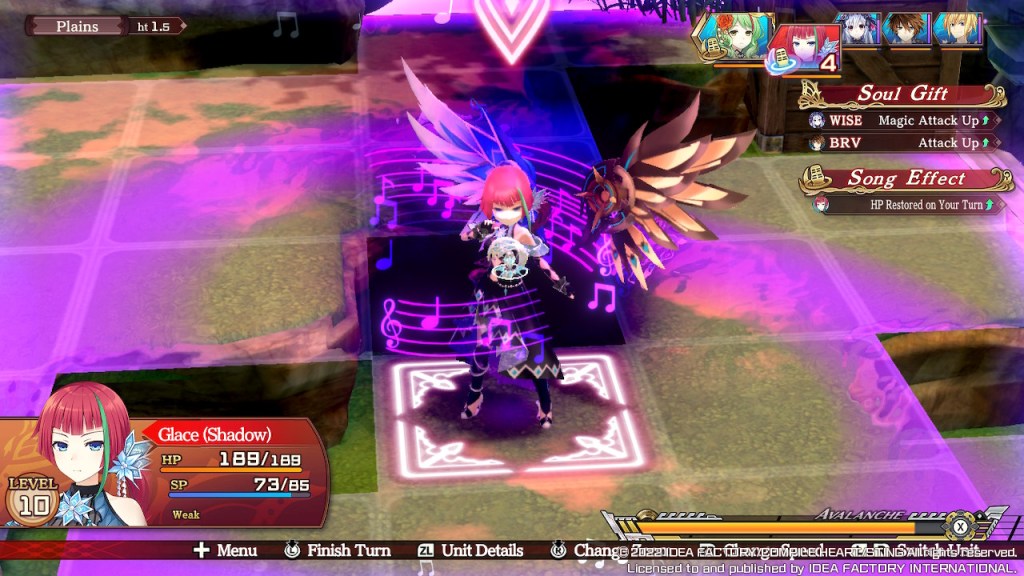
Something that felt odd to me – not necessarily bad – was that Glace pops up in pretty much every single battle, regardless of whether or not she is meant to be there plot-wise. She’ll appear in battles for story quests even if she hasn’t spoken in that scene. There are multiple categories of side quests and free battles in the game, and her “Shade” appears for those battles too.
Glace’s constant presence was confusing, and felt like a kind of contrived way of forcing the Muse thing some more. Don’t get me wrong – I really enjoyed hearing her songs again, but when they attempted to explain her presence everywhere in one of the last chapters it didn’t sound well-reasoned to me. (She’s also fairly sturdy, and it took longer to finish battles that required all enemies to be defeated, including her. 🥺)
Anyways, both Muses are important to consider in battle, but their songs are intended to strengthen other units. They’re important, too! Just like in ADF, your characters can Fairize and merge with their fairies for a boost to their power and movement. Fairizing has turn limits like the Arias.

They also brought back the Avalanche mechanic. When the Avalanche Gauge is full you can use Avalanche Rush; all allies in range will participate in a joint attack against all enemies in range. Using this in range of an Aria makes it an Avalanche Harmonic attack, which is even more powerful!
After using a combination of abilities to defeat the enemy in a story battle, usually a new chapter will begin, and you can choose to spend some time on a variety of optional but recommended activities. They had a mechanic called World Shaping in the last game, which allowed you to access new locations or modify old ones.
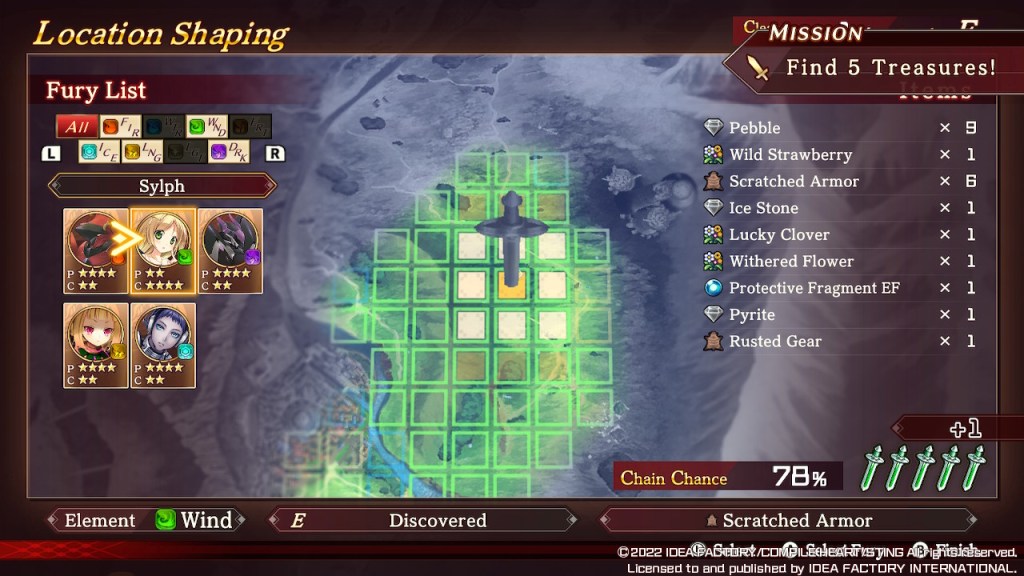
In Refrain Chord they decided to implement something called Location Shaping, a different mechanic that allows you to place Furies in the ground to dig for useful items such as accessories or even new sub-fairies. I liked Location Shaping a lot better than ADF’s World Shaping.
You can also accept new side quests, which I’d recommend for grinding purposes and for the rewards. Synthesis takes a while to unlock (about a third of the way in the game), but you can make better healing items, armor, and accessories at the shop. My favorite use of time in between story battles was going to the inn to learn more about Fang and his teammates.
When customizing your fairies’ abilities, you can occasionally have some shallow conversations with them. But you can view longer – and more entertaining – scenes by watching individual characters’ “episodes” at the inn (and potentially trigger more side quests).
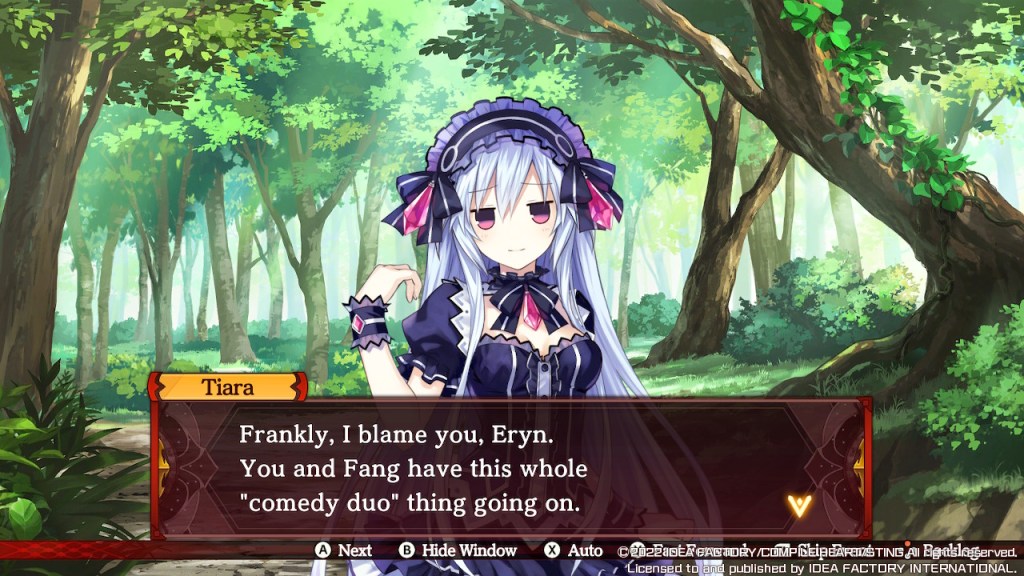
A lot of the character interactions involve slapstick humor with some sexual humor mixed in. There are tropes galore in this game. Admittedly, I groaned a bit when they talked about the female characters’ underwear, or the cliche chest comparison scene. There’s also the obligatory hot spring scene. However, they at least seemed more “equal opportunity” here and included some jokes at the guys’ expense too.

I definitely got some laughs in though. A.J. was one of my favorites, and a scene with Eryn, Marissa, and <name redacted for spoilers> was particularly amusing to me. I can’t speak for the original source material, but I thought the localization was well done, with very few typos.
The episodes at the inn were generally more comedic, but when you continue the main story there are some more grim elements to the plot. Dorfa Corporation’s ethics violations in their “science” department quickly change the mood from happy to horrified. There aren’t too many scenes that discuss this topic, but when it comes up it serves as a strong contrast to Fang and Co.’s mostly happy-go-lucky attitudes.
I ended up with fourteen characters – including Fang – in my party by the end of the game. The amount of characters got a little overwhelming at times, as the cast seemed to constantly expand. I did kind of have an issue with the way that Fang forgave people that had just been trying to kill him. He even lets some previous foe(s) onto the team!
Whenever he doesn’t add an antagonist to the group, he still seems overly forgiving to me. Forgiving someone is a difficult thing to do, and sometimes a person is worthy of forgiveness. But many villains are actually irredeemable, so the quick brushing aside of an antagonist’s wrongdoings rubbed me the wrong way.

The plot wasn’t the strongest, in my opinion. It was often predictable, although I sensed that it was meant to be that way – perhaps due to the “tropey” nature of this series. It could be a bit cheesy with its cliches and heartfelt speeches, but in the end I still found myself somewhat charmed and entertained.
Will this “strike a chord” with you?
I think that players’ responses will vary depending on their prior experience with this kind of humor in Anime, as well as their taste in music. If you can’t absolutely cannot stand a few juvenile jokes about undergarments, or if you don’t care for Japanese pop music, this may not be for you. And that’s okay.

Personally, I ignored the jokes that didn’t land and otherwise enjoyed the humor. And I adore this soundtrack. If you like Japanese pop, I’d highly recommend getting the Deluxe Bundle ($69.99 USD, also discounted now) because that includes the whole soundtrack and art book. The art is really pretty and colorful, and I liked most of the designs.
The overall art direction was a plus for me; however, story-wise it wasn’t anything new, and the tactical gameplay was relatively standard. There are also some minor yet fairly frequent slowdowns during combat animations to consider. But did I enjoy the game overall? Yes – my appreciation for the art, music, and tactics RPG genre in general allowed me to have a good time with this.
 Switch It On Gaming
Leave a comment