
The Ninja JaJaMaru series has been around since the mid-eighties, starting with the side-scrolling “Jump & Run” game Ninja JaJaMaru-kun on the Famicom/NES in 1985. Ninja JaJaMaru games have spanned a multitude of consoles and even genres, but those of us in the West may not have been lucky enough to experience some of them – until now! ININ Games and City Connection decided to bring three (!!!) Ninja JaJaMaru collections to the Nintendo Switch console, and I’m excited to review all three of them below.
For more information on the Ninja JaJaMaru series, please check out the ININ Games link here! If you enjoy collecting physical editions of games, Strictly Limited Games (no affiliation) has a Limited and Collector’s Edition available.
Review codes were kindly provided by PR Hound on behalf of ININ Games and City Connection. We thank them for being able to cover something they’ve worked so hard on.
Ninja JaJaMaru: The Great Yokai Battle + Hell

- Price: $19.99 USD
- Release Date: February 21, 2023
First up is Ninja JaJaMaru: The Great Yokai Battle + Hell. Just starting up the game got me hyped up; they show Ninja Jajamaru running across the screen and defeating enemies as a super catchy Japanese rap song plays. (I stayed on the main menu for a little bit just to listen to it some more.) The way Ninja Jajamaru fights in the footage on the menu isn’t quite the same as the combat in the game, but it sure looks good. In the actual game, the level design reminds me of a less lopsided Donkey Kong.

This game includes solo challenges, 2 player co-op, and a ranking mode. In the solo challenge mode, there are 22 levels across 3 “chapters,” and 25 playable characters. I started with two characters and unlocked the remaining 23 as I played the game. Each level is basically the same in terms of the format – there are always a couple of floors that consist of solid platforms, with breakable sections that allow you to jump between each floor. A finite number of enemies will come out of doors scattered across the level. Some levels include a single giant version of an enemy along with the normal versions.
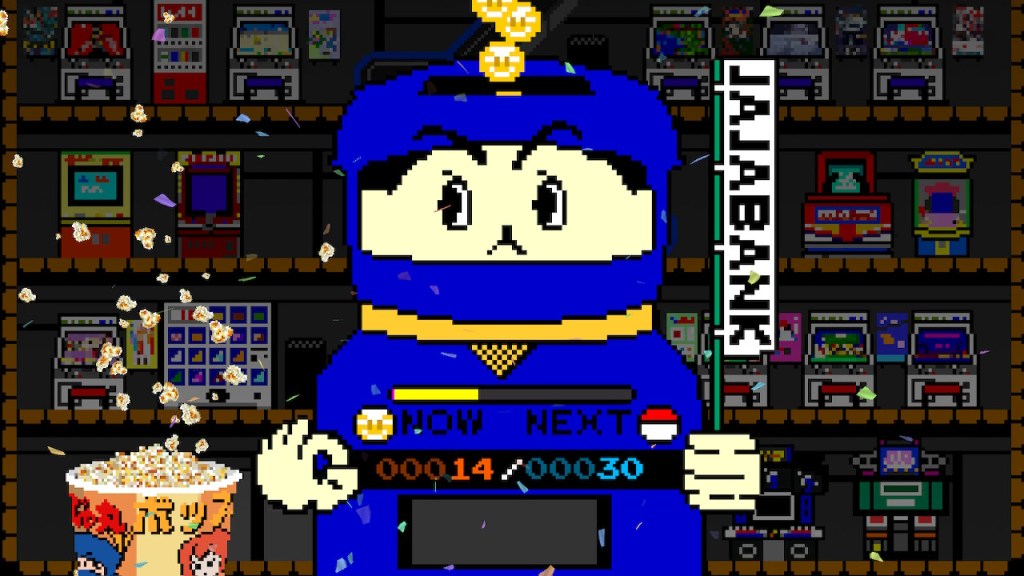
Thankfully, levels are not timed, and you can see how far you are from completing the level by looking at the progress meter at the bottom of the screen. They don’t overwhelm you with enemies, as they come out in smaller waves after you’ve defeated the group(s) before them. Enemies drop gold coins when you defeat them, and once you’ve beaten all the enemies in a level, the coins go into a cute coin changer and then a bank to allow you to redeem them for perks.
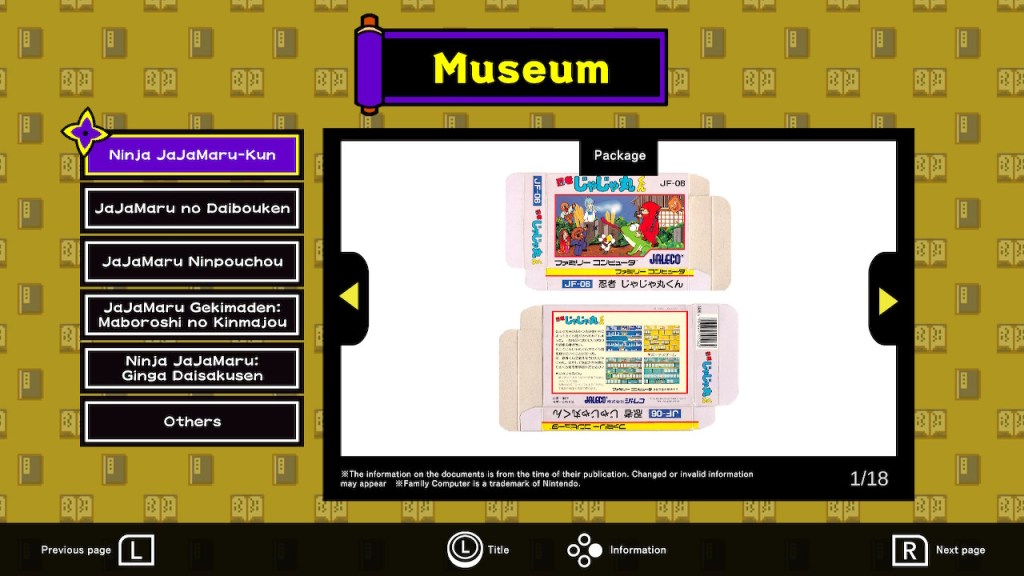
You unfortunately can’t choose the order you’ll receive these perks in, as they are given to you in a fixed order once you’ve earned enough coins. Benefits include new playable characters, additional BGMs, and a neat “Museum” section that allows you to view images of the original Ninja JaJaMaru-kun games’ boxes, cartridges, and manuals! I really liked being able to choose between the retro or new arrangements for the soundtrack.


Out of the 25 playable characters, there is Jajamaru, and then 9 of his relatives. The ten of them pretty much look the same except for their coloring, and their attack style and weapons are different. They also have different HP and attack values, and max heights for when they jump. Besides the “Jaja 10,” other playable characters are the same as the enemies you fight.
Players will more than likely have a few preferred characters; I didn’t care to use slow or close-range characters, or those with awkward movement styles. I really liked using Purple Jaja because he can send his attacks up, down, left, or right. Princess Sakura appropriately uses sakura blossoms as her weapon of choice, which I enjoyed seeing float across the screen. I do wish that we could upgrade our preferred characters’ attack and HP so that we could keep using them for all levels, because I would end up having to switch to the ones with more HP for boss battles.

You’ll mainly attack enemies with your normal attack; your weapons are also capable of deflecting shots fired by an enemy. Jumping on top of an enemy will temporarily stun them, so you’ll get some free shots in until they come to their senses. There are also some fun and zany temporary upgrades you can use, like turning into a massive baseball player, an airplane or car, or being able to ride around on top of a giant frog who eats your enemies for you.

Each stage is fairly short, but they do get more difficult as you go along. There are also 3 optional challenges for you to attempt in each stage. Try to beat the stage without taking any damage, make sure to pick up every single gold coin, and collect 3 sakura petals to beat all 3 challenges. They didn’t really explain how to get the sakura petals (or mechanics like how to use items), but apparently you need to quickly defeat 5 enemies in a row for one to appear. Getting all 3 petals unlocks a bonus stage, where you can get a lot of gold coins. I appreciated that we don’t have to beat all of the challenges in the same attempt at a stage. Completionists may want to replay levels for those challenges as well as the achievements.
The final stage is really difficult because you have to defeat a bunch of regular enemies as well as a giant version of every single enemy in the stage. Then you also have to face the boss for the stage, who I lost to many times due to stupid mistakes. (This meant I had to replay the entire stage again and again.) But eventually, I was victorious! And beating all of the stages in normal mode unlocks “Hell Mode.” 😈 You can’t use any of the Jajamaru units until you beat them and therefore rescue them in one of the stages in Hell Mode. The music is different, and there are more enemies in each stage – some of which are reskinned – and there are also stronger versions of the giant enemies. Add the 3 challenges to the Hell Mode stages, and you’ve got a lot to do in Ninja JaJaMaru: The Great Yokai Battle + Hell.
After playing the retro games (mentioned below), I think they did a pretty good job of modernizing the classic gameplay. It’s a quirky and cheerful game with cool Japanese mythology-inspired enemies. There isn’t really a story or any dialogue, but they still managed to convey a real sense of personality with the character designs, soundtrack, and even the bizarre power-ups. The ending credits were also entertaining! Things like the stage designs could have used some more variety (like the backgrounds in Ninja JaJaMaru’s Big Adventure below), and some mechanics weren’t fully explained. But overall there are more positives than there are flaws, and there’s a ton of content for the player to play through and unlock. As a newbie to the series, I had a great time with it.
8.5/10
Ninja JaJaMaru: Retro Collection

- Price: $14.99 USD
- Release Date: February 21, 2023
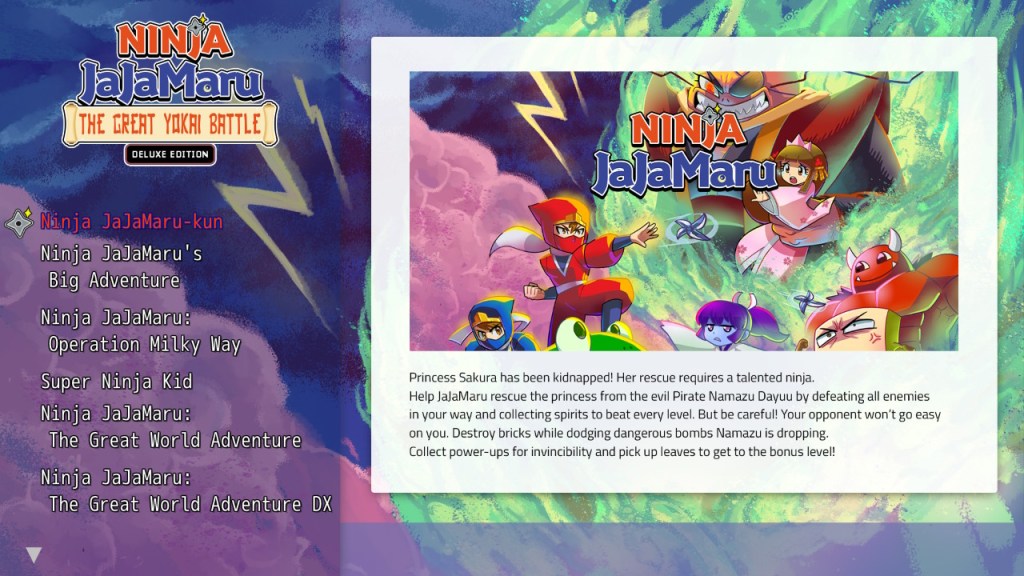
After playing the more modern The Great Yokai Battle + Hell, now I’ll take a look at the Retro Collection. This includes 6 retro Ninja JaJaMaru games. With a single hit resulting in defeat in many of these games, they’re much more challenging than The Great Yokai Battle + Hell, which had characters with several hundred HP. (And in the retro games, defeat sends you to the very first stage again.)
The difficulty could have been off-putting for some players, but they made the very smart decision to include optional cheats and the ability to create saves whenever you want. Some of the games have more cheats than others, and you don’t have to activate all of them at the same time. Giving players the ability to customize the difficulty of their playthrough should definitely increase the games’ audience, especially for people like me who get frustrated with one-hit KOs. It’s nice to be able to experience these for the first time!
*Note: I attempted each game without cheats first and then turned cheats on*
Ninja JaJaMaru-kun


Initially released in 1985, Ninja JaJaMaru-kun is a fairly simple game in which the goal is to rescue Princess Sakura. There are only a few enemies per stage and a single music track. The stages in the newer Ninja JaJaMaru: The Great Yokai Battle + Hell clearly took inspiration from this game. You still break through less solid flooring and defeat enemies as you jump around. But here, stages are timed and one hit means game over. If you’re defeated, as long as you have a life left it will let you return to the stage to defeat the enemies that are left. The game appears to be open-ended, as I got through about 30+ stages without reaching the end.
Ninja JaJaMaru-kun also has you gather 3 sakura petals to activate a bonus stage, with some differences from The Great Yokai Battle + Hell: here, you can gather petals across multiple stages, and the bonus stage includes a boss instead of coin gathering. It also differs in the way you activate power-ups (you apparently have to get 3 different items by breaking through the floors). In later stages, the Kakutan and Pinbo enemies could only be defeated by jumping on them and stunning them first before attacking them. (+ Hell doesn’t require you to do that for the same enemies.) It was neat to see the way that Ninja JaJaMaru-kun inspired The Great Yokai Battle + Hell, as well as the way it differs.
I had some kind of technical difficulties with this one, as the menu (for this game, not the collection) didn’t seem to register my input sometimes, and appeared to show Player 2 automatically playing the first level.
Ninja JaJaMaru’s Big Adventure

Some stages include flashing lights in this game
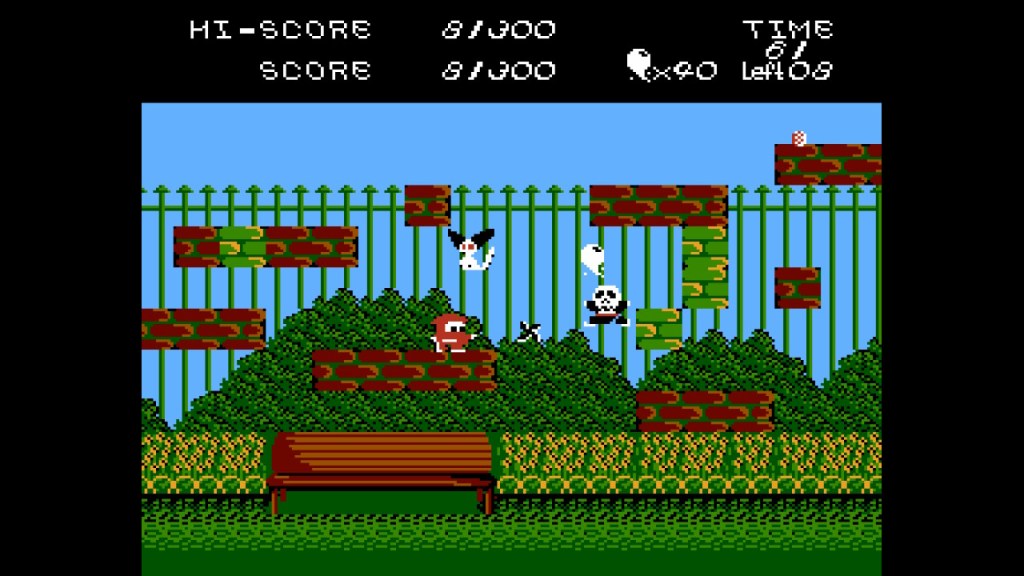
We next see Jajamaru and Princess Sakura in Ninja JaJaMaru’s Big Adventure (1986). The princess has once again been kidnapped, and Jajamaru must save her. While the stages in Ninja JaJaMaru-kun had you remain on the same screen, that’s not the case when Jajamaru runs around on his princess-saving adventure here. Instead, you’ll continue advancing to the right as you defeat the enemies in your path. The backgrounds are also much more colorful in this game.
Stages are still timed and one hit still means game over. There are also bonus stages where you fight bosses that must have inspired the boss stages in + Hell. I found the stage numbering a little confusing (it went from 3-1 to 3-8 for some reason). I liked the artistic elements of this one better than the first game, but I liked the simplicity of the actual stage design more in the first game.
Ninja JaJaMaru: Operation Milky Way

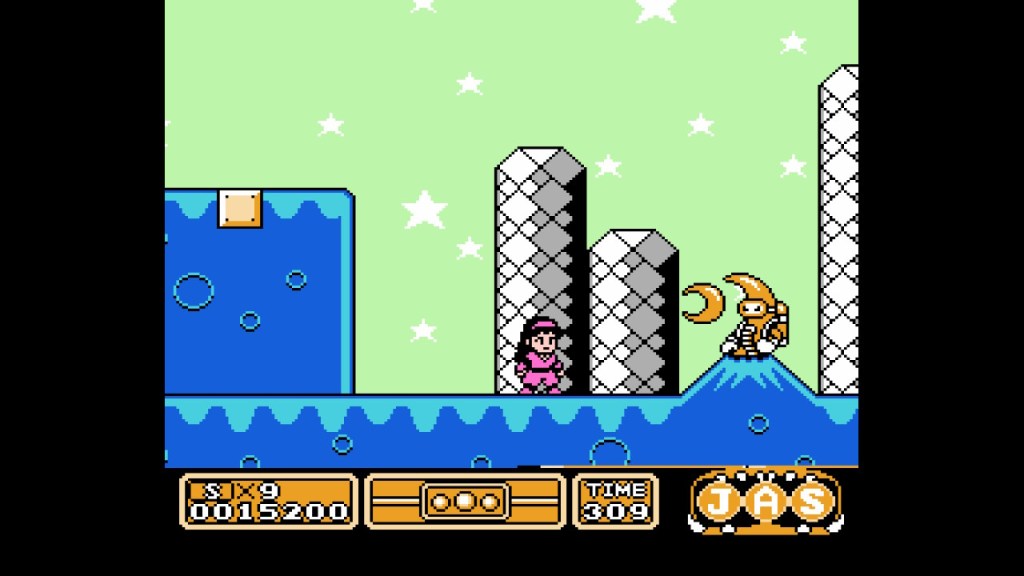
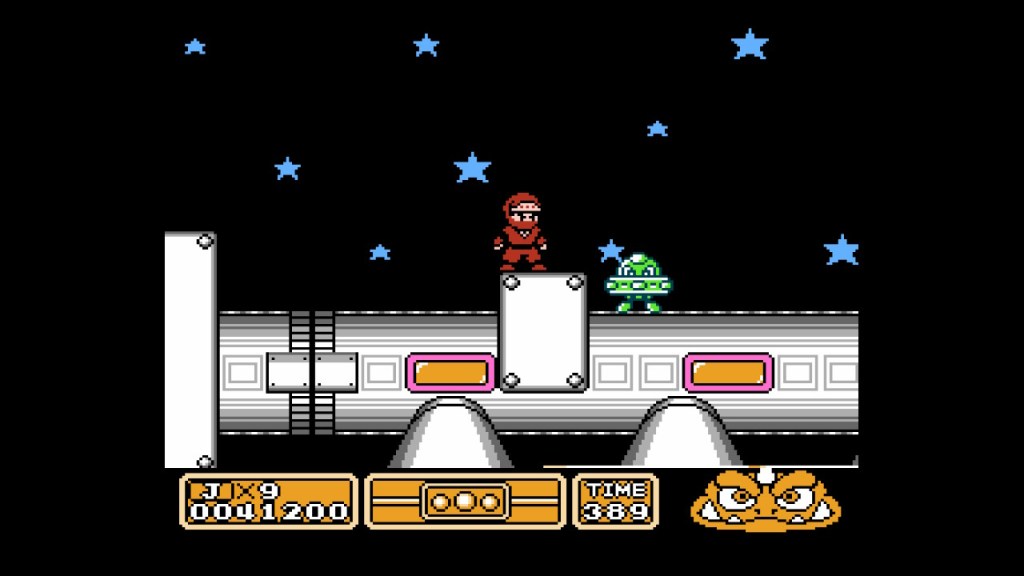
This 1991 space adventure was my favorite game out of the Retro Collection. I loved playing as a ninja in space, and the overall design was my absolute favorite out of the six games. It’s cute and there’s a lot more creativity and variety in the level designs. There’s also a semblance of a story, and you have the option of playing as Princess Sakura!
Again, the game is timed, and you have to start over if you’re hit once; however, this time, you can get an upgrade that will allow you to withstand an additional hit. Oddly, there wasn’t a pause function for this one besides going to the save screen for the collection. They also did not explain how to use some of the moves and other mechanics. I had to figure it out from trial and error. Once I figured it out more, it was still my favorite game in the collection even with a lack of instruction.
Super Ninja Kid

Flashing lights warning
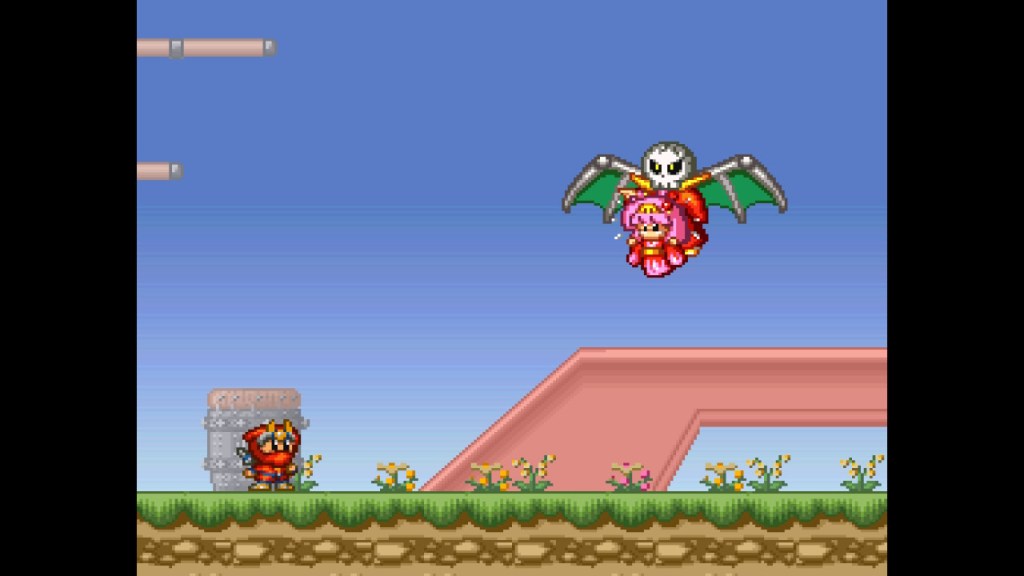
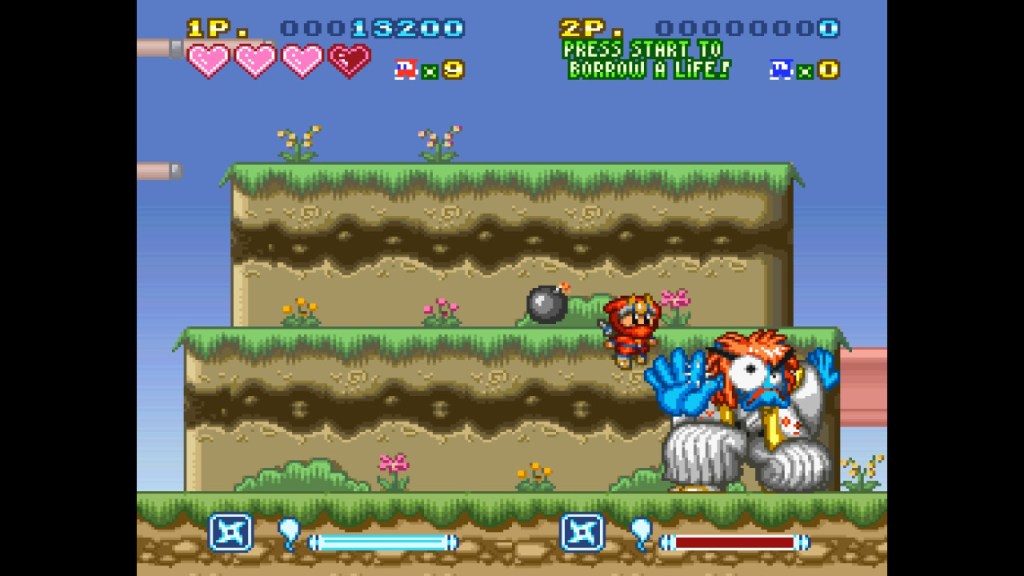
Super Ninja Kid (1994) is the only game in the collection without Ninja JaJaMaru in the name for some reason. But it’s still him! Without using cheats, the original version apparently offers you the choice of 3, 5, or 7 lives for Jajamaru. I really liked the background and music for the main menu in this one, and loved the designs for Jajamaru and the enemies. Even the sound effects when you hit an enemy are adorable!
This one is different in that it’s untimed. But it was difficult to figure out how to access the next parts of a stage. I liked it for the most part.
Ninja JaJaMaru: The Great World Adventure and Ninja JaJaMaru: The Great World Adventure DX

Flashing lights warning
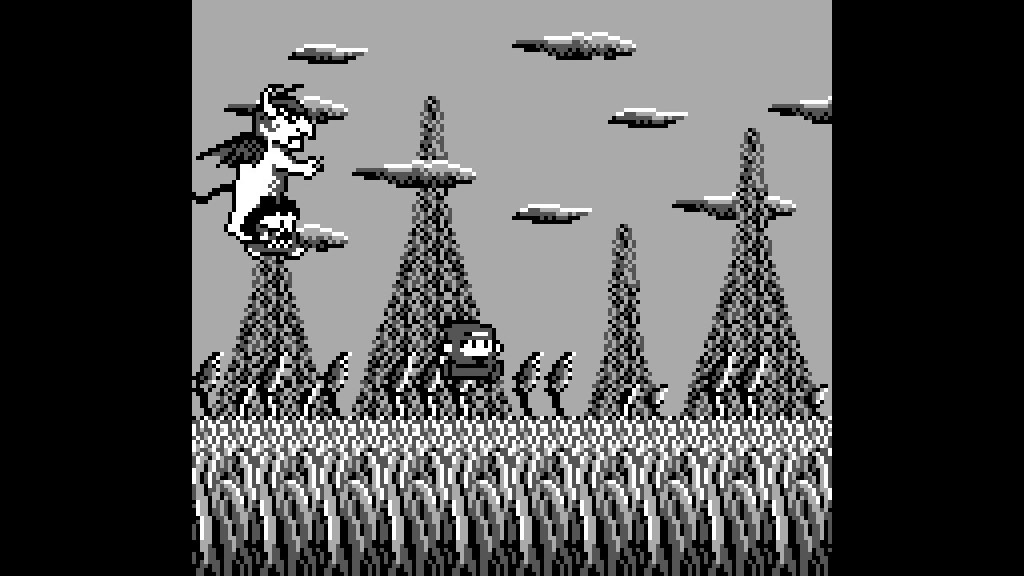
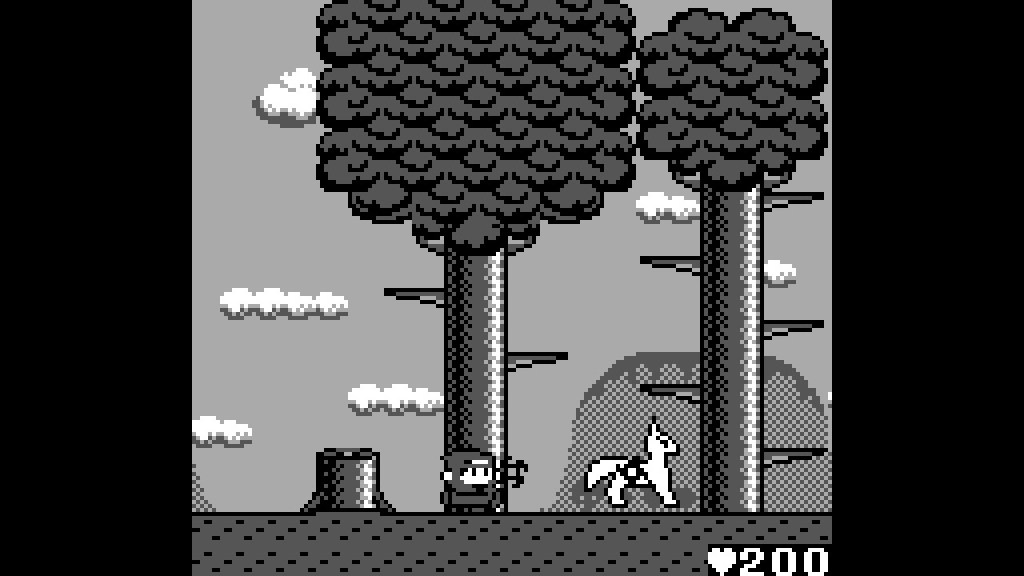
At this point, I think Princess Sakura just needs to hire Jajamaru as her bodyguard. This time, Jajamaru goes international in The Great World Adventure (1990) in order to save her from themed monsters such as Dracula in Romania. I liked the concept for this game. The stages are fairly short, but I liked the designs for the enemies in each stage. The kitsune designs are a lot more elegant in this game. There are cool “chimera” enemies that split into 3 individual enemies when you hit them, and the Frankenstein’s monster enemy was pretty funny.
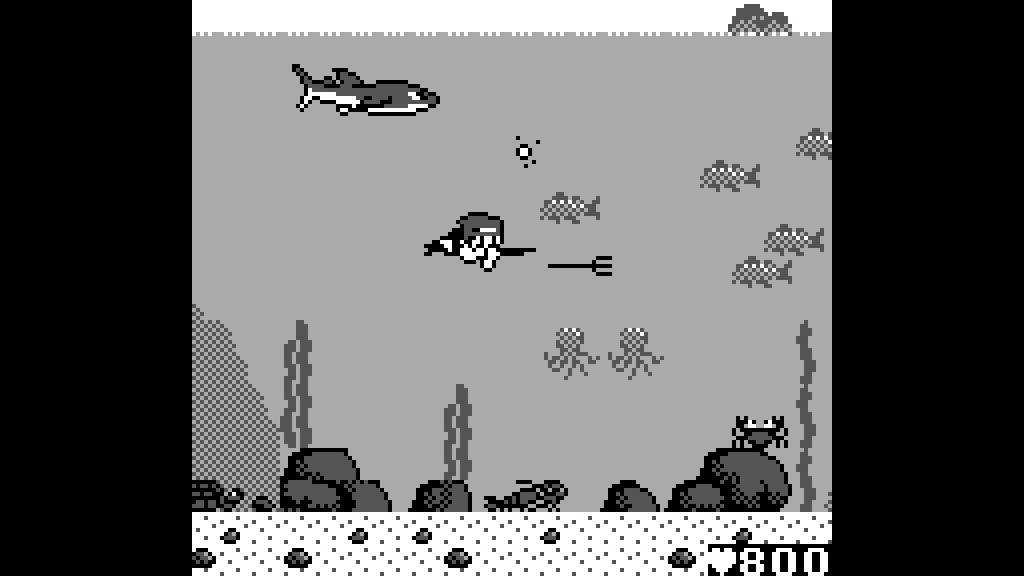
I liked the mechanic that allows you to walk upside down at the top of the screen, and you can jump/float pretty high also. I didn’t like the stage where you shoot harpoons at orcas – they have to be hit several times, and you can see the harpoons in them from previous hits. That was unsettling and sad. Other than that, I liked this. The final game in the collection, The Great World Adventure DX, is the same game but in color.
Although I don’t think I could have successfully played through these without cheats turned on, these are important parts of video game history and I liked seeing how far we’ve come in video game design. My favorite games in the collection were Operation Milky Way and Super Ninja Kid. Some games were harder than others; I do wish that the same cheats were available across all of the games (Operation Milky Way only had unlimited lives and not invulnerability, for example). The main flaw for the collection would probably be the lack of explanations for a few mechanics.
8/10
Ninja JaJaMaru: The Lost RPGs

- Price: $12.99 USD
- Release Date: February 21, 2023
Ninja JaJaMaru: The Lost RPGs contains Ninja JaJaMaru: The Ninja Skill Book and Ninja JaJaMaru: Legend of the Golden Castle.
Ninja JaJaMaru: The Ninja Skill Book

In this 1989 RPG, there’s a lot going on. First of all, the Book of Shinobi has gone missing – hence the title of the game. There are monsters showing up everywhere, people are being turned into yokai, a villainous dragon has taken some villagers, and something is preventing precipitation. Jajamaru is going to be a busy guy.
Before even getting started, I took a look at any enhancements, cheats, or blessings that I might want to use. The RPGs offer more customization options than the Retro Collection. They define enhancements as something that could make the game more fun “without breaking it too much.” These allow you to do things like reducing the random encounters or increasing the experience/gold that you earn.
Cheats let you break the game by unlocking unlimited HP/Jutsu points and gold, the ability to turn off random encounters, or even the ability to kill enemies with one touch. Blessings help you out when you need assistance with your current battle; you can choose to restore Jajamaru or Sakura’s HP/JP or to reduce the enemy’s HP to one. Like with the Retro Collection, I enjoyed having these as an option.
With so many problems across the lands, they ended up splitting the game into four separate yet linked chapters. For some reason, when this game was first made they decided to reset your levels and jutsu progression after the first two chapters, and the items from previous chapters will also disappear. (The fourth and final chapter allows you to keep your levels because it involves the final boss.) If this was a 50-100 hour game, I may have been more upset about this design choice. With cheats turned on, it’s less of an issue.
Like the classic games in the Retro Collection, The Ninja Skill Book is not very complex. Most of the traveling you’ll do will be on foot, but you will also have access to fast travel ride services and a submarine to travel across the seas. There are a few small towns, shops, caves, and lairs for you to explore. You’ll talk to a handful of people as you continue your journey, but the game is not overly plot/dialogue heavy. The shopping experience was somewhat frustrating because you can’t see how the equipment will change your stats. Consumable items also lack descriptions, and you can only buy one item at a time.
Besides the equipment shop and items shop, there is a shaman in each village who will check your experience, revive any downed characters, and apparently saved the game in the original version. This function, the character and enemy designs, and the battle system all reminded me of Dragon Quest. In Jajamaru’s quest, the villagers’ problems all stem from difficulties with demons.

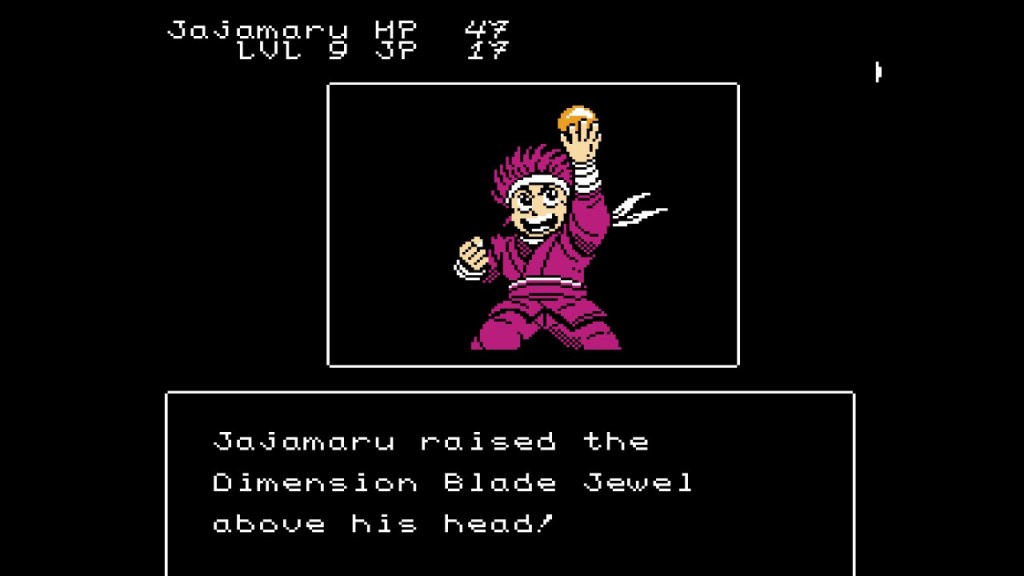

You’ll have to fight those demons in turn-based combat. The flow of the text in the game is a bit slow. At first you will only have Jajamaru in your party, but Princess Sakura will join you in a later chapter. When Jajamaru and Sakura reach certain levels, Buddha will appear and give them the ability to learn new jutsus. Additional jutsus can be learned by defeating cave-dwelling enemies who possess jewels. (Again, there was no description of what the jutsus did; there were only a few obvious ones with healing involved.)
I believe that it took me about ten hours to beat the game. Bosses only seemed to have around 250 HP at most, and I think Jajamaru learned his last jutsu before reaching level 15. I definitely appreciated that the game was short but sweet. The lack of descriptions for pretty much everything made things difficult though, and the lack of world map made it a challenge to navigate without getting lost (even in a smaller world map like this one).
I also ran into trouble when people told me they were giving me something as a reward. One man said he was giving me an axe, which I needed to access the next area. I assumed it would be in my inventory and went to the tree I needed to cut down, only to discover that I didn’t have the axe. What you have to do – which was something else that went unexplained – is use the search function in front of the man, and that’s how you get the axe.
A lack of explanations and descriptions seems to be a common issue across the older games in general, but I don’t think that’s something they could – or should – have changed for this collection. I figured it all out eventually, and those looking for a classic, less complicated RPG would enjoy this. This one gets bonus points from me for having Princess Sakura fighting with Jajamaru instead of the usual kidnapping plot! I also quite liked the character portraits and soundtrack.
Ninja JaJaMaru: Legend of the Golden Castle

Flashing lights warning
Ninja JaJaMaru: Legend of the Golden Castle, a 1990 top-down action RPG, starts off with a wounded samurai arriving in Ninja Village to tell you that once again, Princess Sakura has been abducted (as well as the Lord of the castle). He gives you a Holy Mandala so that you can collect 8 spirits and prevent the events predicted in the Prophecy of the Great Demon from coming true – as well as rescue the Lord and Princess Sakura.


Gameplay and exploration are somewhat reminiscent of the older Legend of Zelda games. Instead of using a sword and shield, your main weapon will be Jajamaru’s Ninja Chain, which allows you to attack enemies from a distance. You can also purchase shuriken in limited quantities. Jajamaru starts with four hearts worth of health and no jutsus, but after you finish a boss battle you’ll learn a new jutsu.
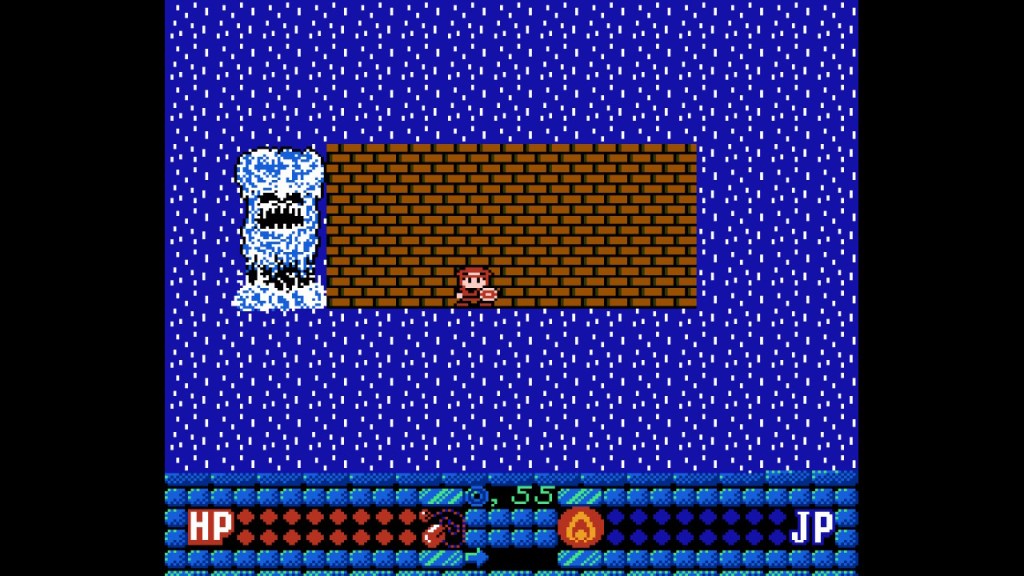
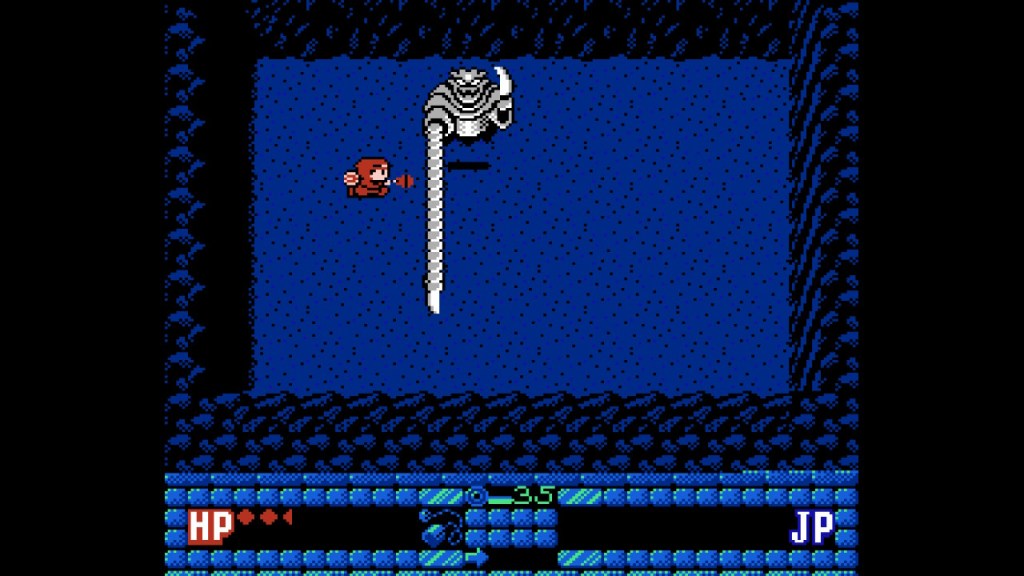
When you lose a lot of health in battle, you can restore your hearts at inns in the villages you pass through. I don’t think games like this tend to have that, so I was happy to have the inns. The game also has very few puzzles compared to Zelda games. Compared to The Ninja Skill Book, Legend of the Golden Castle has similar issues with slow text advancement. There are also flashing lights, and a lot of strange “fuzzy” flickering that occurs when moving around.
It was much easier to figure out where to go and what to do than it was in The Ninja Skill Book. I liked the character portraits a lot in The Ninja Skill Book but felt that the story was more cohesive and navigation was more straightforward in Legend of the Golden Castle. Without using cheats, I think the combat is harder in Legend of the Golden Castle since I could at least grind for levels in The Ninja Skill Book. Both games are short but enjoyable enough.
 Switch It On Gaming
Leave a comment