- Price: $5.99 USD
- Developer/Publisher: Doomster Entertainment
- Release Date: January 12, 2021
Beyond the basics, math has never been my best subject. But when I saw S.U.M. – Slay Uncool Monsters on the eShop, I was still interested in the game because I like educational software. Motivation is a pretty important factor in learning, and connecting students’ interests with subject matter has a higher chance of getting them engaged in the learning process. Decades later, I still have fond memories of playing Treasure Mathstorm. I figured that there would be a high “probability” 😉 of kids enjoying S.U.M., so I wanted to see how it worked myself!
You don’t just get thrown in the deep end when you start playing; there is a practice mode that allows you to choose which operators (+, -, x, or ➗) that you want to use for practice. Then you have to choose the amount of variables (between 1-4), plus up to 100 floors in the “dungeon.” Practice mode will help the player get used to the gameplay, and there aren’t timers, damage to your character, or experience points.

In the main game, you’ll start in a map with a lot of individual dungeons that contain a varied amount of floors as well as specific types of operations. There were only about 10 floors in some of the beginning dungeons, but later dungeons can get a bit overwhelming with 50-100 floors and math problems. One dungeon may only have you solve equations with addition, while another may have multiplication and subtraction.
There will always be a 5×4 grid with a random assortment of numbers ranging from 1-9. You’ll confront monsters in each dungeon; every floor will have a timed equation to solve, and the monsters will be defeated if you choose the correct number(s). You have to come up with a combination of numbers that will equal the specified number when added/subtracted/divided/multiplied. There can be multiple correct answers, and they never give you an equation if the grid doesn’t have the right numbers to solve it.
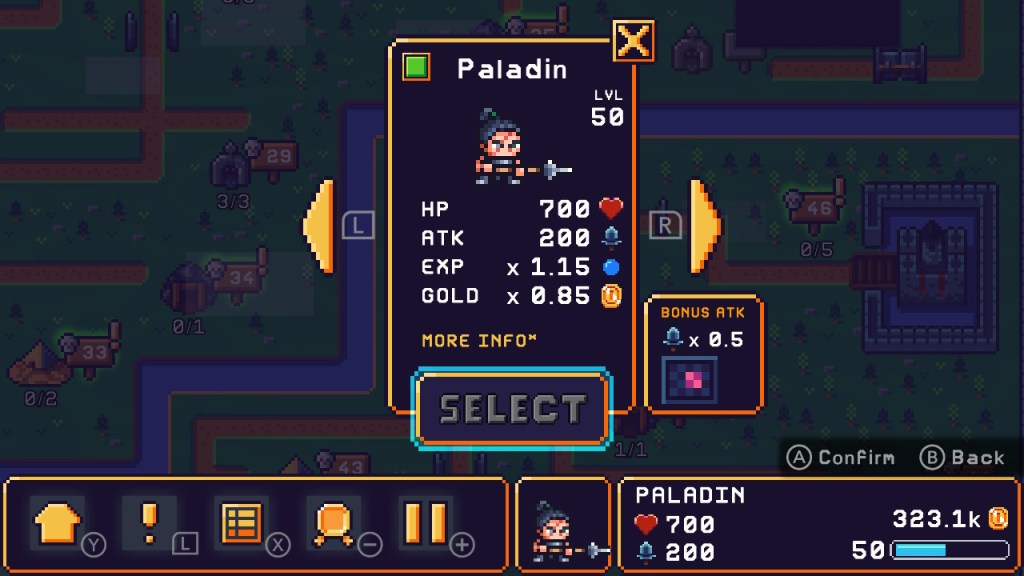

You’ll earn experience points and coins upon defeating each monster. (Coins are used for unlocking gates to additional areas with more dungeons.) If you level up inside the dungeon it restores your HP, which is nice because there aren’t any healing items or abilities for the most part. (An exception is the healer class.) You start the game as a mere adventurer, but once you’ve met some conditions (defeat X monsters or stay at the tavern Y times) you will unlock new classes with special benefits. When you switch to the new class, that class starts at level 1 again, but your initial class will maintain their levels.
Leveling up your character’s new classes will make them a bit sturdier with more HP. The timed element of each floor in the dungeon can sometimes make you rush, resulting in careless mistakes. If you choose a number that won’t work for the problem, as long as it’s not the last missing number you have to solve for you can delete it and select another number. Inputting incorrect answers will break your combo and result in damage to your character. The farther you get on the map, the more complicated the math problems get.


You won’t have time to write down the problem and solve it on paper – it’s all quick mental math. This may be more difficult for some people; I did end up making mistakes sometimes because I don’t do well with timed tasks. Touch controls may have been a helpful option, as using the joystick or directional buttons took longer. I did manage to successfully complete the game, but for those who find themselves unable to solve the problems under pressure, the practice mode may work better.
After completing a dungeon run, you may need to restore your HP, which you can do by sleeping at the tavern. If you happen to lose, it won’t result in a “game over” – you’ll lose some money and have to go to the tavern to heal before trying again. The game will tell you the percentage of right and wrong answers once you have beaten a dungeon, and you can replay that dungeon to improve the percentage of correct answers if you’d like.
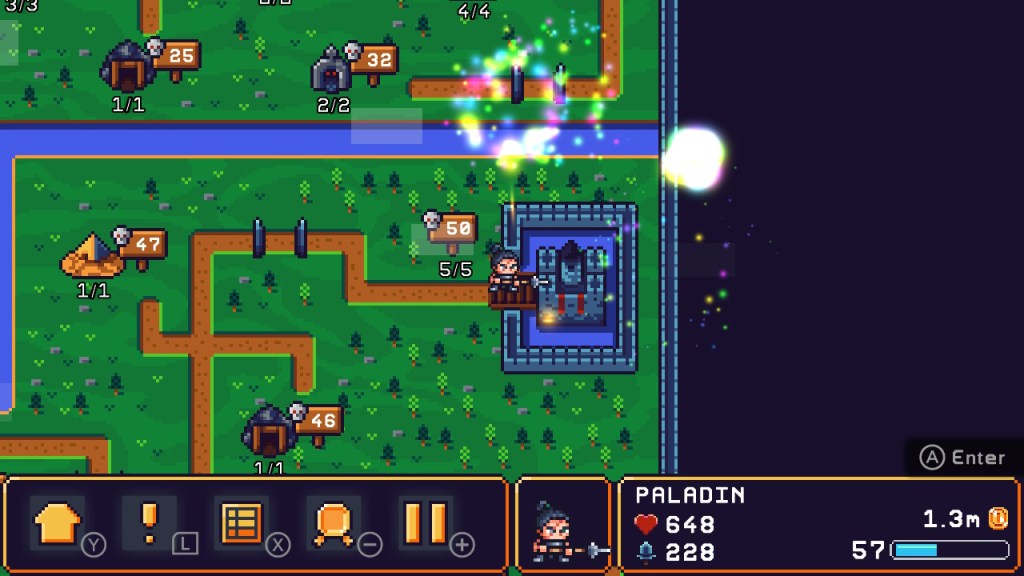
You can beat the final dungeon at the castle, but if you’d like you can also choose to “ascend,” which creates a new version of the world that starts at Level 50 this time. There’s also an endless mode with levels for addition, subtraction, multiplication, and division by themselves (or that include all 4).
I think that there’s a lot to like about this game – including the different modes. I especially liked that the math problems are not just things like the times tables in order, so players really have to know the math instead of relying on rote memorization. (Perhaps they could have included a basic times tables mode for beginners?)
I’m hardly a math expert, and I’m unfamiliar with the current standards in math education, but I think this could be a good game for helping kids make their math-solving skills more automatic. The 62 achievements can give players a sense of accomplishment, and the game also demonstrates that there are often multiple solutions to problems.
As far as the required skills for S.U.M., I had to look up the approximate grade levels for each one:
- Addition & Subtraction: continue to build between kindergarten and fourth grade
- Multiplication & Division: starts in third grade
- Negative Numbers: between fourth and sixth grade
- PEMDAS/order of operations: fifth or sixth grade
I can’t speak to whether or not kids today will find this cool, but I enjoyed the heck out of Treasure Mathstorm as a kid. To me, this seems like something kids would prefer over regular math drills. There’s not much to read in the game, so I would tentatively say it’s dyslexia-friendly (but perhaps not so much for dyscalculia). This could potentially be made into a fun family activity even if kids are at different grade levels skill-wise.
Younger kids could either play in the practice mode with addition (not sure about subtraction due to negative numbers) or they could do the addition levels in the regular gameplay mode. Siblings who work at a higher level could use their turns on the more complicated levels with multiplication and division. One might say it would be a good idea to “divide” and conquer. 😉 If you want to make math more fun, S.U.M. will make a nice “addition” to your Switch.
 Switch It On Gaming
Leave a comment