
- Price: $11.99
- Developer: ISOLATION STUDIO
- Publisher: PM Studios
- Release Date: November 17, 2022
A review code was kindly provided by Team Critical Hit on behalf of ISOLATION STUDIO and PM Studios. We thank them for being able to cover something they’ve worked so hard on.
Say “hello” to GOODBYE WORLD, one of the games included in the recent Indie World Showcase that caught my attention with an interesting premise. Kanii and Kumade, two indie developer friends, have been struggling to sell their games. Coming up with a winning concept for a game is incredibly difficult, and being able to work on a game full-time isn’t always possible. That is indeed the case for Kanii and Kumade, as they both have part-time jobs to support themselves as they try to keep their dream alive. Will they continue on this path, or will it be “game over” for their careers as game developers? We’ll have to find out across 13 chapters and 12 puzzle/platformer stages in this narrative adventure game!

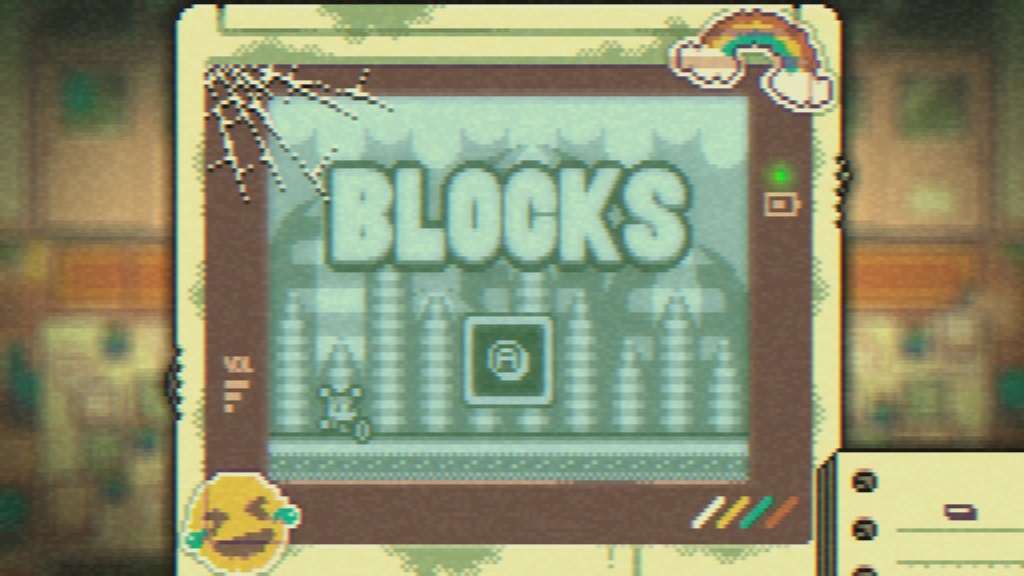
The story begins in 2017, when Kanii and Kumade were just getting started with their collaboration. You’ll get to see how their friendship – and their game – developed over time. Each chapter has a game stage that goes with it, and along the way you will play their platformer from start to finish. Their game, called Blocks, has you control a character that looks like a cute little bear. The graphics in Blocks are fairly simple, but they work well for their purpose of paying tribute to the games of the past. I also thought the music track was pretty pleasant.
Blocks really reminded me of playing Super Mario games when I was a kid. Most stages are in black and white, with the occasional color sprinkled in. To complete a stage, you have to break some cracked blocks, which are then added to a “stockpile” for you to use to build paths. As you have a limited amount of blocks in each level, you’ll often find yourself using one building block to access another one, then return to break the first block again. This adds it back to your building block stock.
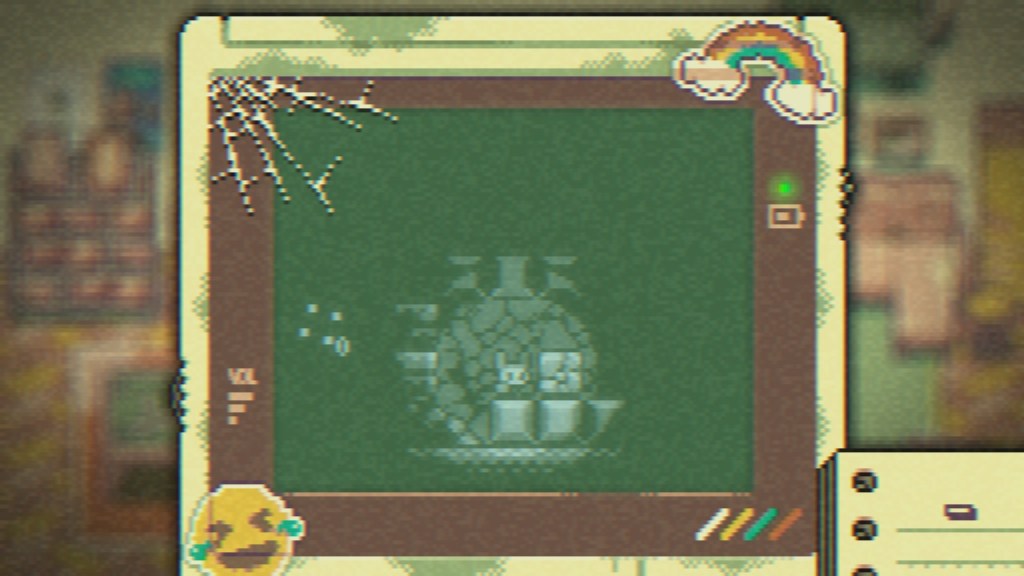
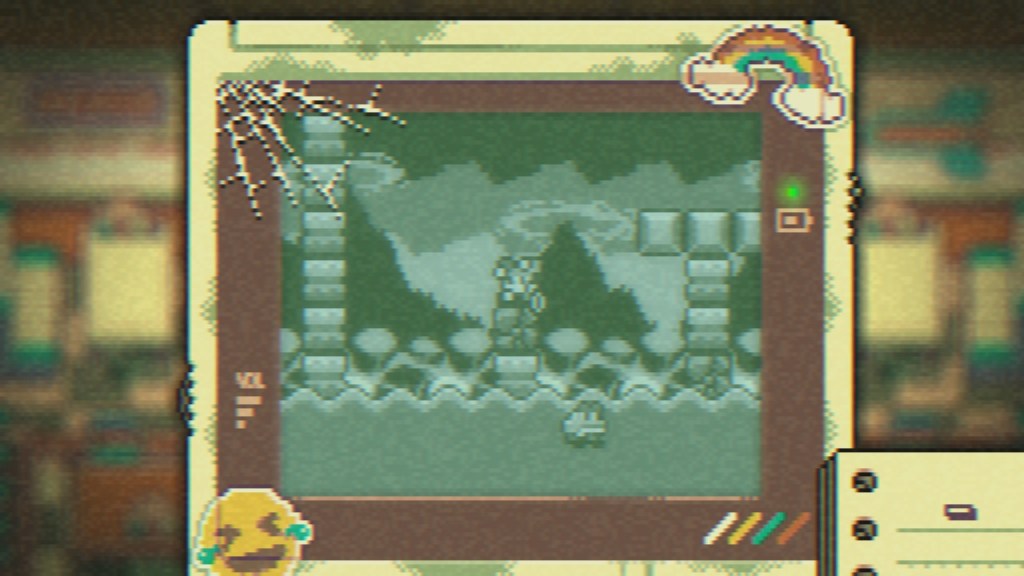
The controls are different than what I’m used to; to jump, you press the up button instead of A or B. A is used to break blocks, and B is used to enter the block placement mode. It took me a while to adjust to the controls, but the gameplay stays pretty consistent across each stage, with some variation based on any environmental obstacles or enemies there. You may have to navigate environments in almost complete darkness, or a stage with lava for you to avoid as it rises and falls. 😬
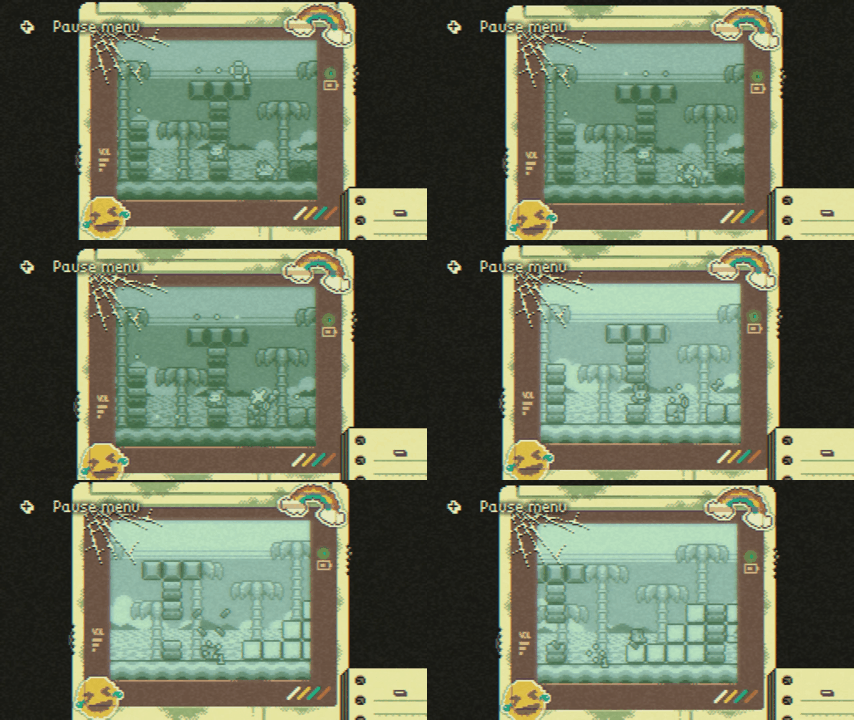
In other platformers I’ve played, I could get rid of an enemy by jumping on them, attacking them with my sword, etc. When I jumped up to try stomping an enemy in Blocks, making contact with it resulted in a game over. Here, you can only defeat some of the enemies by placing a block in their path as shown above. This has some limitations, as there are only certain “squares” where you are allowed to place a block. I also had the occasional issue with accidentally placing a block up high where I couldn’t reach it to reclaim it, and there wasn’t an undo option.
I wouldn’t say that the platforming sections were overly difficult, but I sometimes misjudged my jumping capabilities for the distances I needed to travel and would lose a life for that. Although I wasn’t able to beat every stage within the allotted 3 attempts/lives, I really liked how they still allow you to advance the story even if you have trouble with the brief platforming sections.

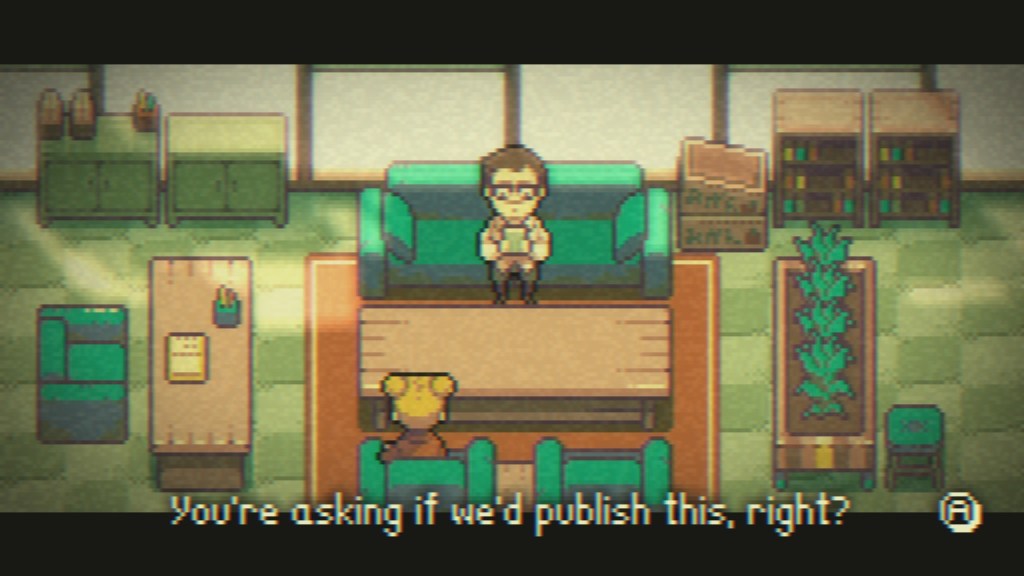
Outside of the Blocks portions, you’ll discover more information on Kanii and Kumade’s “developing” friendship and their work together. Kanii is their programmer, while Kumade produces the art for their games. The chapters are not entirely linear; they start in 2017 in the first chapter, then they go to 2021 and back to 2017 again. The story depicts the difficulties that developers face along the way. You need the right group of people as well as the time and funds to really work on the game. Kanii and Kumade demonstrate how conflict and indecision can negatively affect a game’s development and beyond.
While GOODBYE WORLD is relatively short, I thought it seemed like a realistic snapshot of life as a development team trying to make its way in the “real world” after graduating from college. It reflects how relationships and dreams can change – or even come to an end. Kanii and Kumade discuss using “metafictional ideas” in their games, and when this story ended I was a little confused but it was at least an interesting ending.
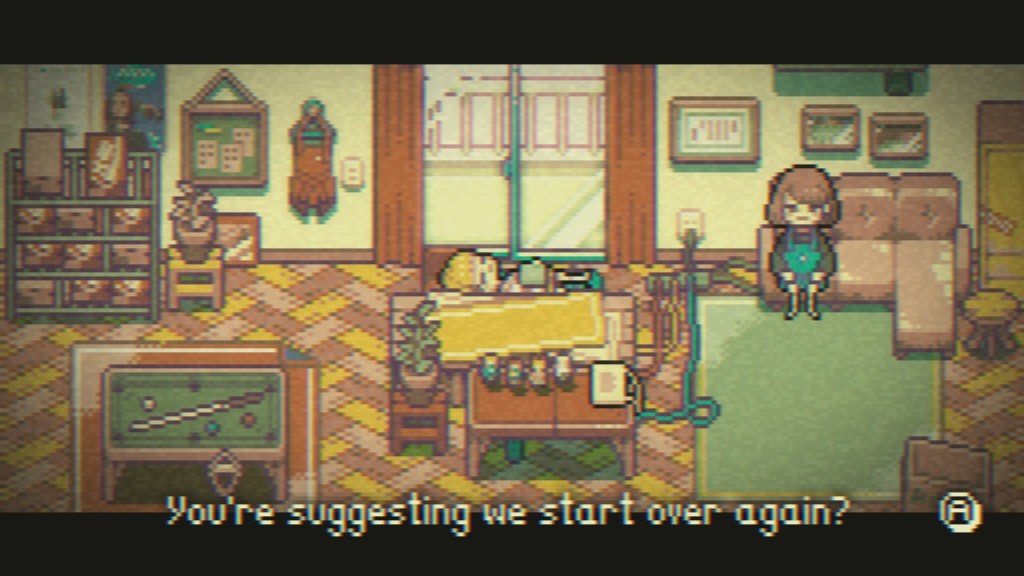
And once you’ve completed the game, you can choose to experience the scenes in specific chapters again, and you can replay that chapter’s stage again as well. Or, if you just want to platform without plot, select the bonus section and replay the Blocks levels. As I mentioned above, you only get three attempts at each stage in the main game. But in the platforming-only bonus mode, you seem to accumulate additional lives as you progress through each stage. You don’t get infinite lives, but you still have more attempts than you would in the “full” game.
Funnily enough, as I was playing through the plot and platforming parts together in the full game, I regretted not being able to retry the levels I failed. Wouldn’t it be nice to see if I could complete them with a little more practice? 🤔 And sure enough, they delivered that exact feature I wanted in the bonus section, and I got to try those levels again there. I would have liked it if they had chosen to let us to select individual platforming stages, as the bonus section makes you start from stage 1 each time you select it. You can’t save your progress at stage 6, exit, and then come back to it when you return to the game. Instead, you’re forced to start from stage 1 again.
That being said, I think it shows thoughtfulness and foresight to anticipate that the player will more than likely want to have a separate mode to master the platforming sections. They also chose not to potentially frustrate players by tying plot progression to successfully completing stages in the main game. Those seemed like good design choices to me. But in terms of the plot, I wanted to see more of Kanii and Kumade’s friendship and how they worked together on their games. I didn’t want to say “goodbye” to the game just yet, and wanted it to be longer. There are good ideas here – it just seemed to need an expansion, with more story and stages.
 Switch It On Gaming
Leave a comment