
- Price: $14.99 USD
- Developer: Bad Viking
- Publisher: Iceberg Interactive
- Release Date: July 28, 2022
A review code was kindly provided by Iceberg Interactive on behalf of Bad Viking. We thank them for being able to cover something they’ve worked so hard on.
We recently reviewed Ambition: A Minuet in Power, a unique game developed by Joy Manufacturing Co. and published by Iceberg Interactive. Continuing our exploration of Iceberg Interactive-published games, we now take a look at Strange Horticulture, described as an occult puzzle game/plant-based detective mystery on developer Bad Viking’s site. I’ve never seen that in a game before, so I’m excited to get started!
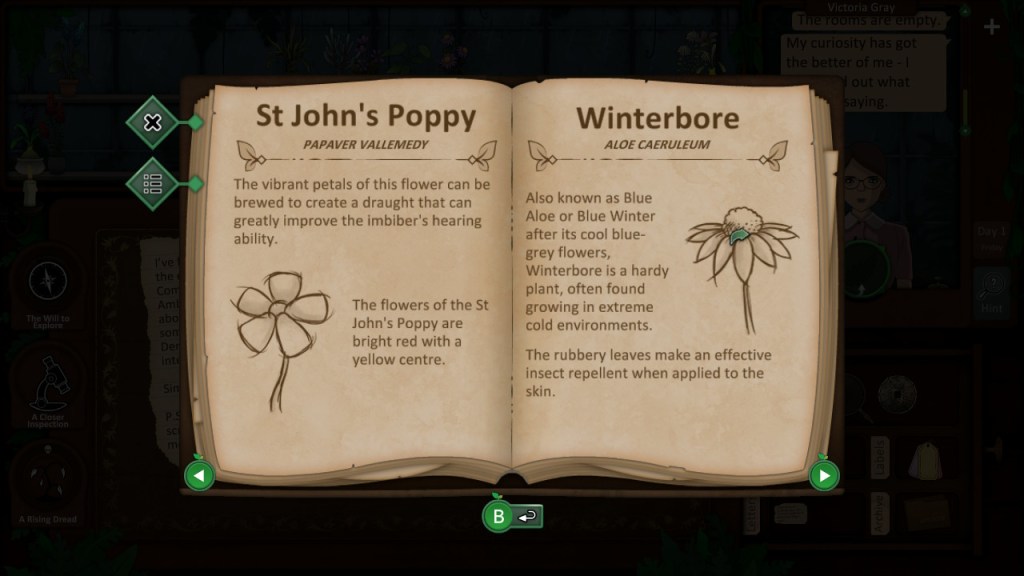
In the game, you’ve inherited a plant shop – the titular Strange Horticulture – from your uncle. You are provided with an incomplete encyclopedia to help you identify the plants in the shop. The encyclopedia includes partial drawings of a plant (either the flower, stem, leaves, inside, or underside) and a brief description of the plant’s appearance and purpose. However, the plant sketches are colorless, so if the description doesn’t mention color as a clue you’ll have to use the other descriptors to identify a plant. (I liked how they included a simplified font option to make these descriptions easier to read, and they also included touchscreen controls!)
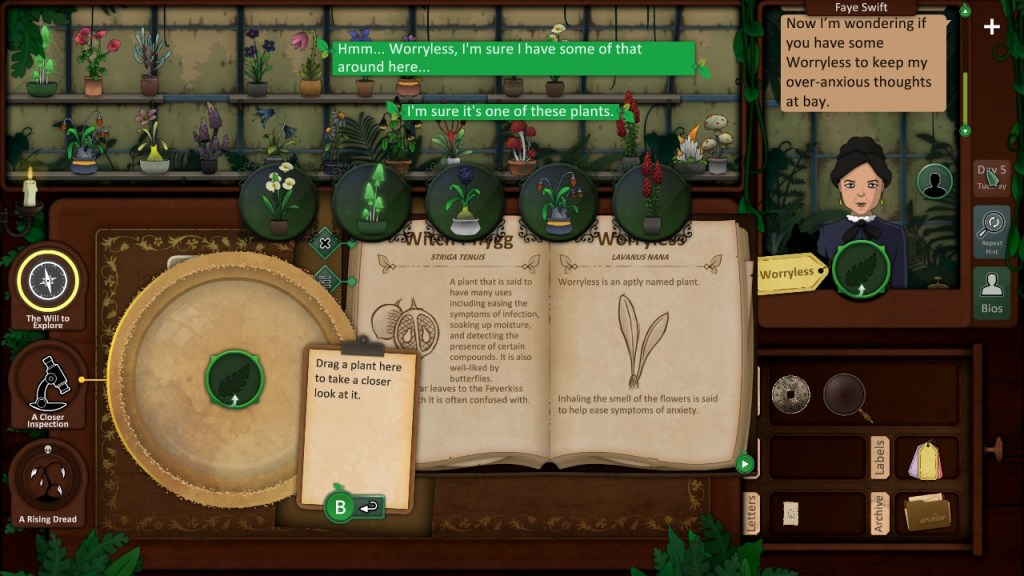
If you make the wrong choice in identifying a plant, it increases your “rising dread” meter; too much of it shatters your mind and you have to put the pieces back together again. I never found out if you can reach a game over by purposefully messing up again and again, but it doesn’t seem like it. (Plus the game conveniently has saves for each day that allow you to start the game where you want to in subsequent playthroughs.) You can ask for progressive hints if you want them, first letting you know if you even have the requested plant, then showing you a group of five plants containing the one you need. It may have been nice to also have hints for some of the more difficult clues for plant locations as well.
Identifying plants could be tricky but not overly difficult, although some can really trip you up when they share similar characteristics with other plants. Once you have correctly identified a plant, you can label them manually or choose to have them auto-labeled for you. Unfortunately, the encyclopedia doesn’t update with full color illustrations of the plant upon identification. The shop’s shelves – and my desk – could get a bit cluttered and disorganized sometimes. Having an updated encyclopedia entry with the full image could potentially have made it easier and faster to locate a plant on those shelves.
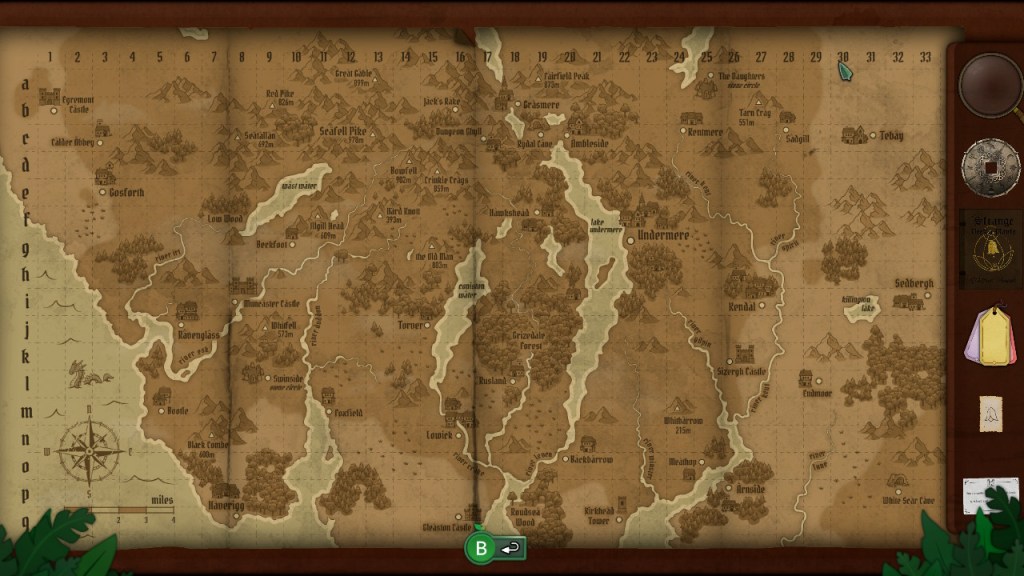
There are 77 plants for you to find and/or identify, and that’s why the shop starts to become more difficult to navigate. Every day, you’ll receive a special card that gives you vague hints as to where a new plant is located on the map. The map is divided into over 500 squares on a grid, and there are various towns or landmarks to reference when looking for plants in “blank” squares. People will also send you letters with clues; some are more obvious, and others were so difficult that I never would have gotten them without random guesswork. I would have liked it if they marked which squares you’d been to already. But overall I did like that the game provides you with interesting challenges to make you think.
I also appreciated the way they implemented the different methods of discovering the game’s secrets. Some clues could only be discovered by using a viewer capable of detecting invisible ink of some sort. There’s also a disk with multiple symbols that helps you find a plant based on another location. I thought the hints and methods of uncovering plant locations were clever.
Besides the plant puzzles, you eventually unlock lab equipment that allows you to brew elixirs, but it was about halfway through the game’s timeline of 16 days, and we don’t get to use it as much. It might have made an interesting challenge to have more puzzles that used elixirs created using your plants. Each elixir uses three ingredients for you to identify according to the clues on the recipe sheet. Perhaps we could have even combined elixirs for an even bigger challenge.
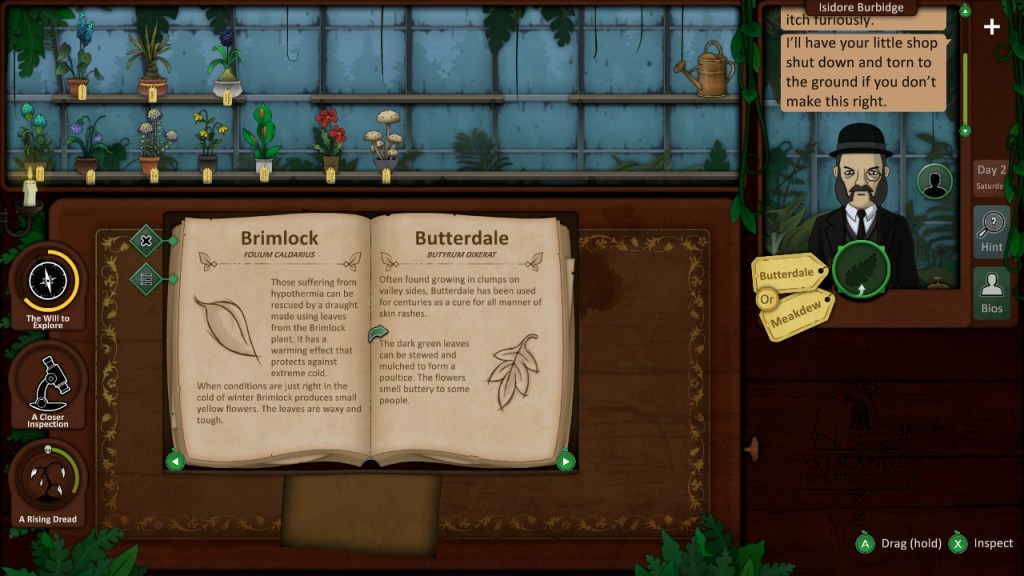
As you continue to solve the puzzles, you’ll also get a sense of the plot with every visitor that comes to Strange Horticulture. There are occult themes in the plot and in the purposes of some plants (such as using them to find someone, or to unlock something). Customers will request a plant or elixir by giving you its name – or desired purpose if they don’t know the name. Most of the time there’s only one option that will work, but there are some requests where you can choose between two options to influence the plot more. One plant or elixir might get a particularly irritating customer to settle down, but the other might be a more permanent solution… 😈
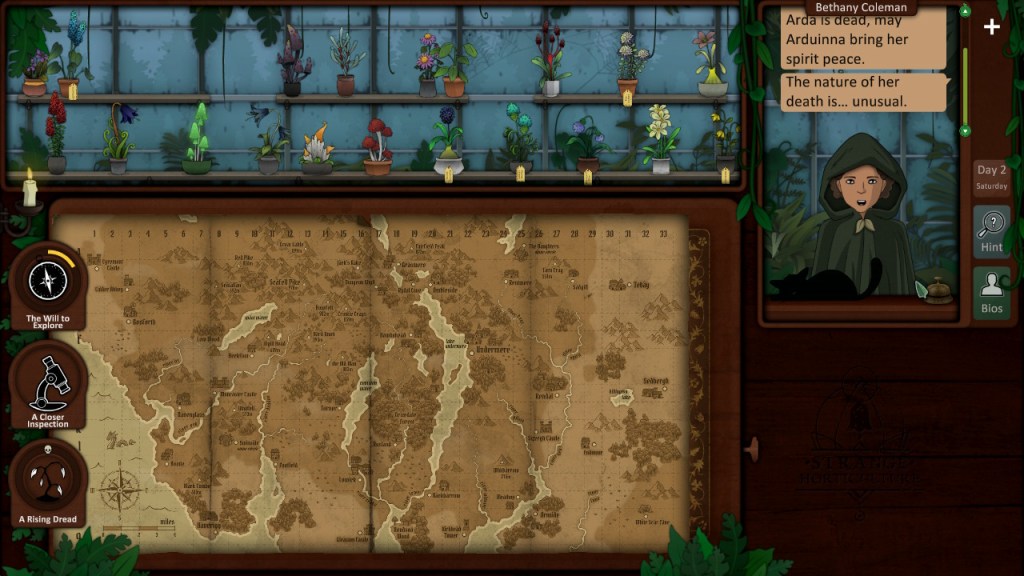
You’ll interact with a psychic, a librarian, coven members, investigators, and more. Solve their problems to their satisfaction and they will provide you with plants or hints. Whenever they come into the shop, they’ll give you the latest gossip on the murders in the community, which have an occult influence. I really liked how they included a section with character profiles that contain some background info and their chat logs from their conversations with you.
At the end of each day, you’ll also get some more details that tie into the origins of the plot. I figured something out regarding one character’s identity after reading the profiles again in my second playthrough. I thought they did a pretty good job with connecting all of the information. There are multiple endings to view based on your choices throughout your playthrough, and I liked how they show you which characters survived, who was injured, who was killed, and they even tell you which characters remain on speaking terms with you!
The subtle details in the game are quite impressive. For example , an article written by one of the Bad Viking developers mentioned that your character’s map was owned by the real-life author of a plant compendium written in the 1600’s (ebook available to download on Project Gutenberg for free depending on your country’s public domain regulations). I read a bit of that compendium out of curiosity, and it’s fascinating to see what people thought plants were capable of back then. Strange Horticulture takes inspiration from those centuries-old beliefs with the lovely original plants they have in the game.
Switch it ON or Switch it OFF? Strange Horticulture is an incredibly unique plant puzzle game with occult themes. A few plant descriptions and locations could be difficult to interpret, and it may have been interesting to have more elixir puzzles. But the game provides a good challenge with optional hints for when you have trouble figuring something out. I loved the designs for the plants and encyclopedia, and appreciated the inclusion of multiple endings. The game is not massively plot-heavy, but it has a creative story that’s complemented by the clever puzzle mechanics. 8/10

 Switch It On Gaming
Leave a comment