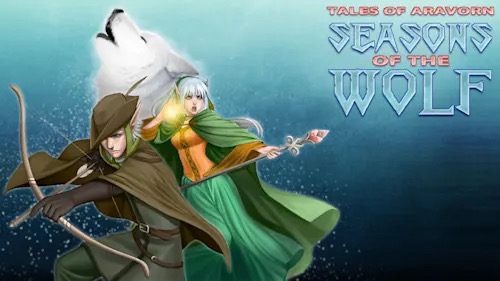
- Price: $19.99 (currently on sale for $15.99 until July 8th)
- Developer: Winter Wolves
- Publisher: Ratalaika Games
- Release Date: June 17, 2022
A review code was kindly provided by Ratalaika Games on behalf of Winter Wolves. We thank them for being able to cover something they’ve worked so hard on.
Content advisory: rated T & slavery is involved in the game’s plot
I remember seeing Tales of Aravorn: Seasons of the Wolf announced in a Ratalaika Games Visual Novel Showcase video a while back, and as the game combines two of my favorite genres (visual novels and RPGs), I was excited to check it out! The developers, Winter Wolves, have previously partnered with Ratalaika Games to bring Roommates and Flower Shop: Summer in Fairbrook to the Nintendo Switch.
Tales of Aravorn has four difficulty options plus a visual novel mode that allows you to skip all battles! And for achievement hunters, the game has 40 different achievements to earn, and you can choose to reset achievements for when you replay the game! (Unfortunately, to obtain the boss related achievements, you would have to play the entire game in Hard or Nightmare mode.)
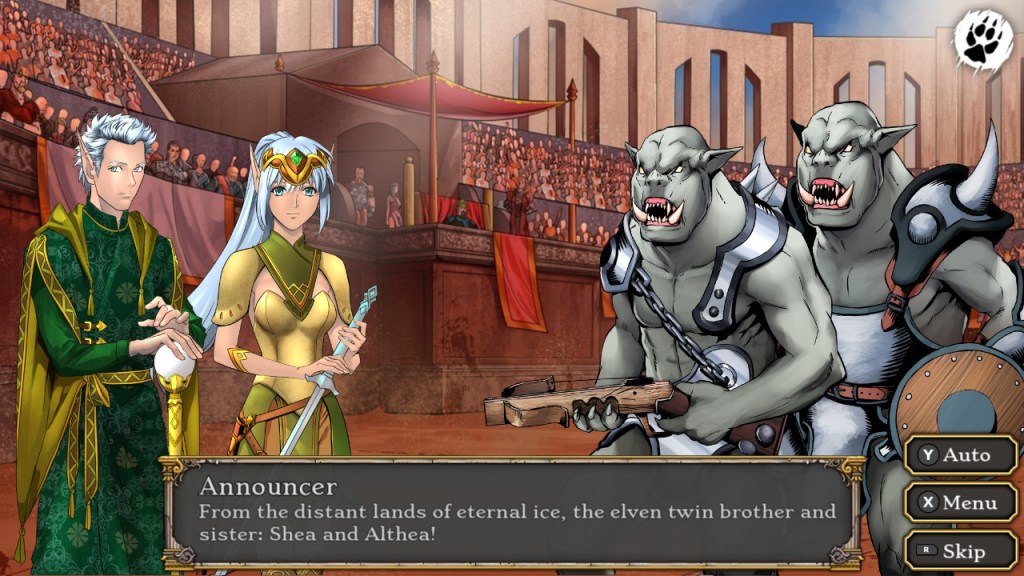
You must choose to play as one of the two main characters, elven twins Shea and Althea – regardless of which character you choose, they’ll both be involved in the game’s story. I like that they have the same class options instead of having stereotypical gender-exclusive classes. You choose the class option for both characters; the three classes include ranger, hunter, and Druid. I liked that the character portraits change based on which class you choose for a character!
After choosing their classes, you add attribute points to the stats you want emphasized, and they even give you some tips on how you may want to build your characters. Then there’s an interesting aspect where you select a bonus trait based on a short story from their early life! You also decide on a starting skill for each of them. It says that playing as either character will only affect the romance options. That was a little disappointing for me because I would have liked it better if Shea and Althea could date any of the four love interests regardless of gender.

Once you’ve decided on gender, class, and stats, the game opens in the arena of a place called Dingirra. Shea and Althea must participate in a battle against two orcs. Combat is turn-based, and in battle you click on enemy portraits to attack, or select ally portraits for supporting actions. You’ll face a variety of foes, including humans, centaurs, the undead, and wild animals.
Once the first battle ends, you discover that Shea and Althea are “arena slaves” in Dingirra due to an incident in their hometown. If you break the law or displease someone powerful in Dingirra, you can end up as an arena slave. The council in their village did not want to anger the Dingirrans because they are essentially their only trading partner due to the village’s isolation. As a result, the council allowed the enslavement of their citizens despite the fact that the twins were not completely responsible for what happened.
Shea, Althea, and another elf from their village are put in a group with an illusionist named Riley, with additional party members joining later on. Apparently, the reason that slaves can’t escape is because they have a “slave portal” spell cast on them that will send them into some sort of void should they attempt to leave Dingirra. They’re assigned to deliver invitations to the four major families of Dingirra, who squabble amongst themselves in power grabs. Yeldin, your “master,” seems content to give you the illusion of freedom in the cage that is Dingirra – as long as you perform well in the arena. Fight in the arena and run the occasional errand for Yeldin, then you can explore the city.

Gameplay occurs across several seasons, and they have indicators that let you know how many sidequests will be available each season as well as how many locations you haven’t discovered yet. You can travel to stores in the area to buy equipment and healing items. Shops will offer discounts based on your party’s “Fame,” which increases when you complete quests. The tavern offers jobs for you to complete as well, and has food and beverages to restore your HP and/or SP. Oddly enough, they don’t offer full HP/SP restoration services like an inn would in most games.
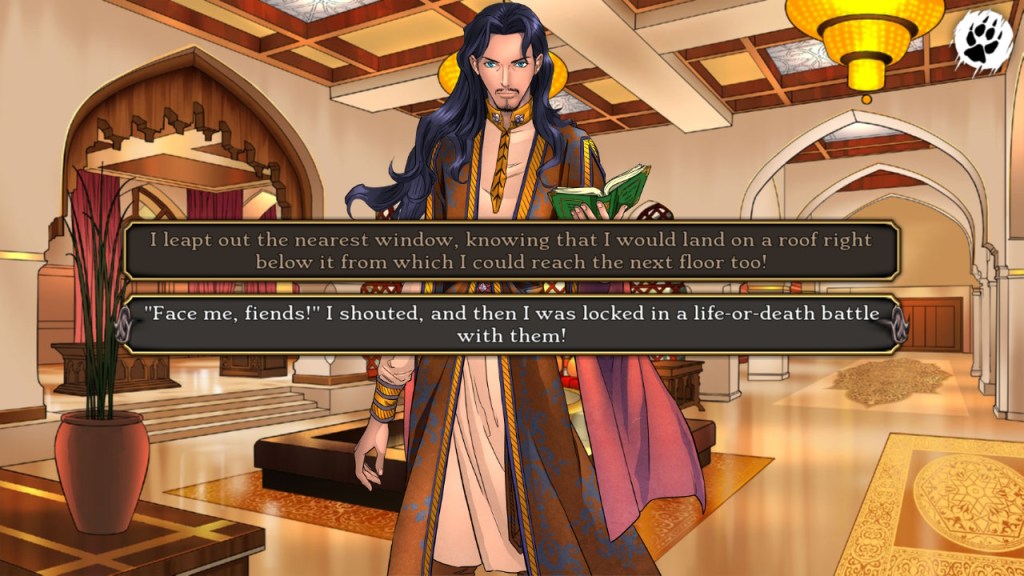
As time goes on, you’ll learn more about your party members; there are interesting flashback stories where you play and fight as the individual character. Completing these flashback scenes will not only give you more insight into a character, but you will also acquire useful items or abilities. I really liked the way they chose to tell these stories through flashbacks instead of merely having characters tell the stories in the current scene.
The visual novel aspect of the game allows you to choose your actions. In some scenes it seems like it doesn’t matter what you choose, but in others it will change the way future events unfold. In my first playthrough, I chose to go one direction first, which made it so I couldn’t complete the other two quests and find out more about what was happening. In subsequent playthroughs, I tried a different order and was able to complete all of the quests there. Many quests will have several choices in a row with different options, and one decision may lead you to an enemy, an item, or a dead end. I really appreciated the effort put into providing different experiences based on your choices.
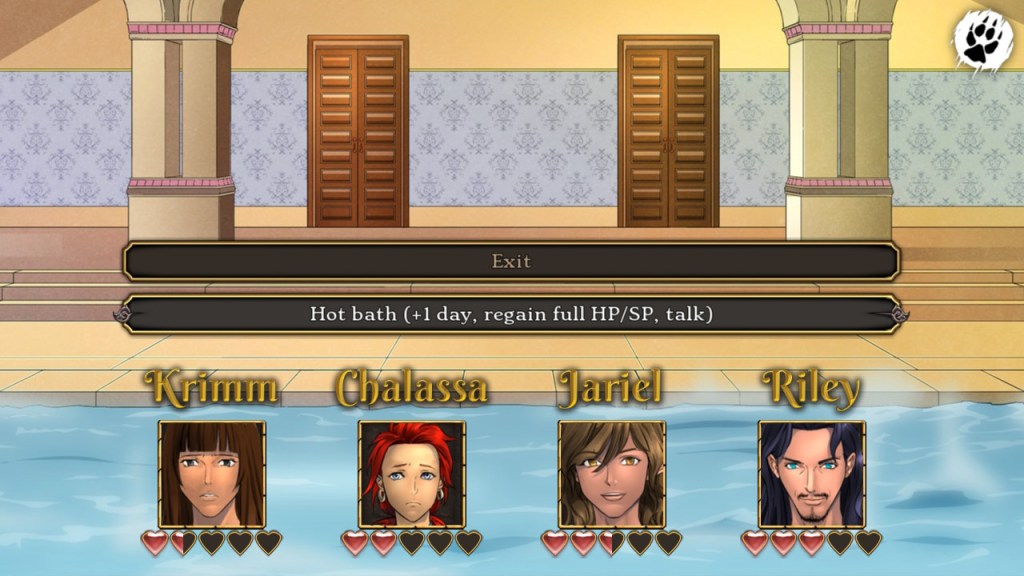
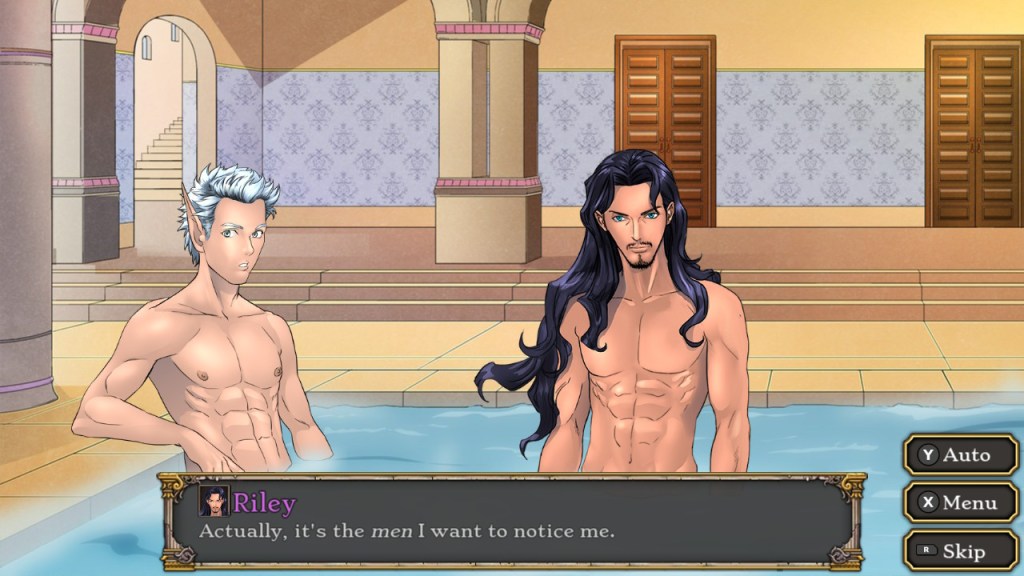
As I mentioned above, there are also choices to make in the romance department. You can choose to experience the game without any romance if you’d like, or there are four love interests to choose from (two for Shea and two for Althea). Shea can date Riley (😍) or Krimm, while Althea can go out with Chalassa or Jariel. I’d recommend creating several saves as you play through the game in case you make the wrong choice in a conversation with one of them, and you can also load earlier saves and choose a different love interest for speedier playthroughs next time. 💕
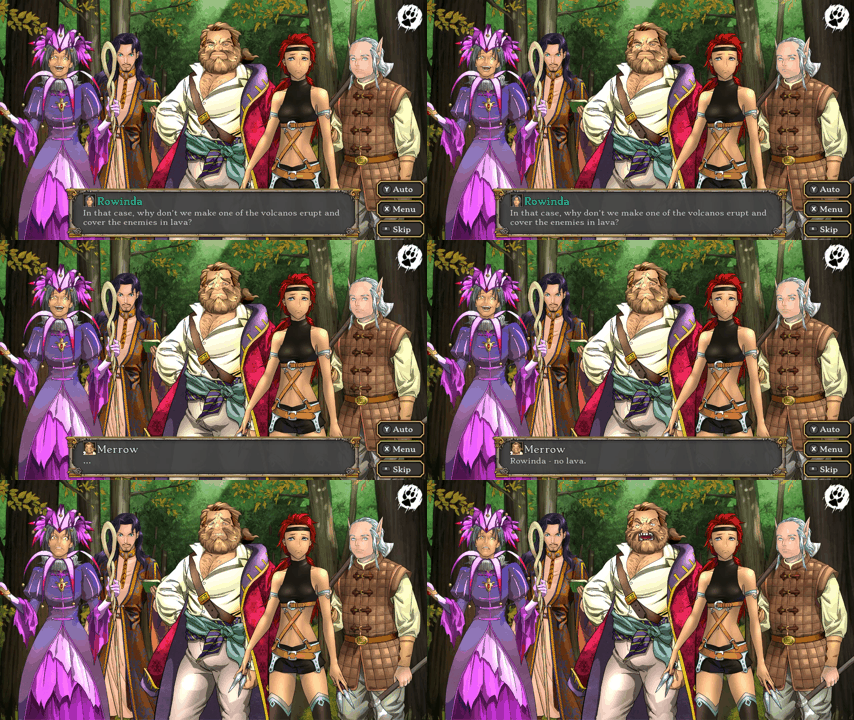
My favorite romance option was definitely Riley, whose appearance reminds me of Dr. Strange with longer hair (and Riley is an illusionist). I also somewhat liked Chalassa, who has an interesting backstory – but her story didn’t feel fully realized between the game’s ending and the DLC due to a lack of explanation as to how things happened between those events. Outside of the love interests, Rowinda, the volcano and lava-obsessed old lady, was one of my favorite characters for sure. She provides some comic relief with her constant suggestion of using volcanoes to solve problems. 🌋
You can use up to six (out of eight) characters in battle, and if you choose not to use some characters at all, there’s a really cool feature once you reach certain points in the game where you can choose to auto level your party members to the recommended minimum level for that part of the game! There are some battles that are more “optional” that allow you to grind a little and make additional money, but you unfortunately cannot grind indefinitely as there are a limited amount of extra battles. It was initially a little difficult to purchase equipment and other items because of this.


Besides the standard quests, they also included some “mini-games” where you make choices to defend people/a location. I was able to replay one of the mini games I failed the first time, too – and I also was given the option to replay a battle I failed. There are a lot of creative ideas and features that make the game an easier and/or more enjoyable experience for the player, and you can choose not to take those options if you want it to be more difficult. Touch controls are even included, which was greatly appreciated because they felt easier to use than the Joy-Con controls.

They even added some nice background details, such as snow falling outside the window of a room with an otherwise static background. I thought that the art was lovely, from the main characters to the animals to the backgrounds. The aptly named theme song, “Seasons of the Wolf,” suited the game quite well in my opinion, and the soundtrack overall was well done.
There were some features I would have liked, such as the ability to access some of the CGs from the main menu, and a new game plus option that allows you to keep your characters’ levels and items in subsequent playthroughs. But I really liked that they included an additional DLC story called Bad Blood, where you can find out more about Shea and Althea’s hometown and view more scenes with a love interest.
There were some aspects of the world of Aravorn that I wanted to know more about once I finished the game. I wanted to know more about Dingirra, the Empire, and Shea and Althea’s background; however, I think that they did create an interesting and engaging world that made me want to know more. 🤔
Switch it ON or Switch it OFF? Tales of Aravorn: Seasons of the Wolf is a neat combination of the RPG/visual novel genres. I did have issues with the Joy-Con controls and the rare freeze/crash, and I would have liked more optional battles for grinding. And although I wanted a bit more detail on some characters’ backgrounds, I was impressed with the overall experience. The characters were likable and the interactions between the different fantasy races and towns were intriguing. I spent a decent amount of time in Aravorn, and would definitely be interested in more adventures with its characters in the future! 8/10

 Switch It On Gaming
Leave a comment